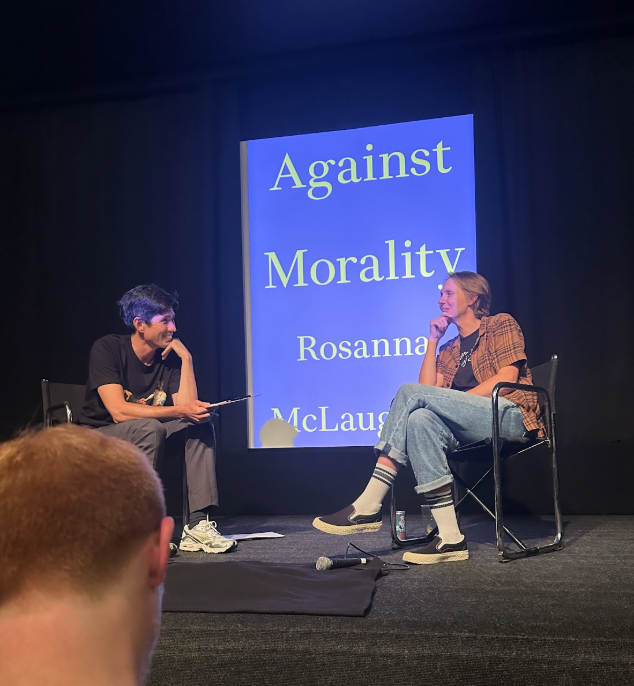
"Against Morality" Dean Kissick speaks to Rosanna McLaughlin at ICA
Review / 18 August 2025 / By: Mandy Warhole / ★ ★
Our very own correspondent goes to see Dean Kissick speak to Rosanna McLaughlin on the eve of her book launch, the surreptitiously named “Against Morality”.
Rosanna McLaughlin, a two-time published author known for her heavy flow of surgical takes dissecting poignant topics within art criticism, is back with another banger. McLaughlin, rocking Vans and flannel, channels a combo skaterboi Lydia Tár and young Paglia.
Her latest work Against Morality takes on the art world’s current mandate to platform only artists whose work centres the tenets of DEI: “I am of X identity, and that experience is like Y, about which I have made this art.” McLaughlin is saying this is the basic axiom that everyone from the Barbican to David Zwirner wants to see in their programmes, which results in press releases comparing George Rouy to Francis Bacon.
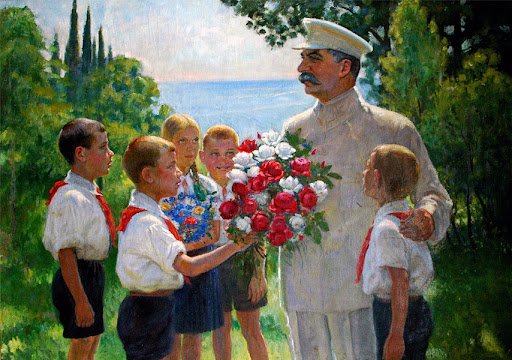
McLaughlin calls this tenet “liberal realism”. It weaponises the conceptual inseam of Soviet Realism, where a set of moral virtues, hard work and self-sacrifice, prescribed the aesthetic model for a country’s propaganda. McLaughlin complains that Western art institutions have entered their own era of authoritarianism, which, to her, is just when you are, like, very particular about something. Much like the title of her book, Against Morality, the use of such blatantly sensationalist language to describe a still very niche phenomenon within a small societal margin feels a bit like a broke, left-field musician’s last-ditch attempt at writing a breakout pop song. It is pop-punk and hard to watch.
Interviewing her about this is, of course, cultural marksman, Spike magazine’s golden era’s golden boy and human Grok, Dean Kissick. Amid McLaughlin’s very subdued and very British attempts at transmuting her agginess at the art establishment, Kissick’s job is to ask the smart, complex and nuanced questions about her work.
“Are you a liberal?” Kissick begins.
“Dean has spent too much time in America, it seems,” McLaughlin snaps back quickly, to merry laughs from the audience. “Are you?”
“Yes, of course I am a liberal,” Kissick replies honestly, hoping his contrarianism is a knife. Instead, the audience erupts in genuine cheer.
And now we are locked into this slurry of ever-swelling internet slop. Kissick reads from a review of Against Morality published in Frieze that is mostly about his cannonball, “woke-destroyer” of an essay, “The Painted Protest”.
He unloads his personal beef and brotherly love with Jerry Saltz, all of it over DMs. He quotes the messages.
McLaughlin remains politely transfixed in her place.
“I have this beef in the DMs with Jerry Saltz,” says Kissick.
“You know, Adam Curtis really wants to talk to me,” says Kissick.
McLaughlin tries to make a decent pastoral point about how anti-racism, anti-ableism, anti-etc. are great principles to apply in interpersonal relationships, but, when expected of art production, prevent us from letting difficult ideas exist within the moral greyscale. She does try to make that point, but with her populist book title behind her, glistening in giant yellow letters like a chicken shop menu, and Kissick trying to start a wildfire with his mouth, no one takes that seriously.
Time for the Q&A:
1. A complaint about how, apparently, DEI art is anti-Beauty (in the Platonic sense). Example cited? The Renaissance. A question that could have been asked only by a twink and my Russian mother.
2. An actually good question about why, according to McLaughlin, art institutions have sought to prioritise IDPol-based art (mine). Largely unanswered. A joke is made about how egg pots at Pret had a Pride flag stuck on top of them this past June.
3. At this point, something actually fun happens. A man, from here on known as the Unabomber, pipes up. He accuses McLaughlin and Kissick of opportunism and says that they both secretly know the only art worthy of mention is formalist, so should they pack up their discourse business, or maybe, even better, kill themselves.
I am by no means paraphrasing.
We pour out into the rest of the ICA, where the discourse, said on stage to be “over-legislating art production”, continues.
As the Unabomber (a friend of Kissick’s) towers over me, emanating high-powered yap and the general vibe of an over-tuned cello, I clock an immutable truth. While the art industry may move in swings and roundabouts to accommodate the flow of capital, the actual artists and art groupies (critics) will be forever guided by the instinct to repel the latest set of expectations. To evade understanding in favour of getting drunk on the feeling of otherness they experienced in their suburbs. Of New England, or of London.
Is it like this? No, it is actually more like that. Like that? Well, actually, now that you said it is like that, it has become like this. And, just like that, I am once again intentionally stuck co-loitering with the hurt children of the contrarian bohème.
I snap back into reality from these life realisations and yell at the Unabomber, “Maybe Proust wasn’t the ultimate formalist, but just the ultimate worst editor?”.
To my absolute delight, he explodes again...