Germanness or Omni-Casuality at Maureen Paley, Review by Dirk Diggler
Review / 9 January 2026 / By: Dirk Diggler / ★ ★
Germanness or Omni-Casuality at Maureen Palel by Dirk Diggler
Maureen Paley, Build from Here, Wolfgang Tillmans, 3 October – 20 December 2025 Sprüth Magers...
A late December Saturday afternoon trawl of galleries offering their end-of-year shows netted two specimens of note. Firstly: Maureen Paley, Build from Here, Wolfgang Tillmans. Maureen occupied 21 Herald Street for over two decades. She was moved out to make way for redevelopment six years ago; given the context of London’s post-2000s boom in crass, viral, "render-core" territorialisation, coming as it did shortly before Covid and the onslaught of Brexit, it was a sad state of affairs.
The actual space has some history from when Tillmans used it as his studio and hosted some very debauched parties there in the 1990s and 2000s; I recall a performance of drag queens giving a fake baby in its buggy a particularly rough ride. I once staggered out of one needing to buy some sobering crack, only to find myself driving down Whitechapel High Street on the wrong side of the road. Later, in 2011, Hotel gallery hosted a show of Keith Farquhar’s sculpture here; at the opening, I watched while a visiting writer snorted a couple of lines of morphine off one of the artworks.
But in these more somber times, the show isn’t really about the art; it’s more about the apparition of Paley’s return to Herald Street. There’s no mystery about the show; Tillmans is often used to herald the opening of one of her new spaces. It’s more her return—like Napoleon escaping from Elba—that interests me. This latest manifestation of her roster of galleries is a statement of intent, almost revenge. Entering the gallery, the first detail is the newly restored handrail of the balustrade: perfectly fitted, pale grey rubber. The fanatical painting of stairs and walls only prepares you for the first floor.
Stepping into the gallery, I thought, maybe I had died and was journeying through the tunnel of light to the afterlife, as I was hit by the force of the whitest, blindingly bright light my retinas have ever had to deal with.
Maybe ASML had installed a clean room, or I was coming to in an operating theatre after having been hit by a bus.
The extremist level of sterile clinicality burned into my consciousness; I could imagine a fly’s worst nightmare would be to have found its way in here on a balmy summer day with absolutely nowhere to hide.
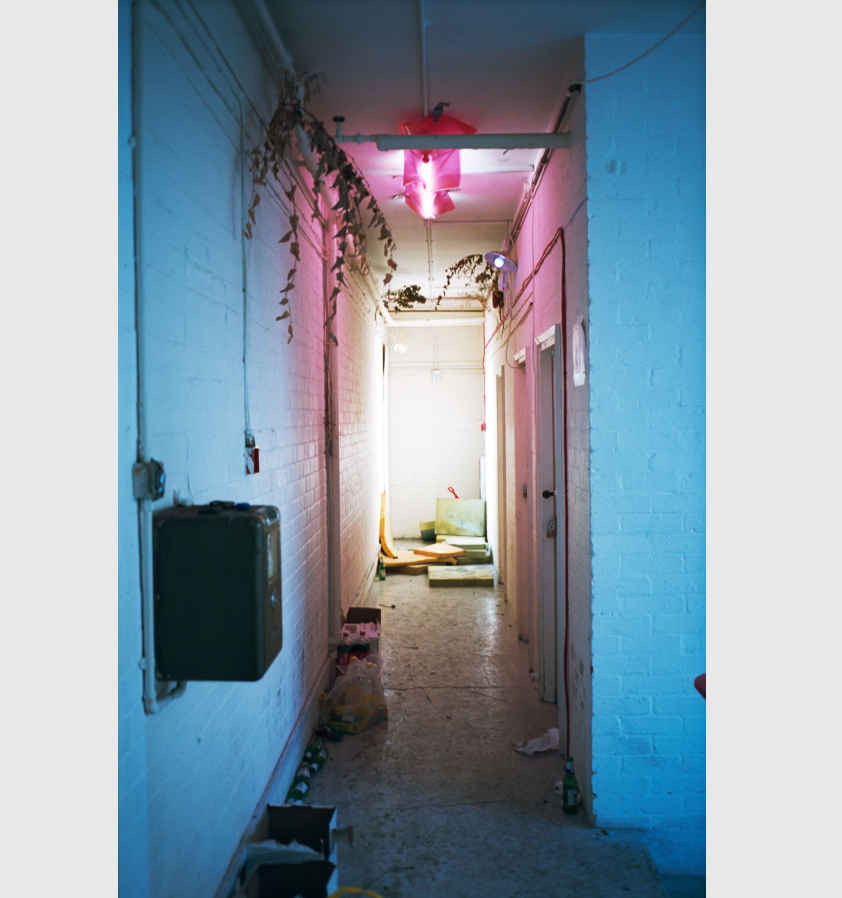
The door to the office is an exact replica of the one from 21 Herald Street—it may even be the same door that has been sitting in storage for the last half-decade. Its polished stainless steel frame holds a single pane of toughened glass, and into this intense environment, a display of Tillmans' photographs, photocopies, and paper works lurks.
It’s hard not to see Tillmans' work as an exposure of him as a figure. In many ways, he is the German version of a YBA artist; coming of age as he did during that heated 90s era, he perhaps suffers slightly from a constraint common to much of their work: early success putting the brake on development.
Much of his output seems to rest in a self-contained appreciation that the spectator needs to "know," but in actual fact, like his British contemporaries, he seems stuck within a banality of his own making.
It ends up feeling like an echo of the worst of day-to-day German culture -—a kind of normcore, "omni-casual" style that hides a very thin interior.
It’s hard to think about his work (and there’s a lot of it) without simultaneously seeing the image of the artist himself as a clinician. In so being, the artist and his production help to back up the return of Paley to Herald Street in a fastidious examination of the accumulation of tedium that our present day will be noted for…