"What is real is fried" Review of American Birds at franknews
Blog / 7 August 2026 / By: Johanna Stone
The Superstar is dedicated to speedrunning/recording the history of the present using the convenient placeholder of 'Gen-Z Aesthetics'. In the words of Stone, see this article, which reviews it as "A starting point for establishing a generational artistic identity".
We also wonder how it is with American Birds and plays like Truck at MOMA PS1; loosely inspired by the 1997 documentary Hands on a Hardbody (1997), if the rise of the Cultural Capital Play is the answer to mid-west YouTube documentarians (Andrew, we looking @ u).
THE LINK TO THE FIRST IN THE GEN-Z AESTHETICS RUN DOWN (FASHION EDITION): Yoona on Instagram, Mutation Fashion Realism can be found HERE.
Addressing the fried elephant in the generational room, Johanna Stone finds value in a play which discusses how they might be laughing their way into losing the right to vote. As stated in the MOMA PS1 press text for TRUCK the play intends to "evoke the malaise and melancholia of contemporary life across generations." Well, fuck institutional speak, and Stone actually tells us what it means to address that, discussing American Theater as a conservative alternative to coastal elite thespianism.
Hollywood wonders what the "London" version of American Birds would be, and concludes that, here, Gen Z is a cultural miasma that is thankfully yet to be pinned down by moving image, stage or otherwise. Except for Josiane Pozi and Solomon Garcon in Opening credits 4 sunset beach (pilot) w Josianne Pozi [sub-titles on].
American Birds, written by Lucy Park Urbano, was held at Frank News, Los Angeles.
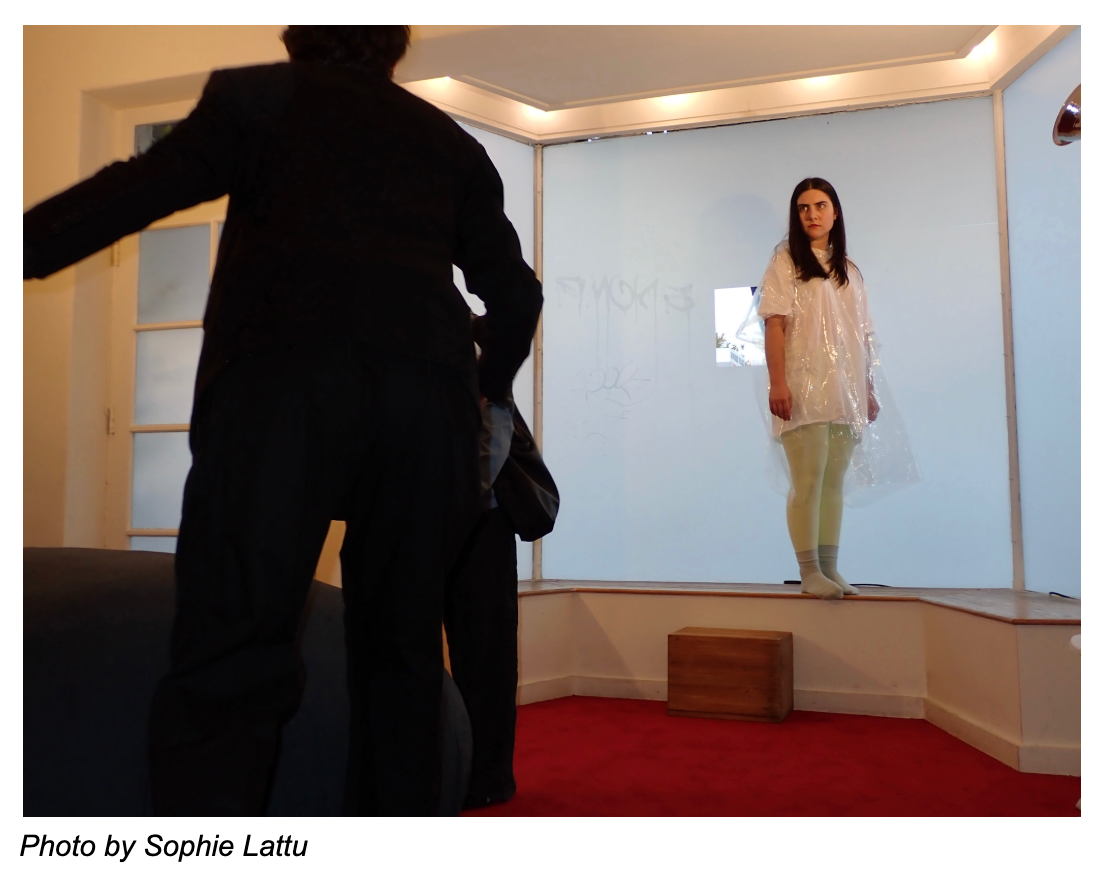
LOS ANGELES (AMERICA?)- On a sweltering Saturday in July, I leave a Millennial art world pool party featuring a pepitas kale Caesar, spiked camel milk, and about 10 mid-size dogs to drive across town to Fairfax for a distinctly Zillennial event: the closing night of Lucy Parks Urbano’s play American Birds.
The show is finishing a sold-out second run, and there’s a large puddle of people without tickets waiting at the door. I add two drunks to this waitlist blob, friends leftover from the pool party, and slip inside franknews, the independent journalism-platform-turned-new-work-incubator that took up residence in the small space between a nail salon and third-rate Italian restaurant on Beverly Boulevard (on the same block as Quentin Tarantino’s New Beverly Theatre) last year. After a whispered relay between backstage and the door, everybody gets in, save for an older-than-zillenial woman who sits on the patio of the adjoining Italian restaurant, drinking an Aperol spritz while the show goes on.
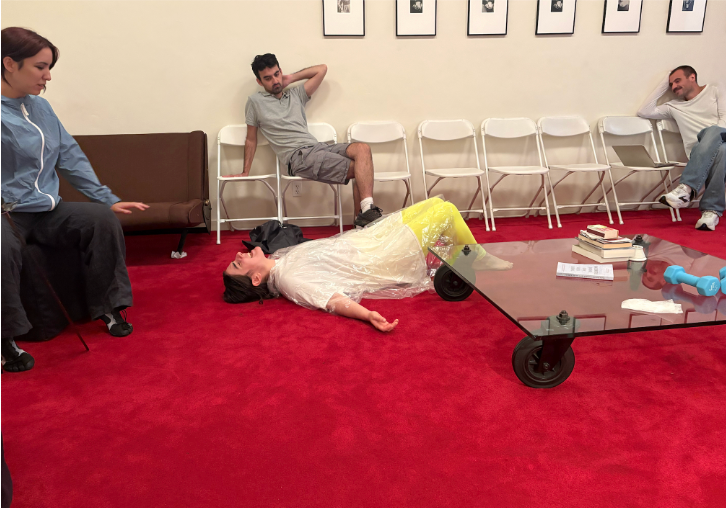
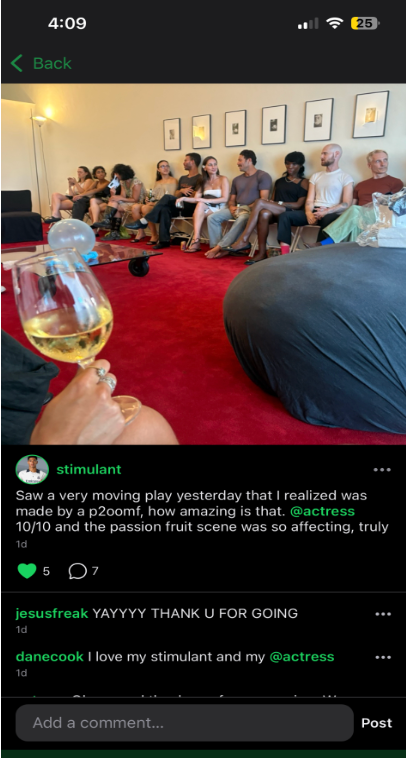
A makeshift three-quarter thrust atop the LA underground’s red carpet passes the initial Brecht-del test; the lights never dim, there was no polite darkness to rest your eyes, leaving HOLLYWOOD to size each other up from across the room.
Moby’s The Ceremony of Innocence starts to play, and a man wearing a plastic bag and neon leggings sashays around the room, making eye contact with each audience member. This is the kind of display that is nostalgic for a graduate of NYC experimental theatre school like myself, the sort of thing that screams there is no fourth wall here, and you are complicit in the capitalist machine. This got nuanced as it went on, thank God.
Lucy Parks Urbano plays an undercover detective investigating the modern American city-state, much like Aristophanes dissected Athens in his classical predecessor The Birds. Although Lucy Parks Urbano tells me she prefers the Greek tragedies to the comedies.
Marcel is a house finch. Melinda is a nightingale who only migrates to the cities you find listed on a vintage American Apparel tote. They’re chirping it up in a tree outside the house of Boy, who’s employed as the social media marketer for an athleisure brand run by his dad.
Boy brings Girl back to his apartment. Girl asks Boy to perform an assisted suicide on her 100-year-old (old, but still poor, the play notes) photographer husband.
The dialogue is high on itself: the classic hyper-referential coked-up humour that afflicts the broader Los Angeles scene:
Aren’t you really sad though
Watching the crowd outside La Poubelle
Become increasingly normal and like employed?
But these observations are cut with a methy edge and carved into delicate lines by Lucy Parks Urbano’s steady hand--
What if
There were wars here
And no one cared
Cause we didn’t care about their wars?
The comedown rattles to an audience of Cuspies stuffed with dieting discourse. LA’s contemporary oral storytelling culture (aka the city’s many autofiction readings) rarely gets so sneakily harsh in its reflections. “I fear that one of the effects of our great city, on me, has been to care about things less, unfortunately, and that my not caring has been rewarded,” Lucy Parks Urbano diagnoses.
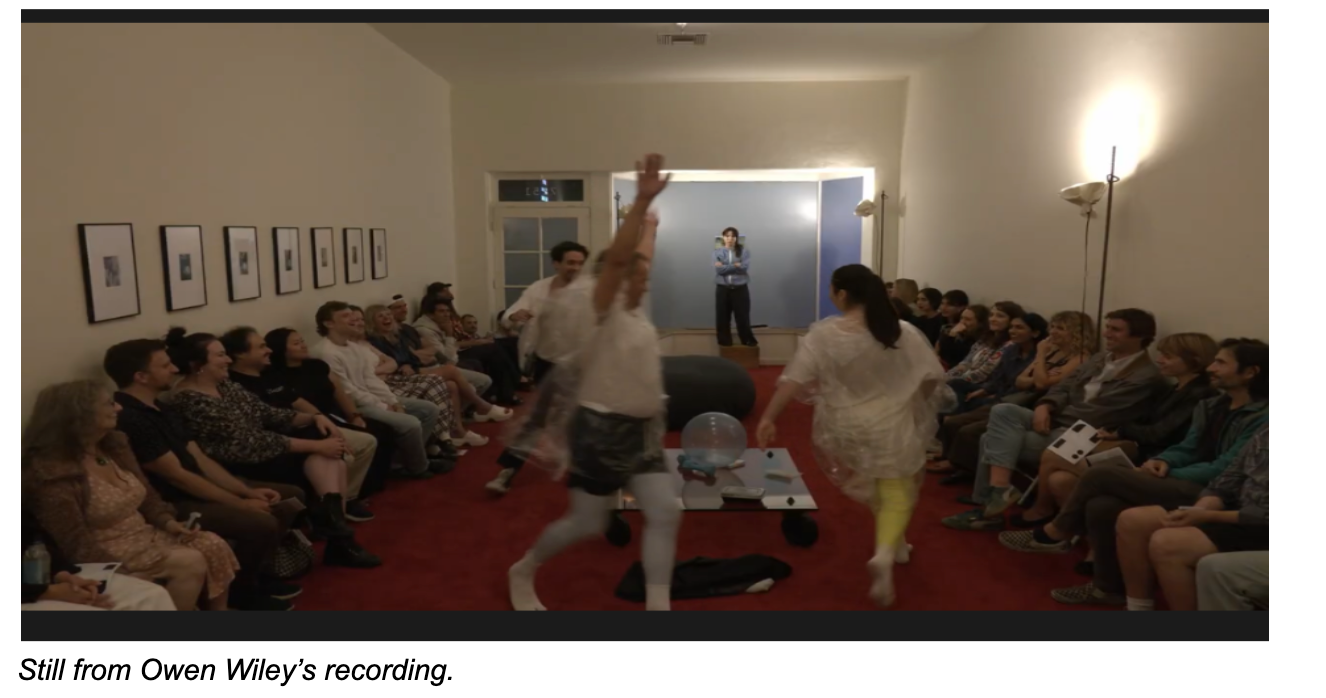
The birds play The States Game, naming any state or region that is not California or New York and imagining what it might be like based on a patchwork of cruel stereotypes and free associations (New England is literally/ Old America/ They’re like/ Living in brick houses/ And making quilts/ Their first alcohol/ Was whiskey at the creek/At the pond/ Oh my god yeah/ They got like raped/ On the bed of the pond). This verbal tornado fluctuates across the map, crescendoing on a debate about whether Los Angeles is America at all, and collapsing into a moment that ponders whether people from Nebraska matter, “how they are/ Just like/ Lost in a field of dust”. The conversation-game brings the birds borderline-sexual pleasure, and you feel the tension in their apathy as they giggle away the idea of possessing the right to vote.
The birds’ explicit coastal elitism tends to feel cooked after a decade of warnings about its electoral consequences. Director Dylan Frederick recently captured the inverse American viewpoint in his documentary American Theatre (2025), following a conservative theatre group that creates a musical retelling of the Salem Witch Trials in protest of leftist cancel culture. Frederick confirms the ignorance of Lucy Parks Urbano’s birds remains period-accurate: *“American Theatre takes place in Georgia, and when we show that movie on the coasts, [the audience] is encountering folks who talk and think like this for the very first time, and they’re often in complete disbelief that what they’re watching is real. So much so that many, many people believe the documentary is fiction.”
*The play’s human characters are stand-ins for stereotypical contemporary hetero relations. Girl, played by Lucy Parks Urbano, is a calcified girlboss, self-described as “a wall you can nail anything into” (Lucy Parks Urbano was inspired to write her own roles after being typecast as “a teenager or a prostitute, sometimes both at once” too often throughout her acting career) Girl mourns the decline of her historied husband, who lived through the North Korean occupation of Seoul and the persecution of his family; conversely, the Boy in the room with us feels completely spiritually castrated, a lonely virgin who experiences the Army through YouTube ads, swiping blindly through the algorithmic jungle looking for love, so desperate for any kind of intimacy that he’ll pile onto someone else’s herstory of violence.
Boy can only communicate effectively via Drake lyrics; at the height of the action, he breaks down while attempting to rap the entirety of “In My Feelings” - Melinda makes similar use of “Passionfruit” to deal with her breakup from Tyler, the Robin. This seems to hit home for the audience.
“Lucy is giving herself an opportunity at every turn to make language fail in the most interesting and funniest ways, the ways that are unsettling,” says Frederick. “You’ve got high stakes, and you’ve got people who are meeting these stakes with failing language.” Through a series of circular fumbles, Lucy Parks Urbano fertilises a Yassified Theatre of the Absurd, where language falls flat due to an excess of meaning, every phrase deep-fried with predetermined memetic significance. It’s barely an exaggeration of Zilennial-speak, and gets a lot of laughs.
A fitting genre for a generation stuck in learned helplessness. The play doesn’t offer much in the way of solutions aside from placing a sword in the hands of its protagonist, a gesture lifted from any romantasy novel.
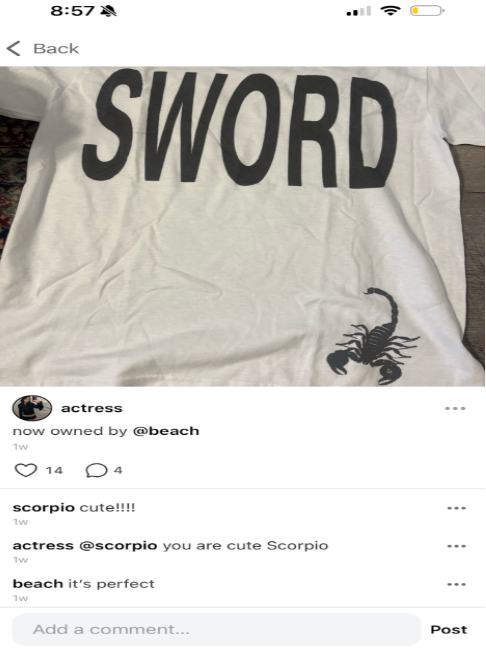
Now for a brief cold plunge down the scenic iceberg, if you even care: American Birds has gestated amid a bubbling ecosystem of Los Angeles experimental theatre, a gap in the city’s art scene finally brought to attention by the arrival of Berlin-based artists Calla Henkel and Max Pitegoff’s New Theatre Hollywood, where I saw Lucy’s surrealist 4HL doomspiral short A Business, last fall. Since its arrival, New Theatre has put up a good chunk of exciting new work that blends mediums and comments on the current- Jasmine Johnson’s immersive reality TV series The Death of a Star was a notable early example. Siena Foster Soltis has also brought new life to LA theatre with site-specific psychosexual dramas- her latest, Sugar Tub, was enjoying a simultaneous run across town, with choreography by Mamie Green. Green’s Volta Collective has been a crucial player as well, heavily incorporating text by local writers into their dance pieces.
Less visible yet no less important is the influence of playwright Agnes Borinsky, whose writing workshops have fostered neural networks in the community- I met Lucy’s former teacher and current collaborator, Kap Taylor, in Agnes’ workshop. Borinsky, herself a student of the legendary playwright Mac Wellman, established a name in the NYC downtown theatre community before relocating to the West Coast. I wasn’t surprised to find that Dylan Frederick is good friends with Agnes, and Arne Gjelten, who plays Marcel, is moving in with her next week. Gjelten was offered the role of Marcel after Lucy Parks Urbano saw him in Calla Henkel of New Theatre’s play The End is New at REDCAT, the only place in the city where the GOAT of the theatrical old-guard avant-garde, the Wooster Group, sometimes performs.
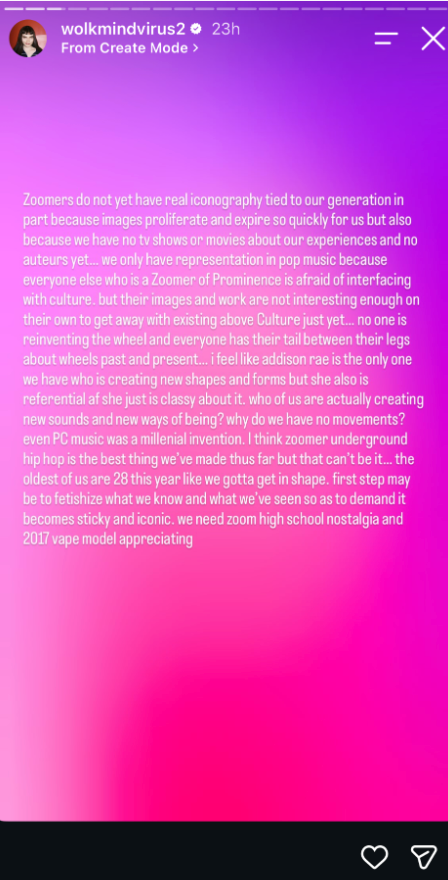
More so than its contemporaries, American Birds recalls this very important take that I recently screenshotted off Gen Z starlet Ivy Wolk’s Instagram story, calling for a Zoomer art movement based in its own iconography and history instead of upcycling the millennial, whether that be through drain, sleaze, twee, whatever...The birds’ sadistic song, the Drake crashouts, the surrealist memespeak all feel distinctly like “fetishising what we know and what we’ve seen”, which, as Ivy notes, is at least a starting point for establishing a generational artistic identity.
Underneath their glib exteriors, Lucy Parks Urbano’s characters are desperate to belong to history, to society, to family, to even just one other person, as they survey the increasingly bleak prospects of their existence. The political stakes aren’t new, but the sense of absurdity develops from an intergenerational stasis. In its final moments, the play implicates the audience using a vestige of national unity; the curtain call is choreographed to the Cha-Cha Slide, and when the song instructs, everybody claps their hands.
In rehearsal, I watch as Frederick instructs the actors to sing a line together in harmony. They attempt several times and fail, laughing through each reset. On the night I watch the performance, the singing line has been cut. Set and costume designer Eli Hauser talks to me about the lone dryer sheet on the Boy’s coffee table. “I told Dylan I wanted set pieces that were abstract and ethereal, but still based in reality and domesticity,” said Hauser. “I was like, does that make sense? And Dylan was like, not really… eventually he was like, what about a dryer sheet? And I was like, yeah.” The effort at every level to understand one another’s siloed existence is what makes the thing Gesamtkunst-werrrrrk.