"Her Selected Works by Carlotta. S" @ Pusher Gallery
Review / 15 September 2025 / By: Madame Beg / ★ ★ ★ ½
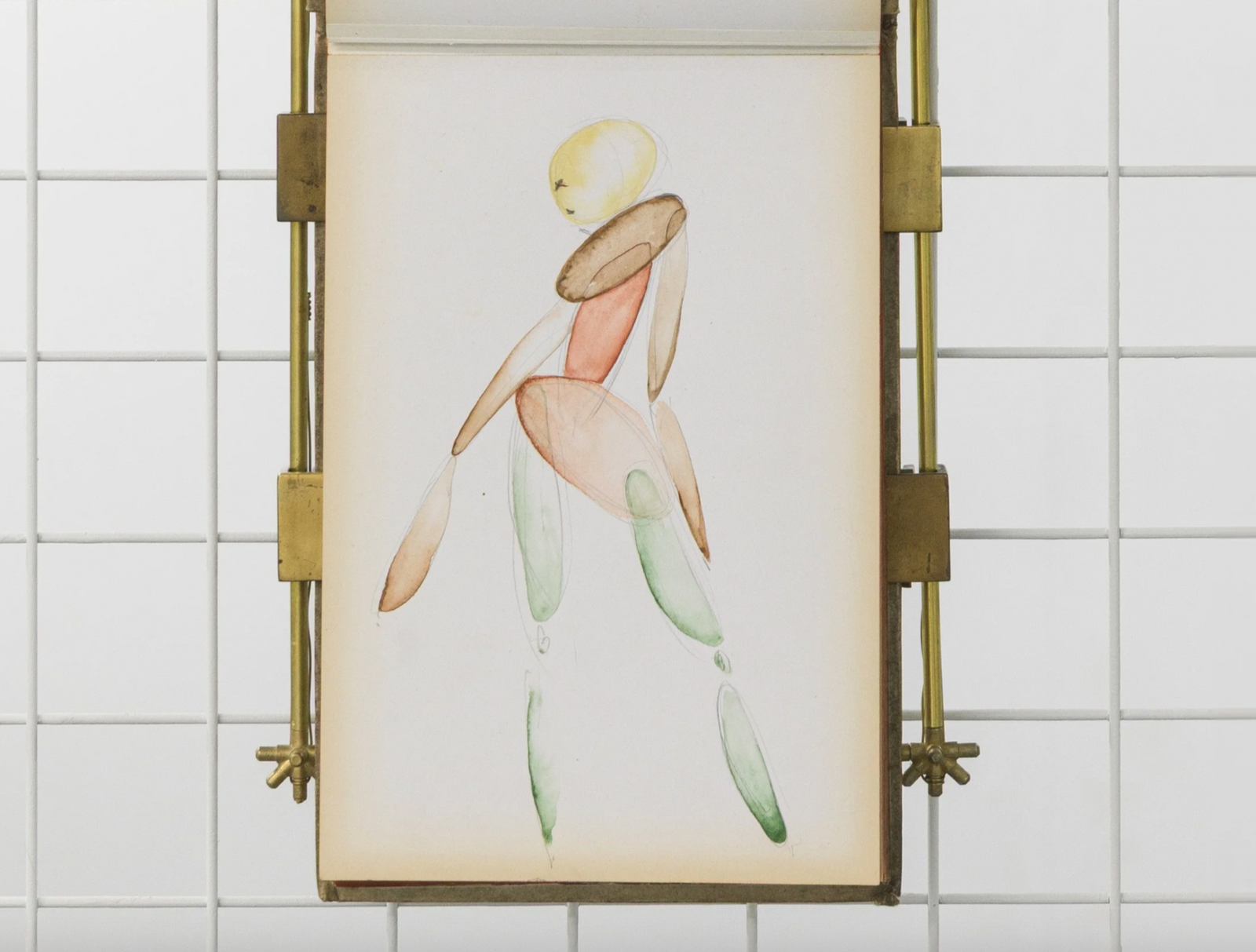
The apparatus of Her Selected Works struck me: railings holding the artworks and the postcards on the rack display as you walk in. They kind of carried the show.
I was under the impression that the works on show were a part of Carlotta’s “collection”. I.e. She was a collector and the works she had purchased were a product of her taste. The curatorial angle is that these are works which could have been collected and kept in storage, so their arrangement is like a hide-and-seek of meaning. As a curator, these works are still, invariably, part of her taste - but it would have been a relief to know that some kind of circular economy existed between the chic state-funded central european art world and the significantly less financially supported London artistic circuit. It would be great if this exhibition signalled that some kind of a) collecting and b) economic transfer had taken place. Gave the vibe of the scene in Tenet (2020) where he breaks into the tax-free hyper-secure non-dom art storage facility. Untaxable offshore funds.
Andreas Schmid’s work Figure Nr 1, 2025 was a highlight: a conttraposto cubist figure whose frame is constructed from various watercoloured ovals is painted on antique card. Schmid constructed a frame for the card, akin to an Ilizarov apparatus, which holds the folds upright with brass poles and screws. Daniel Zeballos’ it’s dark train of thought with too many carriages, 2025 a fine graphite drawing on torn paper, has been seemingly drawn, then torn and re-assembled. This play between material, texture and tromp l’eoil is also present in Gritli Faulhaber’s Ohne Titel (La Solitaire, Zitronengelb) (2024) where 70’s wallpaper-appliqué surrounds the silhouette of a 1920’s flapper. The work was previously shown as part of Les Garçonnes at Gauli Zitter, Brussels, where I think it was better served, contextualised by Faulhaber’s other paintings that muse on the relationship between decorative pattern and depiction of the human form, ala Alois Riegl.
A Deconstructed archive-on-display-type-beat is very cool but actually super hard to execute in principle, especially if the works displayed form a cat and mouse of meaning that is not ever fully deciphered. It would have been great to have some more presence - even heavy handed - from the eponymous "collector".