"KunstKammer Kuration" Review of Thirteen Images, curated by Anna Plowden
Review / 23 August 2025 / By: S.Sweeney / ★ ★ ★ ★
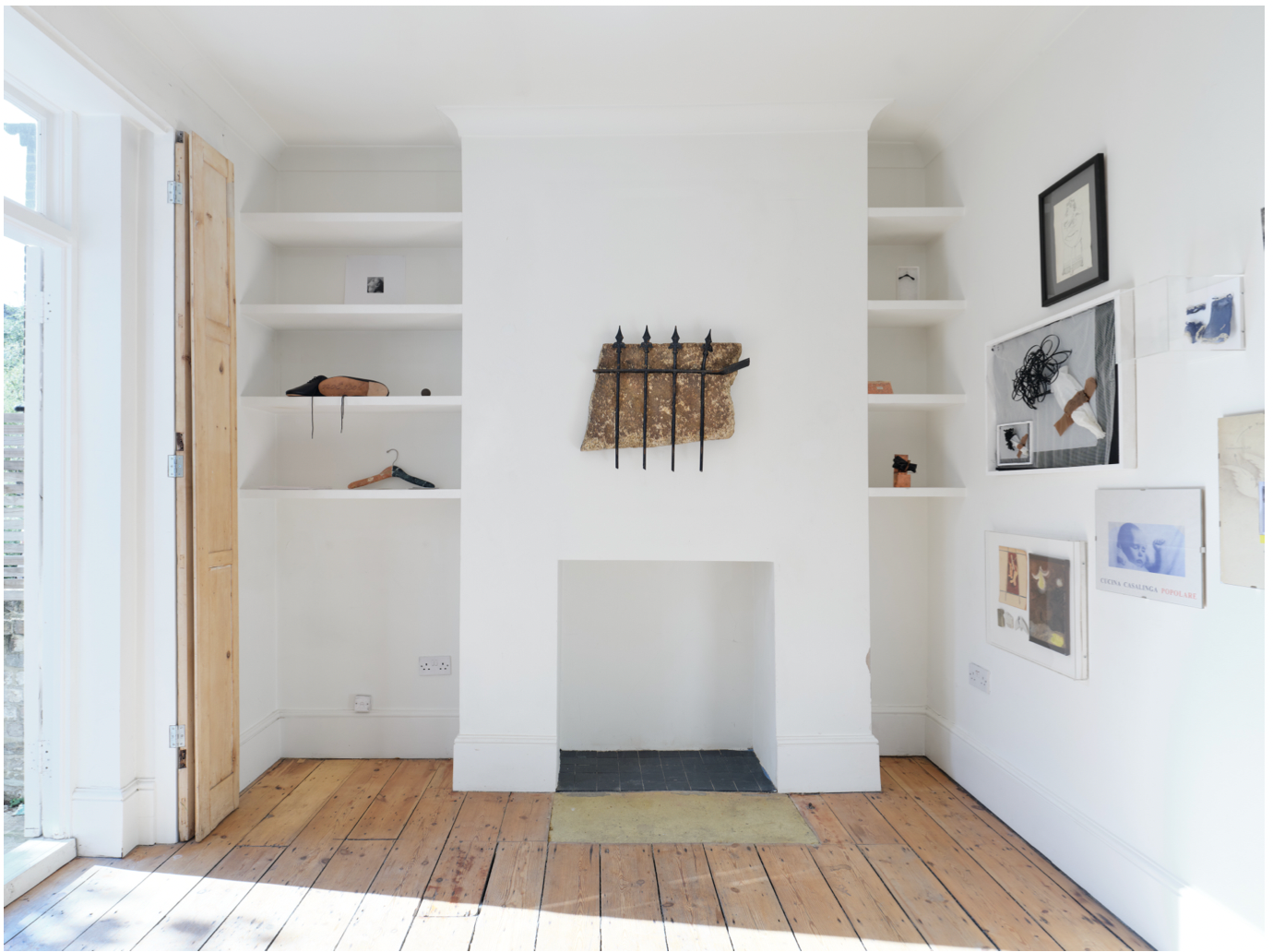
Thirteen Images recalled the RA Summer Show in sentiment only. There was far less garish neon-coloured floral prints (Florals? For Summer? Ground breaking). From the smallest work, Robin Miro’s Hanger (2024), to the largest, I.W. Payne’s Something is rotten in the state of Denmark (2025), nothing felt gratuitous and no detail felt overshadowed, irrelevant or forgotten. It painted a picture of taste within a certain London milieu: artists who are not always full-time artists and whose practice is invariably informed by those limitations. The opening was as packed as a house party. A retrospective survey, but for now, across performance, design, photography, sculpture and drawing (there were a few paintings). The show was held in an empty flat, spanning four antechambers: kitchen, front room, dining room, and bathroom.
Gonna make a call back to Hollywood Superstars ‘17 Trends at Art Basel’ that noted the prevalence of the “Fine Graphite Fetish” at the fair. In this economy (a market barely holding on, driven by weakness, tech bros and Silicon Valley), they’re what’s most likely to sell. Ellen Poppy Hill’s No Point in Making Myself Comfortable (2024) is a mixture of Edward Burra’s post-cubist figures and early Disney animations. Her work as a fashion designer evidently influences her illustrative work - there is a level of caricature that only the sartorial eye can achieve.
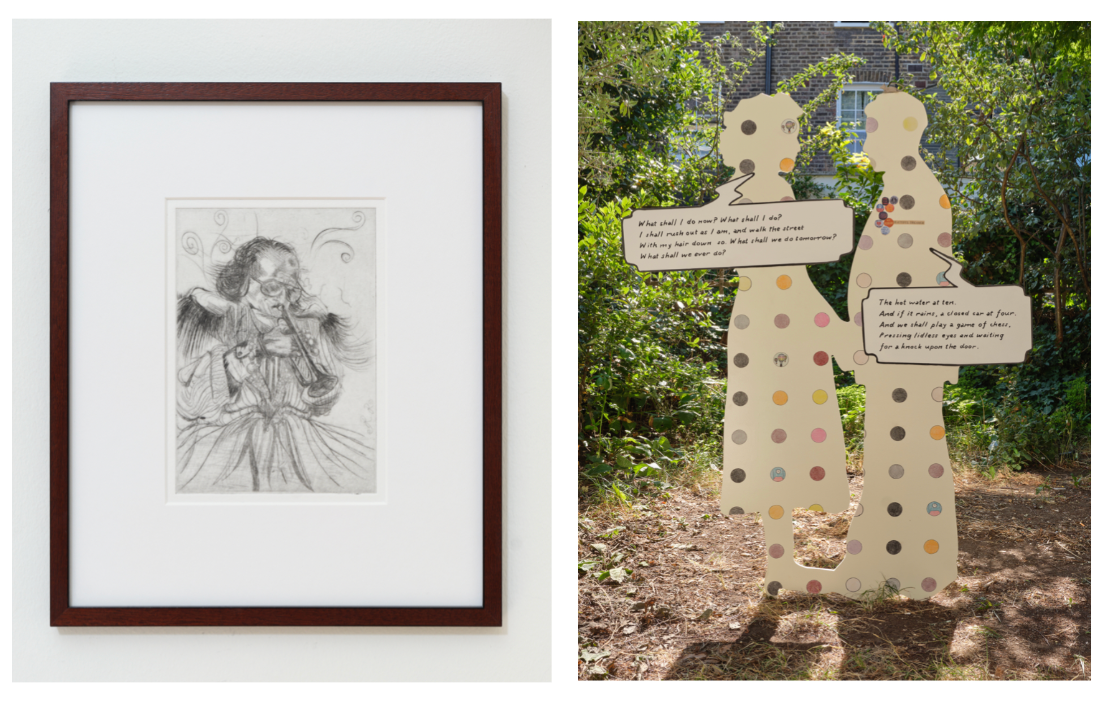
The curved, jumping caricatures are drawn on newsprint. Hill’s handling of pencil has a Lee Krasner-esque vibration: moving between scratchy, thin lines and intense, stacked shading. Building on the theme of caricature, Roberto Ronzani’s Miles Davis, 1980s (2025), like Hill’s work, incorporates fantasy with fine marksmanship. Gen Z artists, in comparison to their direct seniors (millenials) have made greater use of cartoon semiotics in their practice, drawing on a nostalgia for a time when animation graphics were a light-hearted reality visualizer, not just visual computer-generated fluff, Pepe or Wojack. I wouldn’t go so far as to use the moniker of “post-internet”. These works emerge from a place of self-containment, an analogue love of the medium of mark-making.
The contrast of works like Miles Davis and Momo Tibes “Once Upon a Time in Babelsberg” (2025), which frames a screenshot of a YouTube clip from Mockingjay (2015), part of the Hunger Games Trilogy, highlights the diversity of form in Thirteen Images. Now the art world is post-history, genre and form collapse. Screenshots emit the same palpable relatability and society-mocking rabalaisian humour as a pencil illustration. Really was post-internet, though!
``
Some items generated the feeling of a 1980s World of Interiors slightly spooky childhood playroom (non-derogatory). In I.W. Payne’s cut-out silhouettes, a male and female stand facing one another; their bodies integrated with speech bubbles upon a single MDF panel. The panel itself is covered with a large, multi-coloured polka dot pattern (not in a preteen, pedophilic Lucila Safdie style, but rather a mumsy, West London kitchen, Kath-Kidson-esque style). This theme continues in Anna Plowden’s Miladena Mirror (2025) in which a set of doll-sized blue organza underwear is pinned, Lepidopterologist-style, within a floating acrylic shelf. Miladena Mirror is reminiscent of Rosemarie Trockel’s three-dimensional collages, or perhaps the meticulously made-to-order Mary Janes that Hans Bellmer constructed for La Poupée, 1932-1945. I wondered if Robin Miro’s Hanger was a compliment to this piece - both works are akin in their rendering of sartorial objects in miniature. Baby Reni (a moniker for a designer, artist and apartment gallery) presented two pieces. Girlypop (2025) depicts a child’s white dress on a padded clothes hanger alongside a faux-naïve drawing on an apple shopping bag. Babi Reni’s Foundation saw a mannequin hand jut out from the wall, covered in foundation from a bottle cradled in its palm. The latter two works solidified the developing theme in Thirteen Images: Child’s Play or the ludic spirit.
Charlie Osborne’s work 2 Cariads Dw i wedi Syrthio mewn cariad efo ti (2024) could have been more centralised in the hang. A digital print of a blurred image is stretched on canvas, with much in common to the sample images you find in Snappy Snaps frame displays. A man and a woman, one with a 2012-Greenpeace-style headband, smile at the camera and lean into one another. Its title, in Welsh, translates to “Two darlings, I have fallen in love with you” and completed the romantic, blog-esque ideation I, as viewer, had projected onto the piece.
Osborne’s work with blurred imagery is part post-human, part mid-2010s nostalgia. It surmises how it feels to love while also forgetting oneself amid the battle against face-recognition technology and the harvesting of memory. It also looks like a Tumblr rebloggable image circa 2013, the soft distillation of form reminiscent of the focus adjustment on a YouTuber bloggers digital camera: “Hi! it’s X, and I’m here to talk about heartbreak and data harvesting”. I want to know what it was about this time that matters now - a time when the mask of liberalism was slipping, but still in place, the image carries a nïavety that online cultural production, today, does not.
Hollywood Superstar wonders if this “salon” style should continue in perpetuity - a space where one can sample taste and refract it back to a crowd “IRL” rather than “online”. I’d like to liken this show to the Paris salon of 1767, at the Louvre, which Denis Diderot criticized and praised for its great contribution to (to use an anachronistic term for his time) aesthetic discourse. In writing for Correspondance Littéraire Diderot marked the early development of art criticism, from image to word (ekphrasis) and then from word back into image. Instagram stories are the modern day iteration of eighteenth-century ekphratic writing. Thirteen encouraged Cheek-to-Cheek interactions with artwork only previously seen on an Instagram grid - forcing opinions out of the digital circle-jerk and into the remit of house-party conversing.
“Even if all the works of Europe's painters and sculptors could be brought together, our Salon would not be equalled. Paris is the only city in the world where such a spectacle can be enjoyed every two years.”
I’d like to think that London, and Thirteen Images has the potential for catalysing a series of beginning of equally reactive, or summarising, survey exhibitions. More aesthetic discourse, please, the critique of great work eventually aids the development of new formalisms.