"Blind Communication" - My Tragedy by Hunter Boyd at the ICA
Review / 28 October 2026 / By: Eliza Ovey / ★ ★ ★ ½
It's another Gen-Z play! Not in Los Angeles for once!
Zoomers have realised that there are innumerable project spaces for fine art, but there’s only like 5 theatres. Value of the artist work is therefore higher in this space? Hm. Supply and Demand at a crossroads of the art object (hello!)…
Eliza Ovey, takes us to another Yassified theatre of the Absurd, in part II of the Thespain Section of the Gen-Z aesthetic rundown. It's a nice companion piece to the observations from Aria Dean's piece for Artforum on the 'queasy merger of the art theatre and the experience economy', a relaxed reading perhaps...
Next up in the canon of referenceless reference. Criticism and Joy abounded for the same reason‚ who was this non-theatre interloper (Hunter Boyd) who gets a first production at the ICA?
It took three directors and Sophie Barshall (of Toe Rag fame) to bring Hunter Boyd’s conceptual tragedy for one night only… It’s three shows in one! Recession indicator anyone?
--Eileen Slightly
Out of a rubble of cardboard, toy cars, instruments and ripped clothes, and amidst still-withering actors, panting from emotional outburst, a woman emerges, wrapped in an emergency foil blanket. Like a nurse in the midst of a natural disaster, she hands out aid to the victims on-site, in the form of a wad of paper. The antidote? My Tragedy, a play by Hunter Boyd.
The script, written by Boyd, and then interpreted three times by respective directors, comes with instructions. Italicisation and formatting are supposed to help the directors dissect, reinterpret and bring to life his sporadic writing. In the lineage of cut-up poetry, Boyd’s script is more vibe-based than narrative.
References to perfume names and their catchphrases are set beside nods to the celtic legend of Tristan and Isolde, as well as orgies, the fast-life, death, and tragedy. Together they paint an image of the hellscape miasma of late capitalism, which flagellates itself endlessly (or, in three parts). The order of each act was decided on the day. Boyd gives away his power, either as the only person capable of deciphering the text, or because he doesn’t know either, and passes on the challenge to his directors.
The woman in foil who has just handed me the script is Martha Sapsed, one of three actors in Jaya Twill’s iteration – otherwise known as Act 1.
ACT 1 Jaya Twill
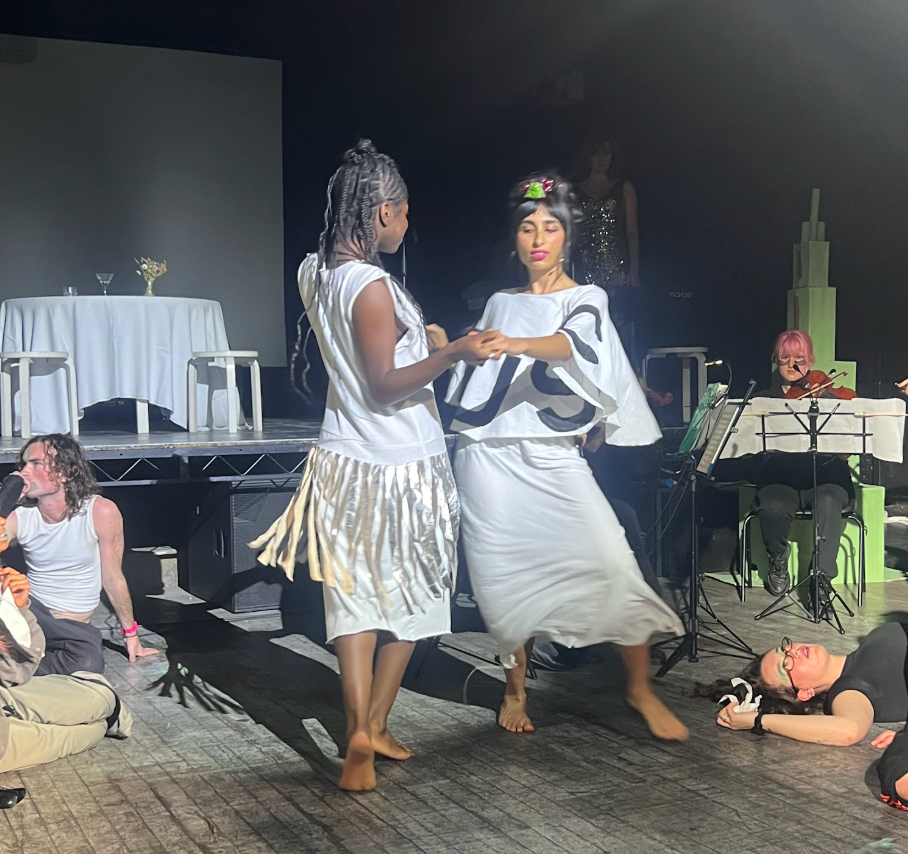
Two women costumed to look like perfume bottles, in the silhouette of a 60s paper dress, pose and strut around a Don Draper type. In varying stages of shirtless undress, he combs his hair back as the perfume bottles circulate him like sirens. What ensues is a violent and hypothetical orgy of strobe lights, the women ripping their dresses off to be left powerless, squirming on the floor, as the man cries into his hands in trembling remorse.
I’d like to take notes but I only have a broken pen and no notebook. The first scrawling I left on my palm reads ‘Neon Demon’. A 2016 horror directed by Nicolas Winding Refn, where the greed and competition of the Los Angeles modelling industry culminates in identity-theft, murder and cannibalism. The oozing appeal of sex and capital are eaten up by its own festering logic.
Twill’s interpretation is the most pop, with its hark to a vintage hey-day, endlessly replaying, like a spinning doll in a little girl’s jewellery box. It is also the most seamless, and the one I find the least penetrable. Twill was originally supposed to star in her own production as one of the perfumes, but was unable to because of a lime bike injury the week before.
Her waist length hair, pristine appearance and born-in-america smile would have been a welcome meta-injection.
The three actors tentatively get up and dust themselves off, ready for another groundhog day...They pass the baton.
ACT 2 dir. Emma Alvin and Gulliver Whitby
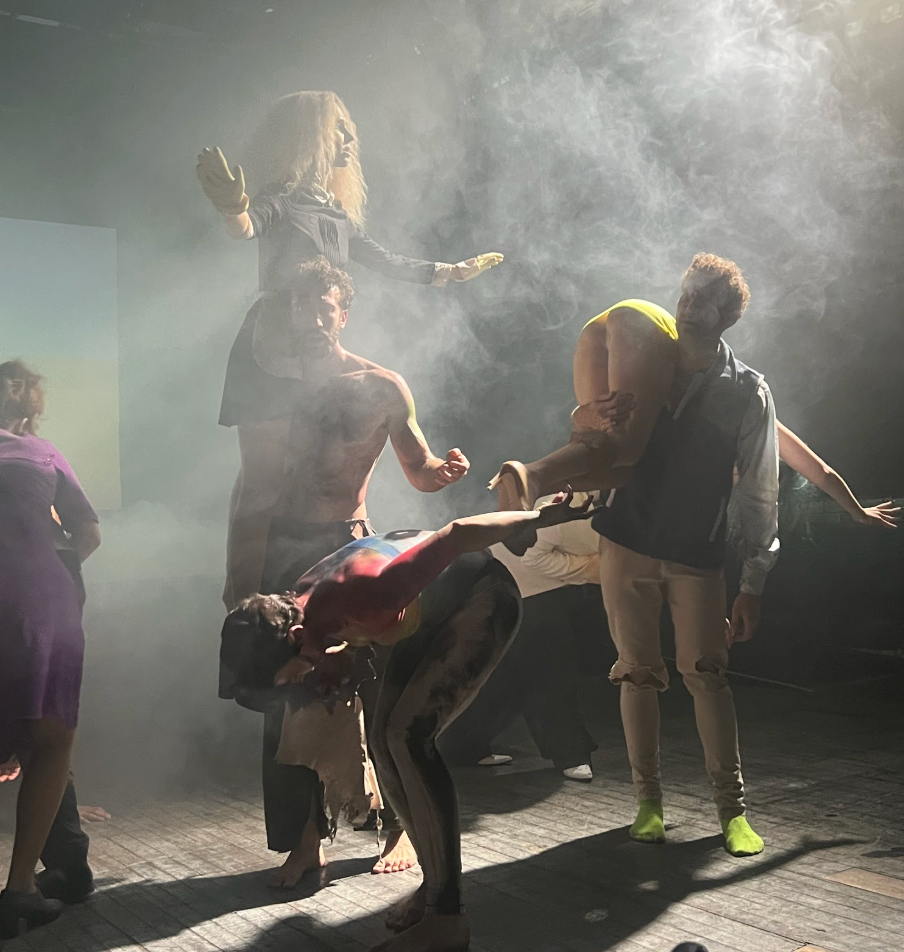
A brand new cast of the Village People emerge onto the stage in a homoerotic wrestling match. The leather daddy is still here in his jockstrap, but we now have a pregnant woman, a muscle man, a party girl, a maid, and Peace. Crying for most of the act and dressed in black, Peace is played by Viking Stendahl in holographic face paint. Emma Alvin and Gulliver Whitby’s direction is a steamy neon apocalypse to Twill’s dusty rose. It is the most sensorial of the three, and does the best job at encapsulating the erratic and competing voices of Boyd’s script. The actors strut up and down the aisle, kissing the audience and yelling into their ears. Our mother-to-be forces someone to feel her bulging stomach. A choir of pleading screams collide into harmony.
Several times, the cast leave the stage, stranding one person behind to deliver desperate soliloquies. They reenact the roles of their attire like forgotten half-ideas of their social obligations. Planes are heard overhead as the costumed leather militant completes his horseshoe transformation back into fascist autocrat. A Cindy Sherman masquerade relaxing and contracting from human-centipede symbiosis and back into disarray.
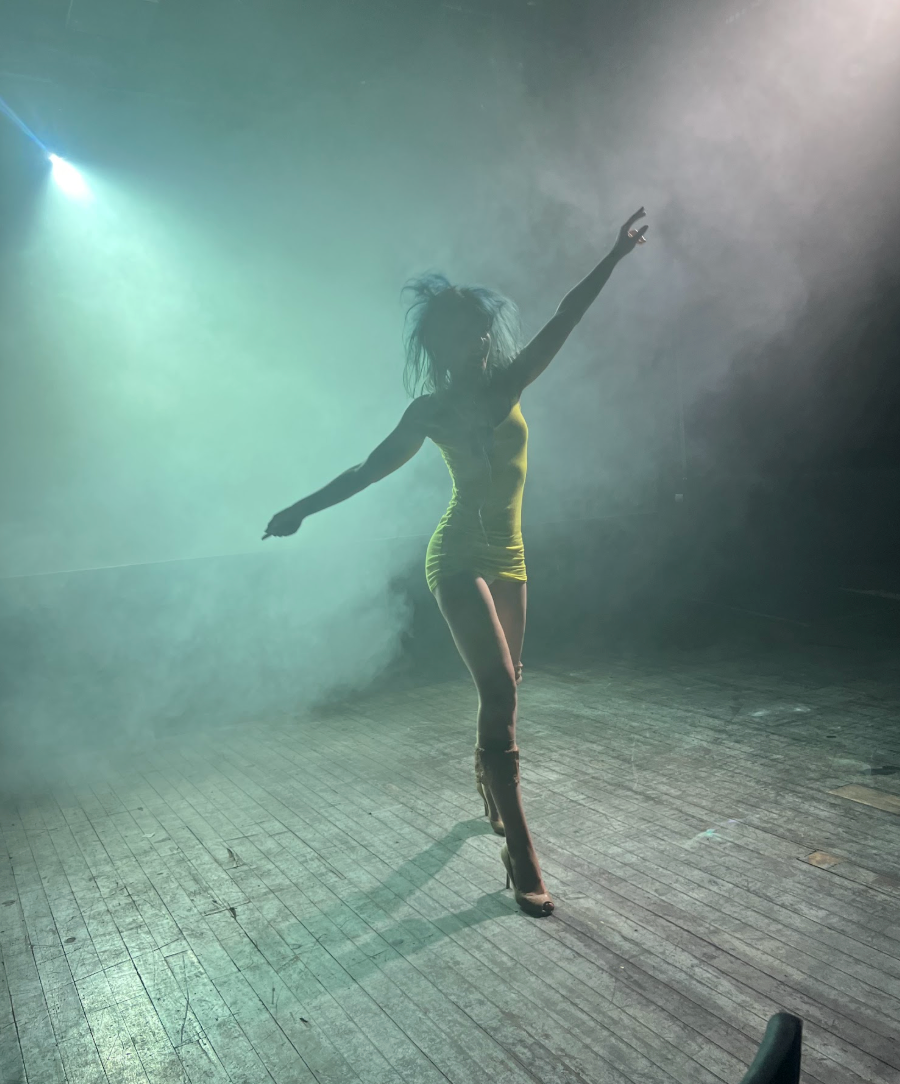
The Party Girl, played by Miriam Simanowitz, closes the act with a monologue of her own. In a Blade Runner mist, she clutches herself cold. What do we do now? She begs in a forged french accent. Ruminating on this mess of broken images, she works herself into a Dyonisian trance. Cathartic, she walks straight into death. A final hot flash fades into black.
Despite their attempts at antagonism, a wall of spectator-comfort was never fully breached. I heard Simanowitz was meant to smoke a cigarette on stage but the ICA wouldn’t let her. Antonin Artaud is rolling in his grave – I blame smoking bans.
ACT 3. dir. Alex Heard
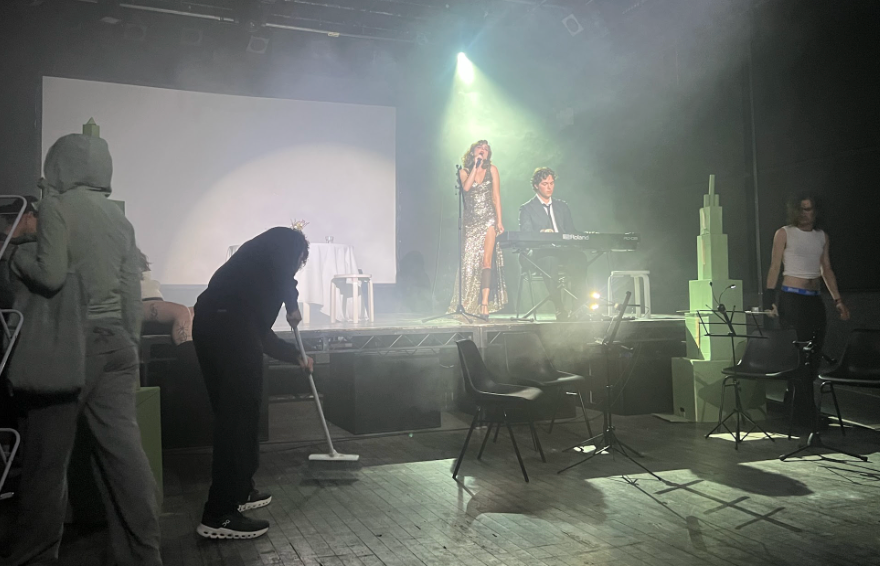
Alex Heard’s production is when the budget is revealed. A cardboard Emerald City is carried in by a cast wearing hoodies and dragging their feet. Dressed in civilian clothing, they look like a group of stand-ins that didn’t have time to change. And then the piano starts, and a light shines on a woman in sequins, Trisha’s own Jazz singer, Zoe Portela, whose mouth opens in an unexpected, sensual crooning, typical of a forgotten style of lounge singing.
The response to Heard’s production was a repeated question about casting: where did he find these people? Aside from the singer and pianist, there was also a four-part string quartet and a classical dancer.
The stage looks like a Peter Greenaway operatic ensemble.
The Civilians linger in the sidelines, endlessly rearranging laundry on a clothes rack, a woman and man play push and pull at a dressed-table, crawling about, mouths filled with fecal-nutella, and the string quartet continues to play as the ship keeps sinking.
The script is taken at its most literal. Lines are supposed to be understood as conversational dialogue between characters, they come out ill-fitted and revealing of the limits of Boyd’s exercise.
If it weren’t for the first two acts, I am not sure that I would be convinced by Heard’s absurdism. But by this point, as the words have become a hammered-in mush, I find that it does the best job at exemplifying this hamster-wheel of a play, rolling forward into further and further nonsense.
The civilians have started WWE-style massacring the set, getting at the cardboard with their teeth, throwing clothes and toys across the room. In a pathetic puff of smoke, a man’s face is projected behind the stage, obscured by static and smoothed out into Mark Zuckerberg uncanniness. He is like Oz in the rubble of Emerald City, disappointingly too real.
EPILOGUE
All that’s solid melts into air, the Marx quote reappropriated in Marshal Berman’s 1982, All That Is Solid Melts into Air, examinationinto the experience of modernity, is repeated multiple times in Boyd’s script.
Talking to hipsters and more experienced theatre connoisseurs after the show, some complained that the script demonstrated an amateur grasp on theatre’s history.
They were perhaps rightfully offended that Boyd had managed to ‘waltz’ into the ICA on his first run.
If you have been to art school, Berman’s book is a familiar first year reference (it just so happens to sound exactly like a perfume slogan). To those hipsters, I ask you to let your hair down; My Tragedy was a formal exercise and experiment in surrendering control. The blind communication between the writer and his directors was both the selling point and its limitation, edging on gimmick but surviving nonetheless.