REVIEW: Jeff Lomex at Lomex NYC
Review / 3 July 2026 / By: Lou Reed / ★ ★ ★
A few of Jeff Lomex's paintings are found wanting in the review of his recent show at Lomex. Do they lack the enigmatic sexuality found in a Balthus, or is contemporary sexuality-as-being-in-the-world flattened, and these paintings are genius representations of that? Or, are we sick of anime girl art? You decide.
There is mediocre painting that shrugs off concerns about influence and formal experimentation in favour of mechanical technique and middling figuration. Then there is amateurish painting—unrefined, enthusiastic attempts to take on canonical forebears and established motifs. Jeff Egner’s recent show “Guest Room” at Lomex falls into the latter category, uniting detached, pornographic manifestations of desire with attempts at well-heeled figurative techniques.
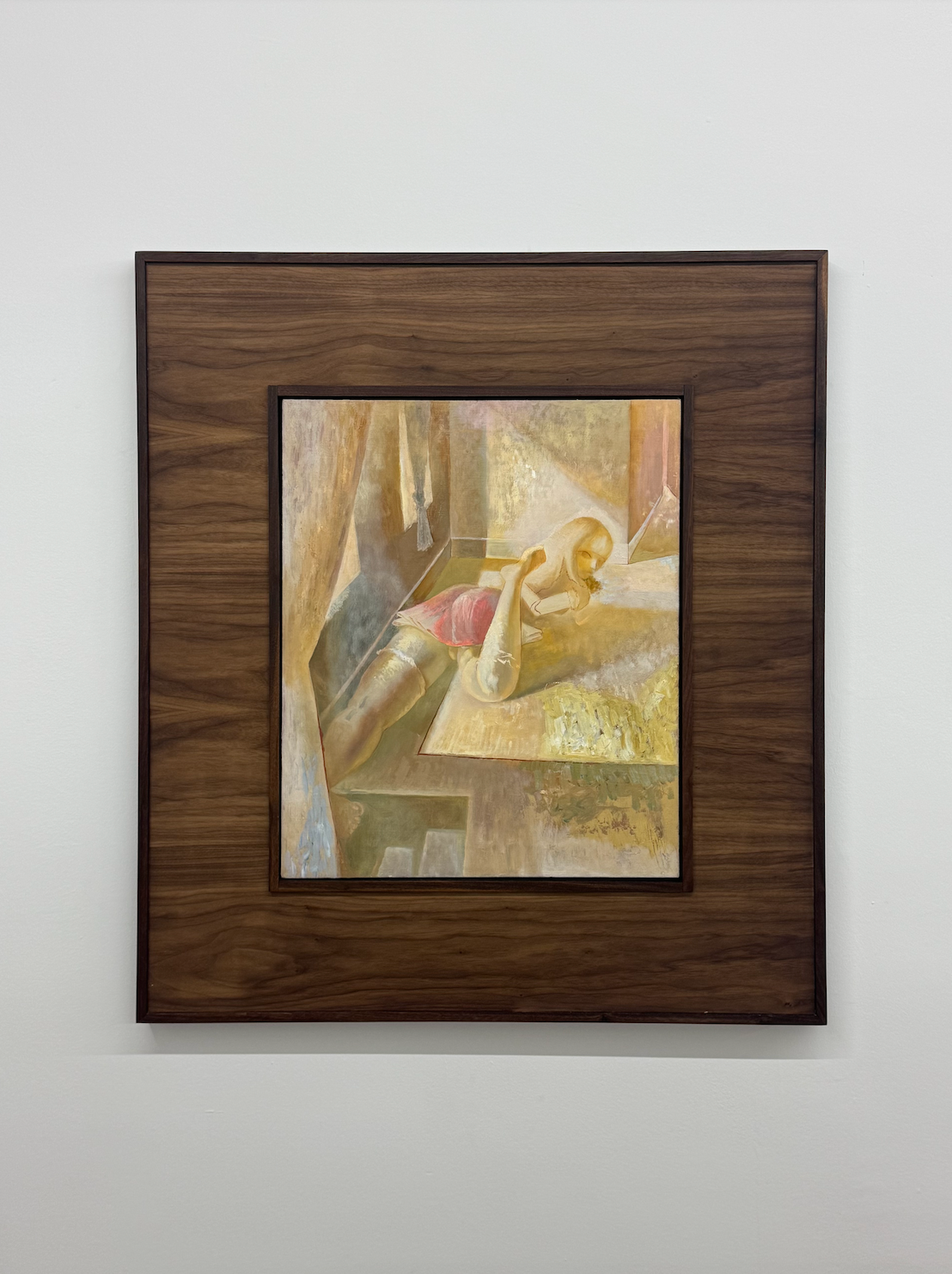
Across twelve paintings nearly exclusively depicting girls and figurines, Egner oscillates between strong and lowbrow influences, attempting to merge the (tastefully) suggestive language of Balthus’s children with the more brusque obscenity of the mass-market Temu sex doll. Take Untitled (Room III), 2025, a work depicting a seemingly inanimate girl bent over a table, offering a glimpse of her underwear as she looks directly back at the viewer. Her body is posed unnaturally—a club foot at the end of an outstretched leg bends at a bizarre ninety-degree angle, and her only visible arm twists around her back before disappearing behind her upturned second foot. At the bottom of her raised leg, a mass of thigh resting on the table accumulates into an abhorrent puddle. Two seams appear at the top and bottom of the contorted arm’s elbow joint, definitively marking the figure as a fleshy cast of silicone stretched around a Barbie-like series of pins and bolts. This is not Balthus’s Thérèse Dreaming, 1938 (a young girl daydreaming while exposing her underwear beneath an arched leg), but a shut-in’s attempt to memorialise his own perversion, a fleshlight collector’s failed endeavour to consummate his unreciprocated desire with the same tension and thrill of a Balthus work.
Other paintings take a more vulgar approach. In Swallow’s Nest, 2025, two women appear before a picturesque castle in a crudely painted scene. One, wearing a crop top and short shorts, leans against a railing to accentuate her preposterously long legs. The other sits on a stone ledge, crossing her bare feet and closing her eyes in a slump. While the painting overtly sexualises the Barbie-like figures of the two women, it is less a piece of toe and leg worship than a fetishisation of detachment, a work dedicated to the “cool girl” as a figure which can be observed yet never approached. If Untitled (Room III) represents a pervert’s approximation of Balthus, Swallow’s Nest is a re-staging of Chen Danqing’s viral Smartphones, 2016, a scene featuring two lithe, fashionably dressed Chinese women stretched out in an apartment facing away from each other while looking at their phones.
Again, Egner’s work simplifies Danqing’s complex themes, reducing the latter’s portrait of well-to-do digitally absorbed cosmopolitanism to an encounter with placid amazons in fantasyland. These are one-dimensional figments of the imagination- undeveloped castles in the sky to be drooled over, lest any intricacy ruin the daydream.
This is not to say that Egner’s show contains no well-executed, keenly observed portraits: Untitled (Boydoll C), 2025, places an androgenous doll in dated garb in a wooden high-chair, its hands stretched out as though waiting to receive an object. The figure in this work, ostensibly a recreation of a young boy in Victorian style non-gendered clothing, questions the role of dress, staging, and surrounding context in the fashioning of sexuality from a young age.
Just as 19th century Britons kept boys and girls in similar dress until puberty, Egner keeps his youngest subject in a suspended state, unwilling to lay his otherwise leering eye on a figure who has not yet been raised into the symbolic order of masculinity. It is fitting, then, that this is the most immaculately painted of any work in “Guest Room,” featuring radiant flared fingers and a hauntingly luminescent porcelain face. Subtle explorations of childhood development are subjects that necessitate a more skillful touch than crass scenes of doll-ogling.
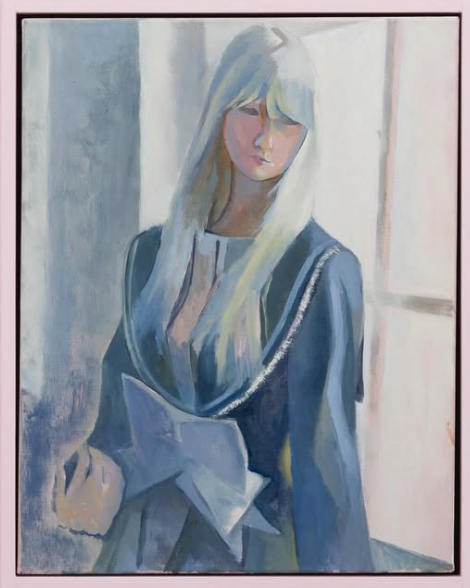
Her Blue Dream, 2025, is simultaneously the most reticent and lifelike of Egner’s canvases. A female figure in schoolgirl’s uniform looks longingly to her side, refusing to offer the vacant, accusatory stare of Egner’s other playthings. It is unclear whether the subject is a doll or a woman—her face carries more emotion than any of the inanimate personages, and her body is posed in an avoidant stretch. Unlike the mottled domestic scenes which comprise the majority of the show’s works, Her Blue Dream is painted in long smooth strokes, emphasising the drape of the figure’s arms and floes of hair. It appears as though Egner has positioned his doll to reject his advances, scorning himself for taking advantage of otherwise vulnerable subjects. Finally shameful for his lascivious scenes, Egner breathes life into his subjects through restraint.