Review of Callum Eaton’s "What A Shit Show" at Carl Kostyál
Review / 7 January 2026 / By: Anna Delving / ★ ★
What A Shit Show at Carl Kostyál
11.12.2025 - 17.01.2026
Last year I planned to write something about Callum Eaton. About how his photorealistic and life-sized paintings of ATMs, vending machines, lift doors and telephone boxes (openings in public space) cleverly messed with our ideas of surface and impenetrability. I was going to write that his paintings render in paint what Lauren Berlant calls capitalism’s ‘cruel optimism’: the way that it repeatedly offers us up a faint hope of passage to freedom whilst keeping us sliding endlessly across its greasy surface. Using Berlant to comment on these paintings is superficial: but now is the time of surfaces.
Public space is dominated by adverts, locked doors and shiny cladding that reaches all the way to the pavement. London is a hermetically smooth surface with no cracks to squirm through. I thought his paintings were about desire and fantasy in capitalism – of openings that appear to allow us a way beyond them but are just more surfaces (saying nothing of openings in other people’s bodies!). I was going to argue that Eaton’s paintings spoke to the claustrophobia I feel when I look at the screens in Picadilly Circus, or the empty shells of houses behind green park.
I was going to write that I thought that his paintings were witty – that they tricked the rich people who bought them into staring at a depressing trap of their own making. Their easy commodification was part of the critique.
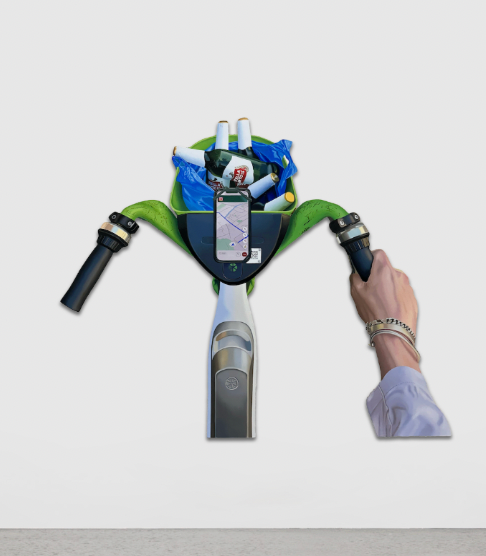
But Eaton’s latest show at Carl Kostyál trades in the cleverness of his previous work for banality. He’s still making photorealistic paintings, except now he has ditched openings in public space as his primary subject – seemingly in favour of relatable moments (a lime bike?) and things that lend themselves to being painted photorealistically (a crashed car, a fire extinguisher, a parking ticket). There is no denying that the paintings look good, Eaton does photorealism well, but instead of the angular constraints and clean lines of his previous work we now get a series of paintings depicting a benign jumble of crumpled and shiny objects that do little more than showcase his technical ability.
Gone are the formal restraints found in his earlier work to only paint rectangular openings in public space. Now he can paint anything you like (read: commision), on a canvas perfectly matching its shape. This comes off as a gimmick.
If I had to try to redeem these paintings, I might write that the invention of gimmicks is the substance of neo-liberal life and that Eaton makes fun of this repetitive cycle of newness. To argue this I would point to Rear View (2025), a painting in which a man looks through a rear-view mirror at a car crash he has just avoided, the only one featuring a person. The viewer is the guy in the car, the archetypal subject of late-stage capitalism, always just escaping disaster and gliding towards the next gleaming thing that grabs our affect. Surfaceness doesn't get to us as long as we keep on moving. On this reading Eaton implicates us in the neo-liberal game of constant newness as we move through the gallery from painting to painting looking for a meaning which isn't there.
But the gap between satirical invocation and mere reproduction of capitals machinations is narrow. The show’s title: ‘This is a shit show’ indicates that Eaton fears he is on the wrong side of it. It’s overcompensation gives away the fact that there is not a shit in sight, there is no actual difficulty or discomfort for us in consuming his paintings, no real moment of crisis - just its fantasy. This is a clean line of product, vacuum packed and ready to be shipped. It’s a difficult line to walk, to be fair, making something popular and commodifiable that critiques its own commodification. Eaton is on the wrong side of it here, pivoting from the wry unctuous critique to providing the slick, oily, capital required to grease the wheels of the endlessly self-ironising collector.
Unlike Gili Tal’s Leperello work at Terminal Projects for example, which successfully incorporates adverts found on London’s hoardings (walls around building developments) to mime superficiality without replicating it.