"Teenagers are in history lessons that they don’t want to be in" Review of Fieulleton Magazine, London
Review / 7 September 2025 / By: Milie Bobby Brown / ★ ★ ★ ½
Hollywood Superstar Reviews London’s latest magazine-to-end-all-magazines, Alex Heard and Middleton Maddocks' satirical, “Fieullieton” (literal translation francais: "Little bit of Paper"). Since a little bit of paper cannot be on Instagram, it has instantly become the most authentic, interesting and fun site of London Art Criticism, fml. It was launched theatrically alongside PLPC's shadow puppetry and a performance from Memory of Speke. Our daring reporter Milly Bobby Brown congratulates the satirists but retains reservations about "performative adolescence".
Teenagers are in history lessons that they don’t want to be in, they don’t like the reading material and they don’t like the teacher, Milly Bobby Brown.
3.5 stars - Puppet Show and Memory of Speke
4 stars - Fieulleton Publication
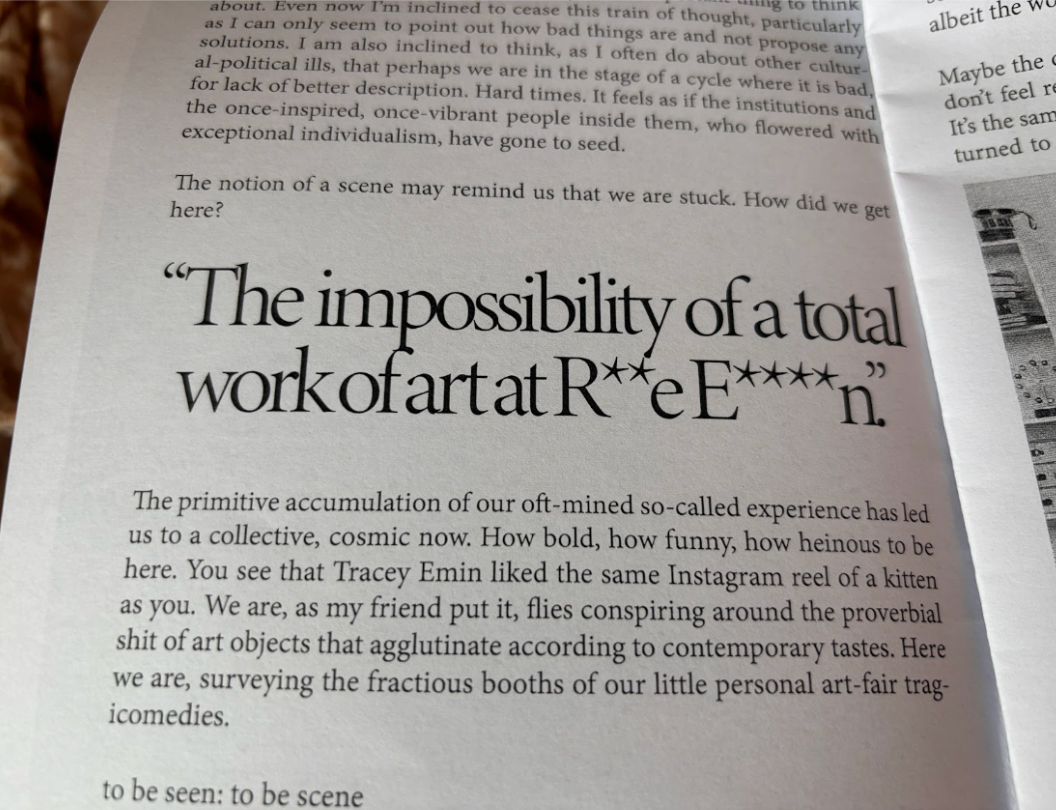
We arrive at the basement of Bethnal Green Working Men’s club for the launch of Feuilleton, the new print-only publication edited by Middleton Maddocks and Alex Heard. Copies of Feuilleton, whose name is taken from the Arts and Gossip column in 18th-century French newspapers, are crammed into a vintage suitcase at the door. Exaggeratedly passé in style, mimicking Publications of the highest order (The Paris Review, Frieze) this edition features short fiction, essays, and poetry. Text is interspersed with false adverts for DIY galleries, blogs, local wine bars, and Goldsmiths University.
At about seven thirty, we hear from the editors in a letter that seeks to position themselves in relation to institutions, literary readings, commercial art, and the nebulous ‘scene’ that orbits them. “It's not just the woke art that is bad”, Alex reads , "although that's most of it.” Artists, like teenagers, have always forged identities in relation to what they are not.
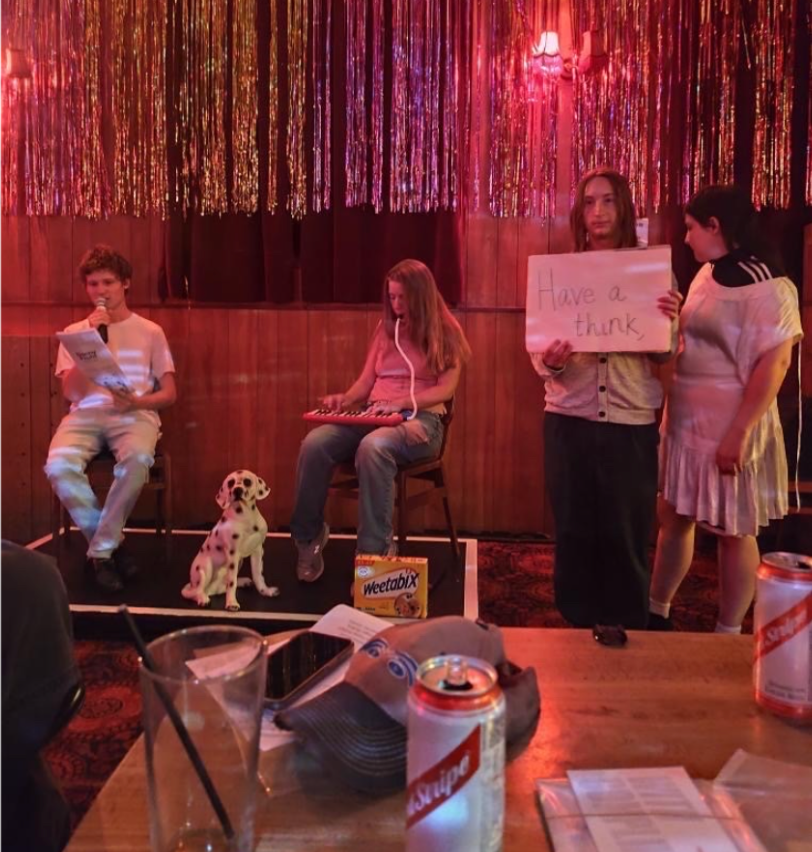
With juvenile spirit, the launch launches into something lawless; they don’t seem to be able to get the tech to work. T.C. Hell debases children’s characters TinTin and Snowy, in a piece which exploits lapses in audible speech and ambiguous translations to fulfil the narrator’s masochistic fantasy. We hear poetry out of the mouth of a plastic Dalmatian named Cole Denyer, who struggles to get verses out between barking from a malfunctioning hidden speaker. Rachel Fleminger Hudson gives us a playful, girlish striptease. She is telling us about a very sexy lady. As her performance escalates, there is a negotiation of the sexual dynamic; her character forged through claims of aesthetic enjoyment.
After escaping from the smoking area, we return for a shadow-puppet show / ambient road movie. PLPC’s performance takes us on a ride through the desert. Biker gangs, cop cars, and fuel trucks are shadows moving across the makeshift screen, overlaid with a textured soundtrack of chopped up dialogue and music by Memory of Speke. Evoking the slacker absurdity of Beavis and Butthead and the early MTV cartoons, reconstituted in the archaic but equally lowbrow/ populist medium of the puppet show. The result of an asdf movie watched in private. But now, given a full cheek-by-jowl theatrical treatment, watching is a uniquely collective experience. The crowd wave their phone torches at the outro.
Memory of Speke’s later set weaves flamboyant narrative vocals with repetitive grooves. The band’s usual theatrical costumes are swapped out for jeans and shades, a distinctly Royal Trux-ian swag that fits with the cool-Americana of the shadow puppet show. Their catalogue is bouncy, tight-knit, theatre-kid bangers, straddling no-wave, new-wave and ska, in a performance that is perhaps too much of everything (instruments, genres, influences) to feel like anything new.
Coming away from the night, I am thinking about the current trend in art and music of reviving adolescence. Reading Feuilleton, I’m struck by the critical potential the figure of the adolescent actually holds. It is used here as a kind of post-historical device, to read inherited systems and aesthetic codes. Parody and subversion are ways of rebelling against an old order. Whilst Memory of Speke and PLPC also co-opt the aesthetics of childhood, both seem to function primarily to draw us into their own special universe. Struggling to articulate this key difference, I speak to a friend. He offered that “performative adolescence should always be about learning.” I think without this we risk regressing into the confusing blur of nostalgia.