Review of Yung Lean's Exhibition
Review / 15 November 2026 / By: SadGirl222 / ★ ★
In the week leading up to the debut solo exhibition of Jonathan Leandoer Håstad – that’s Yung Lean to most of you – there was much gossip about who was going to which opening: the pre-opening, the press opening, the pre-pre-opening, or the supposedly even earlier friends-and-family thing (pre-pre-pre?). Come the weekend in question, nearly all of my coke-adjacent fashion friends with half decent salaries had shoved the sales PDF in my face with the conspiratorial excitement of having been let “in” on a once-in-a-lifetime opportunity: the prospect of buying something at this fated exhibition in an old gasworks in Stockholm. Such exclusivity was somewhat undercut by the PDF itself, which seemed to contain millions of works. “Should I get this one? Charli xcx and Salma Hayek already bought theirs.” For a moment, everyone got to play the glamorous role of art collector, for a fraction of the market price (at least at entry level – the larger works were, in fact, not cheap at all and more like 600 000 SEK ≈ 60 000 €).
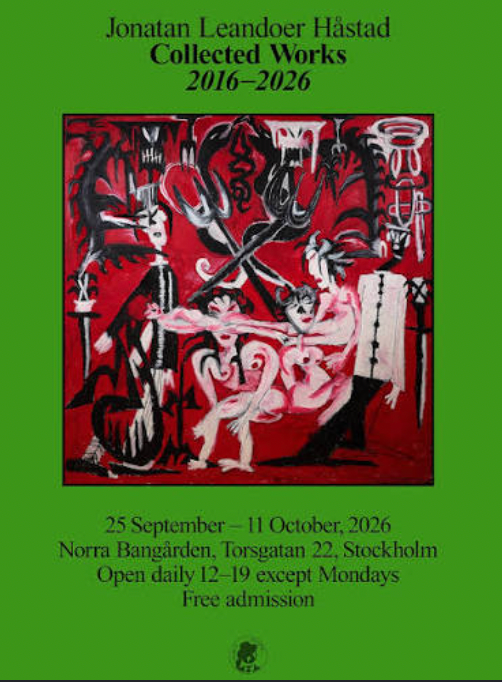
It is striking how quickly the apparatus of an artworld career has assembled itself around Yung Lean. Earlier this summer, Adidas and TTGT Studio staged a “Stan Smith residency” in Paris, where Lean made his first entrance as a visual artist (not counting Instagram posts and a 2024 group show in Seoul) through a durational painting performance. Three months later, Collected Works 2016–2026 is his big ‘retrospective,’ the title at least hinting at an attempt to historicise the whole thing. Some days after its closing, twelve works from the show made their auction debut at Sweden’s premiere auction house Bukowskis, and entered the secondary market. While a few works sold around their estimates, most failed to meet their reserves and were bought in – an oddly public audit of who, exactly, got a good deal the first time around. In the space of a single season, Lean has acquired the basic milestones of an entire art career. Blame it on fame or call it a symptom of cultural hyper-acceleration(idk).
Yung Lean the musician has always been exceptionally sophisticated when it comes to producing a vibe – his own signature being the perfect mix of boys’ bedroom, Swedish folklore and Scandinavian sincerity, plus a dash of medieval-meme melancholy, successfully carving out a niche in popular culture. His exhibition is very much built from the same vocabulary. You might read Lean’s positioning as an artist along the same lines by which the public persona has become a conscious and continuous aesthetic project for many celebrity figures, with “artist” functioning as another referent folded into the ongoing making of his own mythology. It also places Lean within the broader trend in which almost every successful artist of any kind will try, sooner or later – and with various degrees of success and commitment – to become a visual artist: Johnny Depp, Ed Sheeran, Skepta, Brad Pitt, and, closer to home, Bladee, Lean’s longtime collaborator, who last year had a Stockholm solo of his own. In tandem, brands increasingly appropriate the institutional grammar of art through archives, foundations, exhibitions, residencies and cultural institutions of their own: think Fondazione Prada Foundation, Fondation Louis Vuitton, Cartier, Gucci, and so on.
A 30-metre banner wraps around the exhibition building’s façade. It’s giving art fair, maybe educational museum blockbuster, and not exactly tuned-in contemporary art exhibition – a slight wobble in the art-world semiotics that makes the whole thing feel a bit Bambi-on-ice. Especially in Stockholm, where the art scene’s most fashionable move right now is to operate on an if-you-know-you-know basis, with galleries tucked underground and works camouflaged in shopping malls.
In the first room of the exhibition, a low beam of light comes through the only unboarded window. A jazzy soundtrack by PAN-affiliated artist Heith plays somewhere in the background. It’s quite an atmospheric installation – one I have a hard time understanding as Håstad’s work exactly, but which makes more sense if you think of him as a kind of creative director and the exhibition as part of his worldbuilding, akin to a stage set.It's unclear how much is the product of his artistic agency and hand, and how much has been shaped by his brand managers, the architect involved, or the show's actual curators, Slobodan Zivic and Kaj Lindhé.
The rest of the exhibition unfolds like a video game labyrinth, perhaps Big Boo’s Haunt in Mario 64. Concrete blocks are stacked into walls punctuated by small mullioned windows inset with colored glass, while spotlights drop in from above, casting harsh dots of light through the otherwise mysteriously lit space, picking out the lurid paintings dispersed throughout. It’s an ambitious piece of set design – expensive, I reckon. I’ve certainly never seen Stockholm’s old gasworks, otherwise used for lower-profile exhibitions, parties and sample sales, transformed like this. The maze eventually gives way to a large-scale video projection at the far end of the exhibition, which follows Håstad and his ex-girlfriend drifting through a fictional tale assembled from Nordic folklore and the sentimentality of 00s summers in the countryside. Håstad eventually transforms into a nixie to the strains of “Uti vår hage”, a song so tied to Swedish school ceremonies that it comes preloaded with some version of a childhood memory for anyone who grew up here. For an international audience, this might give an air of mystic authenticity. For me, the result is a confusingly dense slurry of national nostalgia. The film is packed with different symbols, but gives the viewer little to do with them beyond registering their aesthetic charge. What feels like Håstad’s longing for the past never breaks through into anything vulnerable or personal: there is no real path into a feeling, a social observation or an experience that extends beyond the exhibition’s own ecosystem; the work puts almost all its faith in the virtuosity of its visual codes. Which ultimately feels a bit self-absorbed.
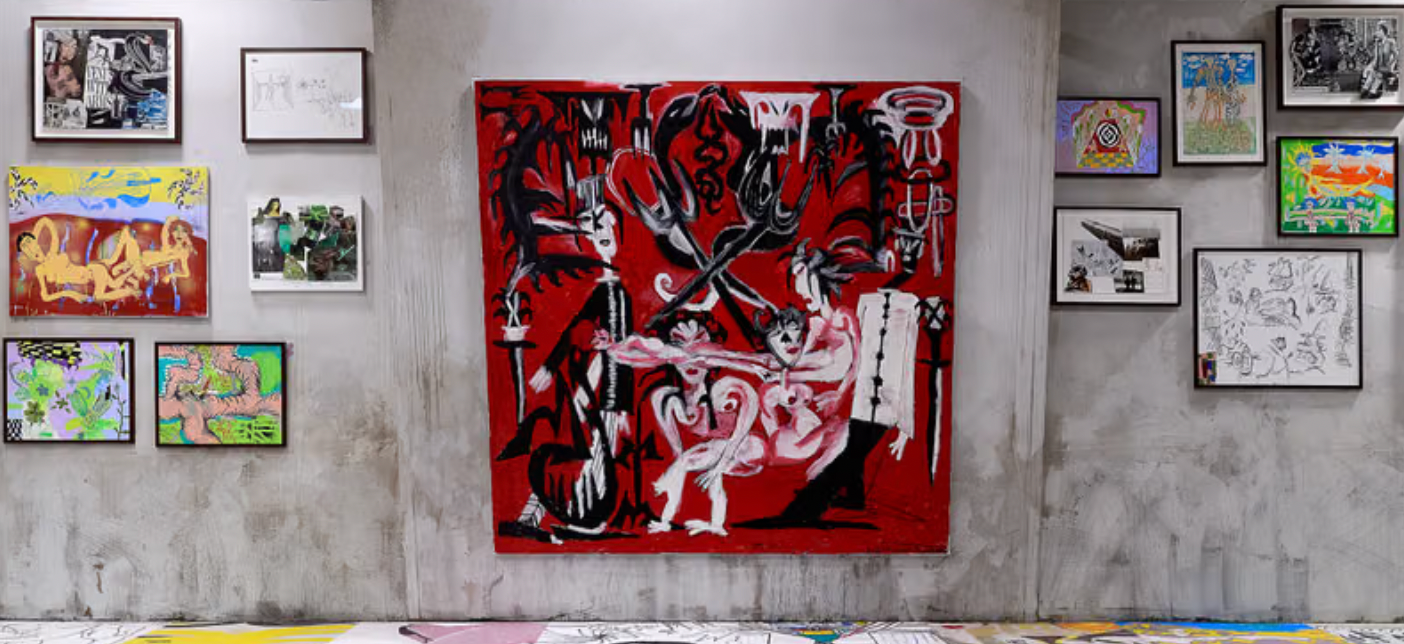
At the centre of the exhibition is a large room, hung salon-style, with works covering the walls from floor to ceiling. There are a few charming collages, a handful of ok ceramic sculptures, and lots of juvenile painting, populated by the DMT-elf-like figures that abound in Håstad’s semi-figurative painterly world. In the last room, a small box TV sits in front of a dusty couch, playing a selection of YouTube clips chosen by the artist, from black-and-white jazz jams to some obscure German noir.
The exhibition reads, more than anything, like a Yung Lean starter pack where nothing ever really moves beyond the surface logic of a moodboard. When doing my second and third lap in the show, I can’t shake this feeling that the whole thing could be reverse-engineered by someone fluent in his aesthetic. Indeed, this idea of art as a taxonomy of referents and moods arranged in a way that sits so comfortably inside its own model – vibe slop – might be do the trick as fan service, but it’s less understandable when the work wants to be considered as more than just pricey merch or a big branding extravaganza. It would work better as a Yung Lean theme park than an art exhibition with ideas or authority.
Lean is hardly alone in wanting to write himself into some kind of art-historical continuum. I think the art world likes to flatter itself by explaining this recurring desire in terms of freedom: art as the final creative territory beyond utility, market logic and pop culture’s endless popularity contest, hence the natural destination for anyone whose ambitions eventually outgrow their original medium. But I have a feeling it’s also increasingly about accessing the machinery through which cultural relevance is canonised and converted into value, and ultimately into prices bearing no discernible relation to the object itself, only to the elaborate fiction of its importance (the wet dream of any lifestyle economista).
Indeed, contemporary art has spent the better part of a century dismantling the old conditions by which an artwork could be recognised as art – medium, skill, autonomy, eventually even the object itself – which is, of course, convenient for anyone trying to enter the system. The art world is not exactly well positioned to call out larpers when so much of its own authority depends on everyone agreeing to play along. The exhibition also benefits from the art world’s soft spot for the autodidact, who is rarely judged by quite the same standards as everyone else. [Aside: reviewing a celebrity exhibition leaves a critic in a somewhat tricky position. Simply dismissing the pop star playing artist based on, say, the quality of the brushwork or the schkitzed-out palette is obvious, but embracing the whole project as some kind of anti-elitist gesture is equally predictable, not least because being a Drainer is conveniently a way of placing yourself on the right side of taste.]
So maybe what grates me the most is not that the art is kind of whack, or that Lean turns the apparatus of art into commercial spectacle, but how he completely misreads its current codes while doing so. The whole thing, not least the bedsheet gift-shop merch, just felt profoundly uncool. For someone whose entire appeal has depended on an almost preternatural sensitivity to taste, tone, and the tiniest calibrations of popular culture, this new identity feels genuinely strange, and clumsily staged. By contrast, Bladee managed to align himself with one of Stockholm’s most mysterious galleries, without the PR-firm spectacle, and pulled off the rapper-turned-artist move with considerably more finesse. There’s a difference between disregarding a culture’s conventions and simply being oblivious to them. Lean approached the art world with an almost obnoxious degree of the latter. Leveraging his pre-existing fame to stage an exhibition more in line with the unwarranted grandeur of Swedish House Mafia than with the effortless swag of Sad Boys risks making Yung Lean, the visual artist, appear like the art-world equivalent of your latest pop-world industry plant.