Wipe Away The Pre-cum, Review of Jeff Egner at Lomex
Review / 9 July 2026 / By: Lou Reid / ★ ★ ★
When Tiqqun wrote their Theory of the Young Girl, some people pointed out that it was a bit misogynistic, using the assumed vacuity, emptiness, and ultimate energetic frivolity of women and girls in the West as both an analogy, a mode, and a mask that governments, men in suits and anyone (?) under late-stage capitalism can don at any moment. Why always dolls and not women, like cmon now.
As Lou Reid explains, Egner's paintings incorporate the mass-market with the acceptable pre-war pedo vibes of Balthus in a manner that could be read as "relatable" for contemporary femininity. But the young girl, or the doll, can't ever just be a vessel, and is more of membrane, bearing the trace of its observer, or theorist, or painter, who doesnt wash their grubby little hands before handling.
Anyway, post-impressionist paintings of dolls...
— Syd
There is desire, a burning passion for the all-too-real and ultimately unattainable, and there are one-dimensional figments of the imagination – undeveloped castles in the sky to be drooled over, lest any intricacy ruin the dream. Jeff Egner’s recent show “Guest Room” at Lomex dances the line between the former and the latter, conjuring scenes of strange, lurid intimacy with well-heeled influences and unrefined (yet enthusiastic) figurative techniques.
Across twelve oil paintings almost exclusively depicting dolls and feminine playthings, Egner oscillates between the high and low-brow, attempting to merge the (tastefully) suggestive language of Balthus’s children with the more brusque obscenity of the mass-market Temu sex robot. Take Untitled (Room III), 2025, a work depicting a seemingly inanimate girl bent over a table, offering a glimpse of her underwear as she looks directly back at the viewer. Her body is posed unnaturally – her club foot at the end of her outstretched leg bends at a bizarre ninety-degree angle, and her only visible arm twists around her back before disappearing behind her upturned second foot. At the bottom of her raised leg, a mass of thigh resting on the table accumulates into an abhorrent puddle. Two seams appear at the top and bottom of the contorted arm’s elbow joint, definitively marking the figure as a fleshy cast of silicone stretched around a Barbie-like series of pins and bolts. An easy comparison can be drawn between Untitled (Room III) and Therese Dreaming, 1938, a Balthus painting of a young girl daydreaming while exposing her underwear beneath her arched leg. This is a provocative theme, and any work influenced by the voyeuristic gaze of the adult male on the helpless girl must tread carefully lest it cross over into the realm of the flagrantly exploitative. Egner meaningfully tweaks Balthus’s unrepentant examination of his sitter with a healthy dose of self-admonishment, positioning the doll to look back at the viewer, implicating them in their overt sexualization of the figure. The tension (and thrill) of the Balthus work is absent, and instead replaced by the shame and contemplation akin to a fleshlight collector memorialising his own perversion, turning his urges inward and mixing his lust with an unshakable embarrassment. To so obviously fetishise the inanimate qualities of the doll is to take away from its uncanny appeal, and render an otherwise complex being disappointingly flat.
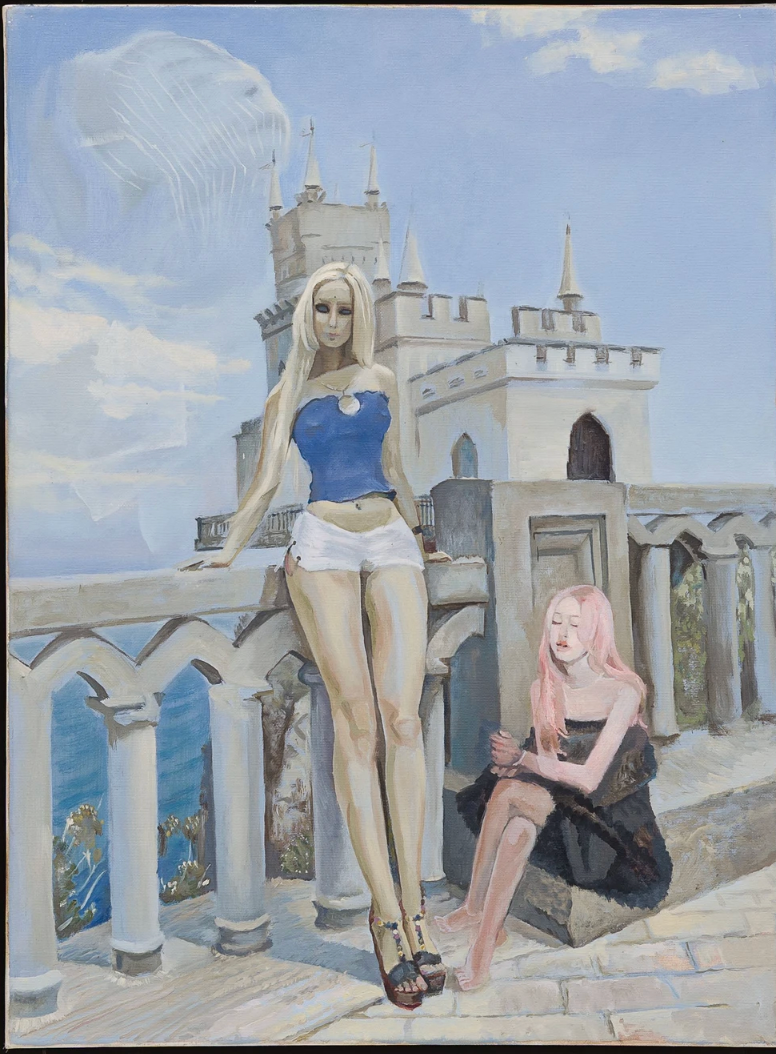
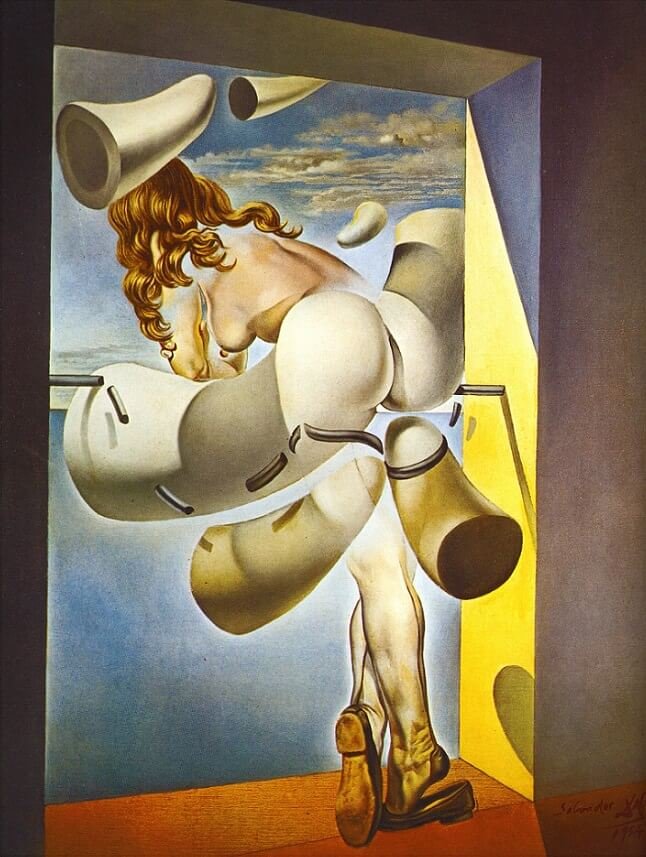
In Swallow’s Nest, 2025, meanwhile, two women appear before a picturesque castle in a crudely painted scene, haunted by a floating male visage. Appearing somewhere between a reflection of a face on a glass pane and the ominous floating phallic rhino horns which crowd the female subject of Dali’s Young Virgin Auto-Sodomized by the Horns of Her Own Chastity, 1954, the face watches over the women with startling proximity, as though the cloud-like lines which define its hair and brow will soon be breathed in by the girls. The taller woman, wearing a crop top and short shorts, leans against a railing. The other sits on a stone ledge, crossing her bare feet and closing her eyes in a slump. While the painting overtly sexualises the Barbie-like figures of the two women, it is less a piece of toe and leg worship than a fetishisation of detachment, a work dedicated to the “cool girl” as a figure which can be observed yet never approached. Dali referred to Young Virgin as the most chaste of his paintings, in spite of the penis-dream’s paradoxically “erotic appearance”. Egner lands on a similar feeling in Swallow’s Nest, bringing a male figure into a painting in the most ineffectual, flittering manner possible – while the women could breathe in the wispy vapours of the face, they could just as easily turn and blow them away. The delicacy of this relationship is, however, jeopardised by the cardboard-cutout inertia of the women. Painted as placid amazons in fantasyland, they are frustratingly disconnected from the unstable encounter Egner is anticipating.
This is not to say that Egner is incapable of producing complex and captivating work: In Her Blue Dream, 2025, a female figure in a schoolgirl’s uniform looks longingly to her side, straining her right hand to play with the fabric of her sleeve. The woman’s pupil-less eyes do not rest on the viewer, but out a window, conveying disappointment or yearning for something outside the scene. Her face carries more emotion than any of the other inanimate personages here, and her body is posed in an avoidant stretch. The question of the figure’s animation is the painting’s greatest success, highlighting the importance of Egner’s rendering of his girls in the success or failure of his unsettling tableaus. Unlike the mottled and flat daubs which comprise the majority of the show’s works, Her Blue Dream is painted in long smooth strokes, emphasising the drape of the figure’s arms and floes of hair. It appears as though Egner has positioned his doll to reject his advances, engaging the productive tension between each inanimate yet uncannily attractive doll to question the root of his desire. Here – at last – Egner imagines the doll as being able to say no, and produces a portrait instead of another silicone still life.