The Rattling Sigh of Relief Echoing From Issy Wood as She Falls Down A Rabbit Hole Into The Centre Of the Earth (Internet Trend Exhaustion).
Review / 15 November 2026 / By: LukeTurnerArtist / ★ ★
The rattling sigh of relief echoing from Issy Wood as she falls down a rabbit holl into the centre of the earth (internet trend exhaustion). Review of "ARTIST FOCUS" Issy Wood at National Portrait Gallery.
A while ago (one year), Timothée Shamalet reviewed Issy Wood's paintings in a piece entitled "On the IsseyWoodification Of Painting". Popular opinion (one Substack essay and one Artnet hit piece) now echoes the opinion of Shamalet that Wood is slightly passé. While on the art market, Wood’s works are still sterling; appearing regularly at art fairs, the value of her work is increasing at a steady pace. Hollywood can’t help but speculate if this downfall is self-propagated.
It is not particularly nuanced to point out that a major artist, once venerated by the market and continually encouraged to paint "the same thing" over and over again, is no longer evergreen. What’s more interesting is the vicissitudes within the fashionability of dislike. How have things shifted so far out of Wood’s favour — that her work appears plasticine — moving from 2023 ingenue into the 2026 bin with all the grace of Etsy handmade home décor? Who could predict that closely cropped self-portraits of a millennial woman doing skin care could be so unrelatable? How have her many imitators oversaturated the so-called ingenuine quality of her “close crop”?
Is it, as Artnet writes, because the close cinematic crop “does not engage seriously with political issues of our age”? Or is it the case that the novelty of being “vulnerable” online has worn off in favour of deeper, much darker mediums, like Dark Woke, Rabelsian Grotesque, or straight-up ceo shooter nihilism. Is Wood fed up with the painting style that launched her to stardom, and keen to start anew, rising from the ashes of a self-propagated fall to paint? Instead of depicting herself with a luxury swimwear brand ERES bag on her head, as she did in her recent show in Kyoto with Carlos Ishikawa, perhaps her popularity would gain some purchase if she painted Flottilla, or AI vertical dramas about jewel people who cheat on each other.
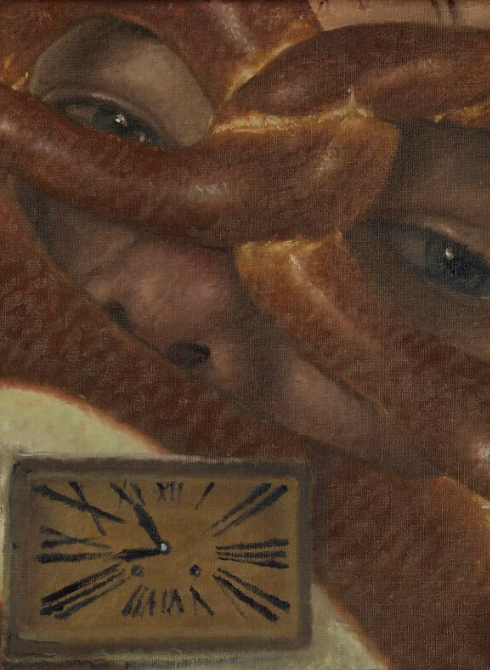
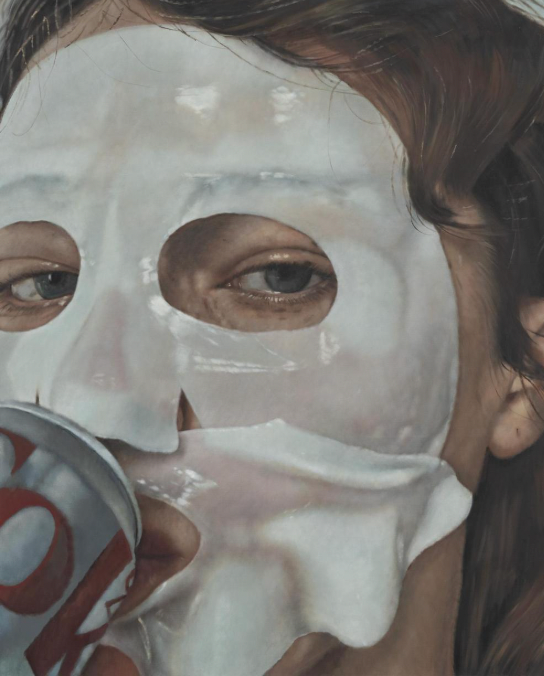
Her current solo show at the National Portrait Gallery, “Self-Portraits”, consists of eleven “intimate” Woods. In three canvases, self-portrait 22, self-portrait 71 and self-portrait 63, we see Wood’s face tastefully squished or reflected. In one work, she holds an ugly curved mirror with a chunky green frame, the kind you would have bought from TIKTOK shop in 2021. In another, she has plastic witch fingers on her hand that appeal to an attempt at tabloid-like labels of her as a self-obsessed female artist (recently, an Instagram account identified an identical painting by another artist, Emma Beatrez). In the most Iris Law one, she wears a sheet mask while she drinks a Diet Coke. This exhibition is an inaugural part of NPG’s tri-annual “artist focus” section, and if we could harbour a guess, the next couple of artists will be similarly safe bets. It is doubtful the genre of “self-portrait” will be in any way problematised.
For lack of a better word, the objects Wood contrasts with her face no longer appear novel when painted. Even if you frame her cold-liminal gaze upon ephemera as “a critique of hyper-capitalism”(to quote her 2026 press release), the point's been made. Now, Wood is trapped in a time warp of her own online saturation.
For millennials and Gen-Z elders, Wood's brilliant technicality and penchant for the unobserved, detournement object made her oeuvre balanced: teapot, selfie, toy car, selfie, bunny rabbit, selfie. Etc. Etc. What Barry Schwabsky called "Perverted Realism" in 2020 - painted verisimilitude with a slight uncanny lilt of her observed world- has instead become a "Bland Nihilism". British institutions, as usual, are only just realising a national darling. Maybe, now, we can add Wood to the “British” roster of Hockney, Bacon and Freud and her style will become uninitiated but eminently collectable. While she remains saleable, she will be de facto pupae.
The label of “out of touch” we are levelling at Wood at the end of 2026 is not helped by a Telegraph headline which reads "Art wunderkind Issy Wood: Has being attractive helped my career?" As so-called "millennial art" reaches its zenith and nadir, the idea of “self-obsession” being interesting, or even pitied, is outdated. The same goes for Wood’s imitators that appear in various London galleries: those named by Shamalet (Joseph Yaeger, Chloe Wise) and 2026’s additions (Emma Stern, Sun Woo Kim); or any art that uses pink faux fur is out of style. Timothée Shamalet outlined last year... Wood has a lot to answer for: her style – tight crops, photo-similar faces, kitsch Disneyfication, bathetic scenarios, darkened peripheries like early-Instagram vignette filters.
Perhaps, she will go full hog and commit to satire, like Guston in the late 60s. While she's been compared to Michael Borremans before, I'd like to see her go full method and take her slight perversion of the real into a more full-fledged surrealism, or cartoonish appliqué, such as the stylistic world-building of Christina Ramberg or Domenico Gnoli. Lose the sheet masks, which are no longer a symbol of “baring all” or an Ottessa Moshfegh-style agoraphobia. Rather, sheet masks have all the cultural currency of false earnestness and spare time, something the public sees enough of online.
Various literature has, of late, built upon this amoebic...exhaustion... with Issy Wood's self-portraits. Anna Petrovna, in a recent Substack essay entitled "The Problem with Painting Photographs", places Richter and Wood together for their photorealistic style: “I can’t be the only person to have visual fatigue from what I think of as Richter-mania.” Stylistically, they may very superficially have a semi-photorealistic style in common. However, Hollywood disagrees with Petrovna. The main difference between Richter and Wood (beyond the vast chasm of time, age, style and poise) is that Richter uses German media as a way to capture a relationship between both self-fashioning and postwar nationhood.
Photo realism, utilitarian in its presentation, will not save her from accusations of shortsightedness. If her subject matter does not shift with the times - Wood will always remain a true auteur of only photo-realistic Tumblr-esque paintings – and thus consigned to the ruthless cycle of dismissing the recent past. Like Joanna Kutcha, she will be frozen in time. Maybe this is what she wants, as she said in an unserious Instagram post, “I mostly paint book covers now”.
The pairing of her work so closely with the Instagram square format, from the outset, is the premise of her decline; once the trend cycle moves on, and she does not, she will (gainfully) be left behind. Consider the show at the NPG a gravestone for the close-crop self-portrait. While Carlos-Ishikawa wont need to find another cash cow, it may be bad news for the satellite galleries basking in the sunlight of the trend.
Epitaph for Issy wood by Dame Isabelle Grok:
Good old Hume (who nonetheless located in “delicacy” the faculty of making fine distinctions, and who therefore would seem to be our man) counted prejudice among the capital defects of judgement, and not least prejudice “for the time or place” in which one happens to live. This is the prejudice now at work in the current irritation with Wood, the decade that taught us “how to read” her photo-paintings. For to date a sign is precisely to tear it from tradition and re-file it in the inventory; Wood’s vice is that of one who looks only from their own time. Nor is it an accident that the convenient idea should be that permanence decides. ARCHIVING, once again: the infamous sheet mask has already been dated, which is to say, it has been beheaded by the calendar. And since tastes are above all disgusts, the distaste for pink faux fur should be called by its name, disgust.
The principle of pure taste is first of all a refusal, and true distinction is measured in distance from current aesthetic conventions, which brings us back to the only practical consequence: if the judgement that condemns Wood today is saturated with the prejudice of its era, we do not escape it by waiting for time to pronounce sentence, but with a critic cleared of all prejudice—capable of setting those canvases against something other than their own saturation– that is, that judgement “improved by practice, perfected by comparison” which remains the only resistance that does not consist in timing a decay.