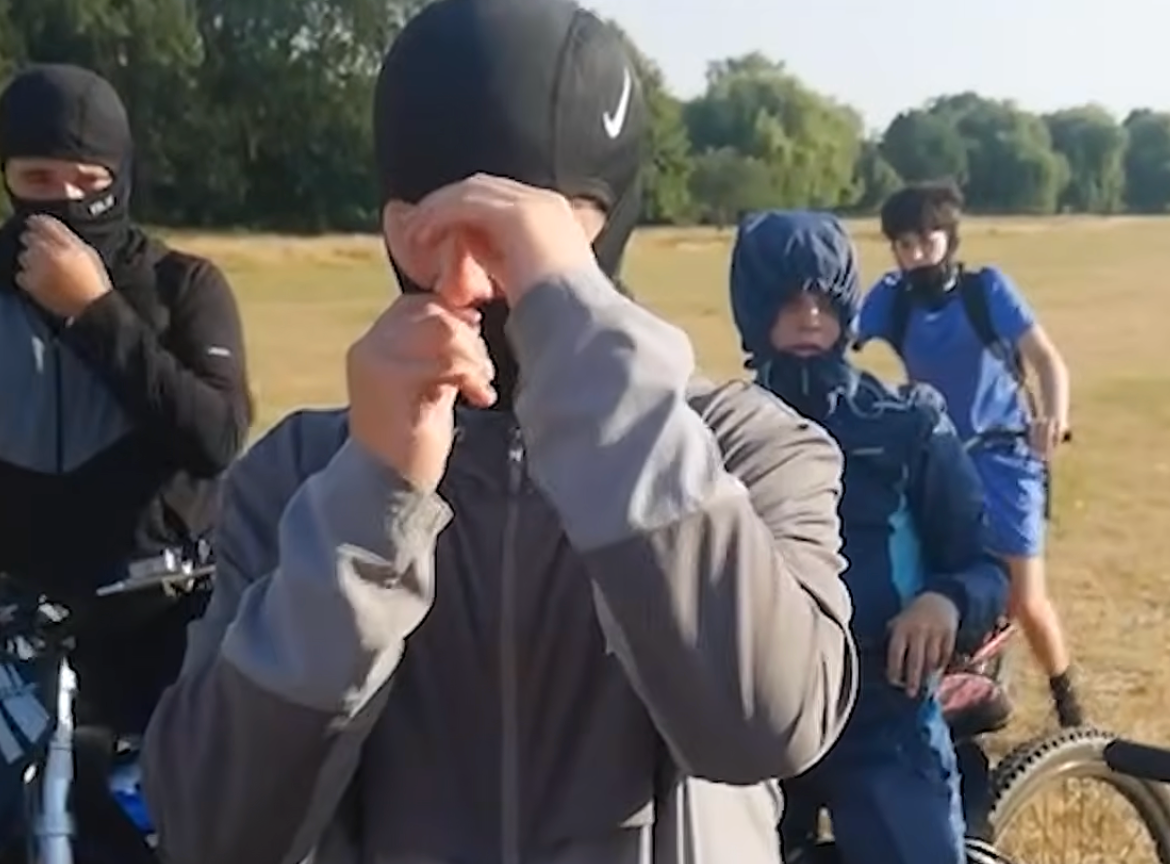
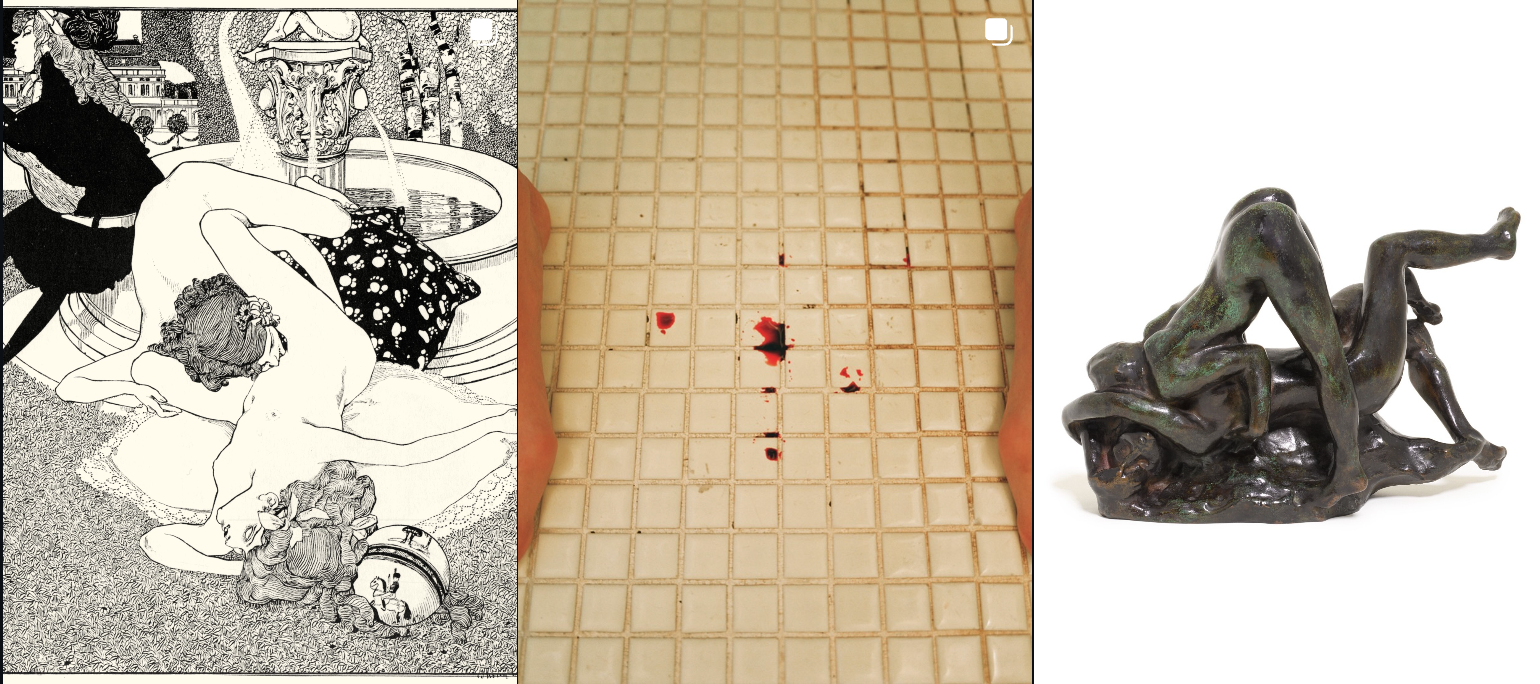
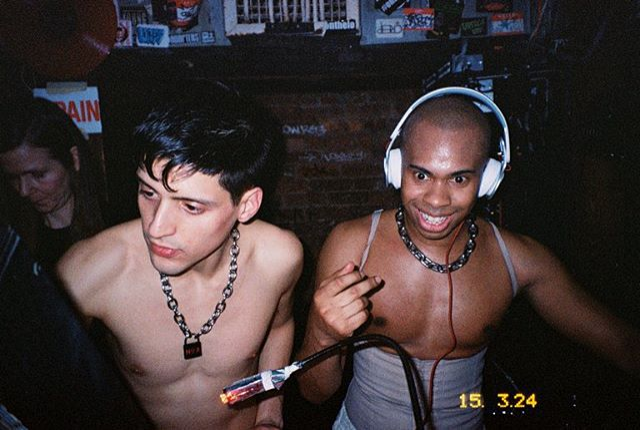
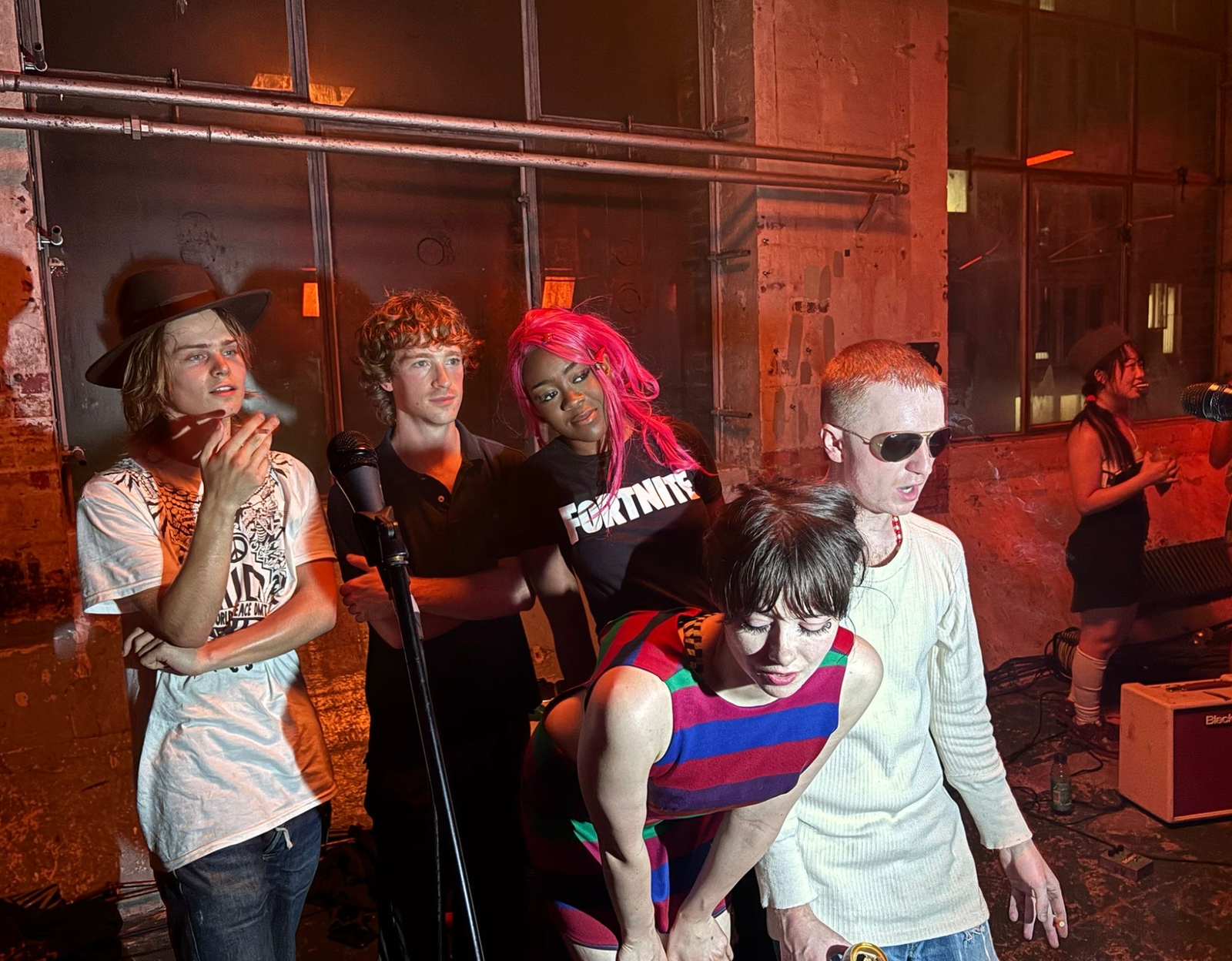
"I can tell by your sound that you do it because it's in right now."
"300SkullsAndCounting has chiptune screams. Jenny Sparks is a bassline curator who has developing a curious aesthetic for years. The whole album is audible proof of my theory that screamo is the substance that brings people together.
Their album THIS IS SPA TOWN in an outcome neither genre was built for, but as our reporter Teo points out, is inevitable. This therefore becomes PART THREE OF OUR SERIES ON GEN-Z AESTHETICS.... MUTATION IS THE AESTHETIC. Apparently, Jenny Sparks promo'd the album by carrying around a huge JBL at Czech music festival Creepee Teepee. For keen listeners, the album is full of easter eggs of nostalgia for their own adolescence, which because of the trend cycle, is also everyone else's adolescence, now."
But we are here to give a voice to Teo,
AND TEO THE HOLLYWOOD SUPERSTAR ARGUES THAT
“if you scream loud enough... the culture might drift towards you.”
300SkullsAndCounting and Jenny Sparks want to incinerate London venues and assault hipster sensibilities. It seems that the only thing they revile more than trendy music is boring music- that is if the two aren’t synonymous. And not being trendy, or worse, boring is a game that they are particularly good at; their gambit being a carnivalesque genre collision that is the exact intersection of the 300skulls' chip-tune screamer and Jenny Spark's bassline curator’s solo work and taste.
Perhaps what marks London’s current underground as the epicentre of new musical output is that its most eminent contributors share an ethos rather than an underlying sound; namely, the consensus that as an artist, you ought to give yourself total and utter permission to do whatever you want, no matter how outdated or uncool- bassline, screamo etc…The idea that anyone would even try to replicate this sound is hilarious, but not so unlikely at a time when x publication can say something about laptop twee and all of a sudden everyone is making music that sounds like belle and sebastian processed through a calculator. So 300 screams the sheep away; “kill you in the bace” narrates an altercation with kids at Ormside, “I can tеll by your sound that you do it 'cause it's in right now” sounds like a cry from the weird kids at school trying to scare away the popular kids. And “You can tell that I do it 'cause I'm out of touch” assumes a new meaning considering the duet's newfound virality. On paper, they’re bitingly out of step with today’s easily reiteratable, monocultural, musical fads; but 300 and Jenny suggest that if you scream loud enough, persevere, and dare to stick to your emo-and-bassline-loving guns well enough, the culture might drift towards you.
Both bassline and screamo originated as countercultures led by teens who didn’t have much else; kids who sought to turn the barest of sounds into sounding outrageous- pantomime-esque, artificial caricatures of EDM and hardcore respectively; and so the combination is doubly outrageous. The two sounds are antagonistic throughout, but what threads them together is 300 and Jenny’s seeming brotherhood. A bit like their ex’s, the femcels, the new album is packed with teases into their studio and real-life antics; 2 of the tracks being phone calls, placing ribeye orders, and the artists giving live comments on the music throughout. You can imitate chord progressions but you can’t imitate the zany synergy of the split-brain these two seem to share. Accidents and inside jokes seem to be the whole point of the collaboration; beyond anything, they’re making music for themselves, which is probably why everyone loves it.
“Use a fucking cymbal; to decapitate a hipster” is a gorey image that sums things up pretty well; splitting ears as much as emotion, 300SkullsAndCounting and Jenny Sparks’ music feels like an emblem of the unconformity and audacity that is required of artists to make music in London.
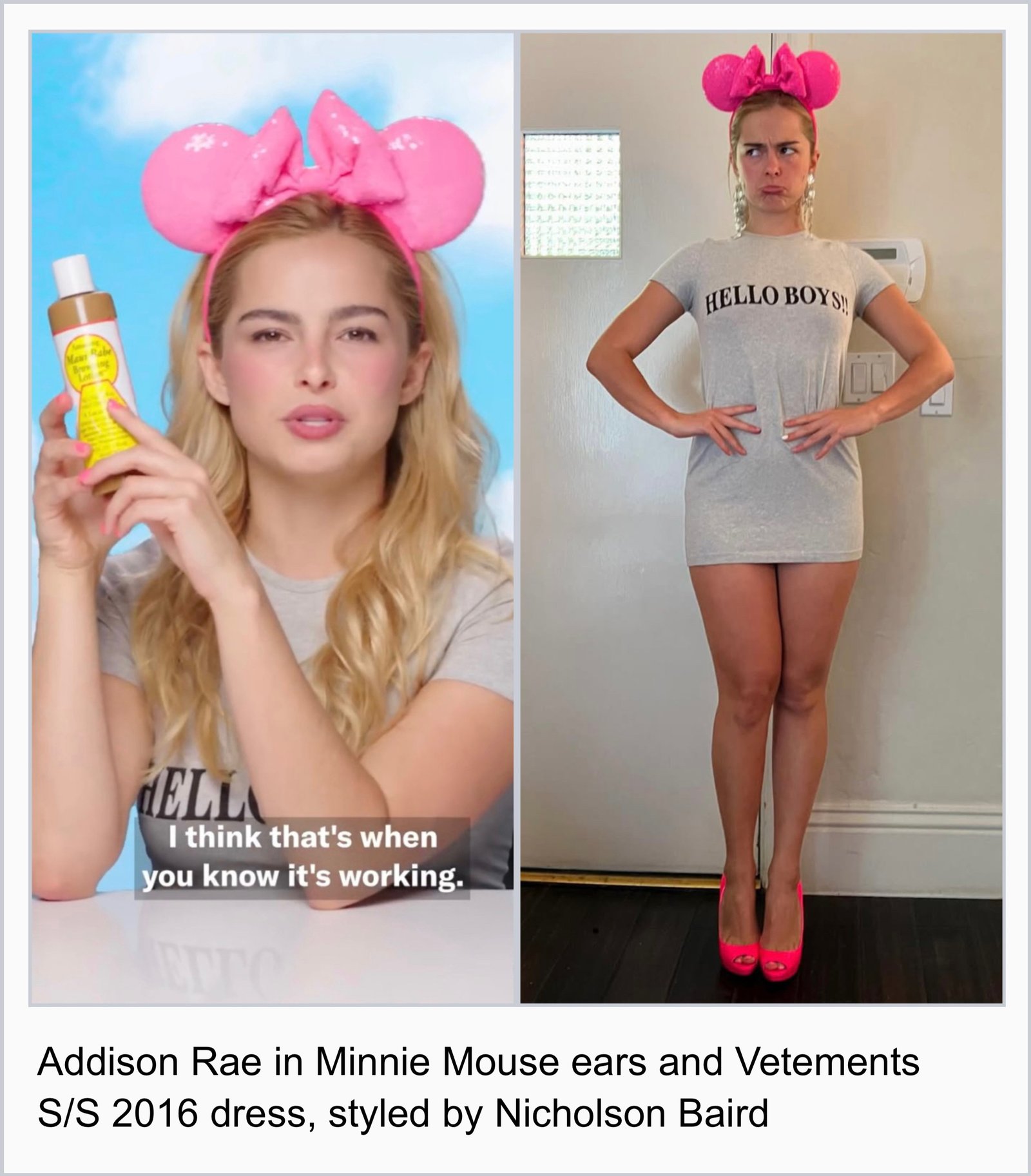
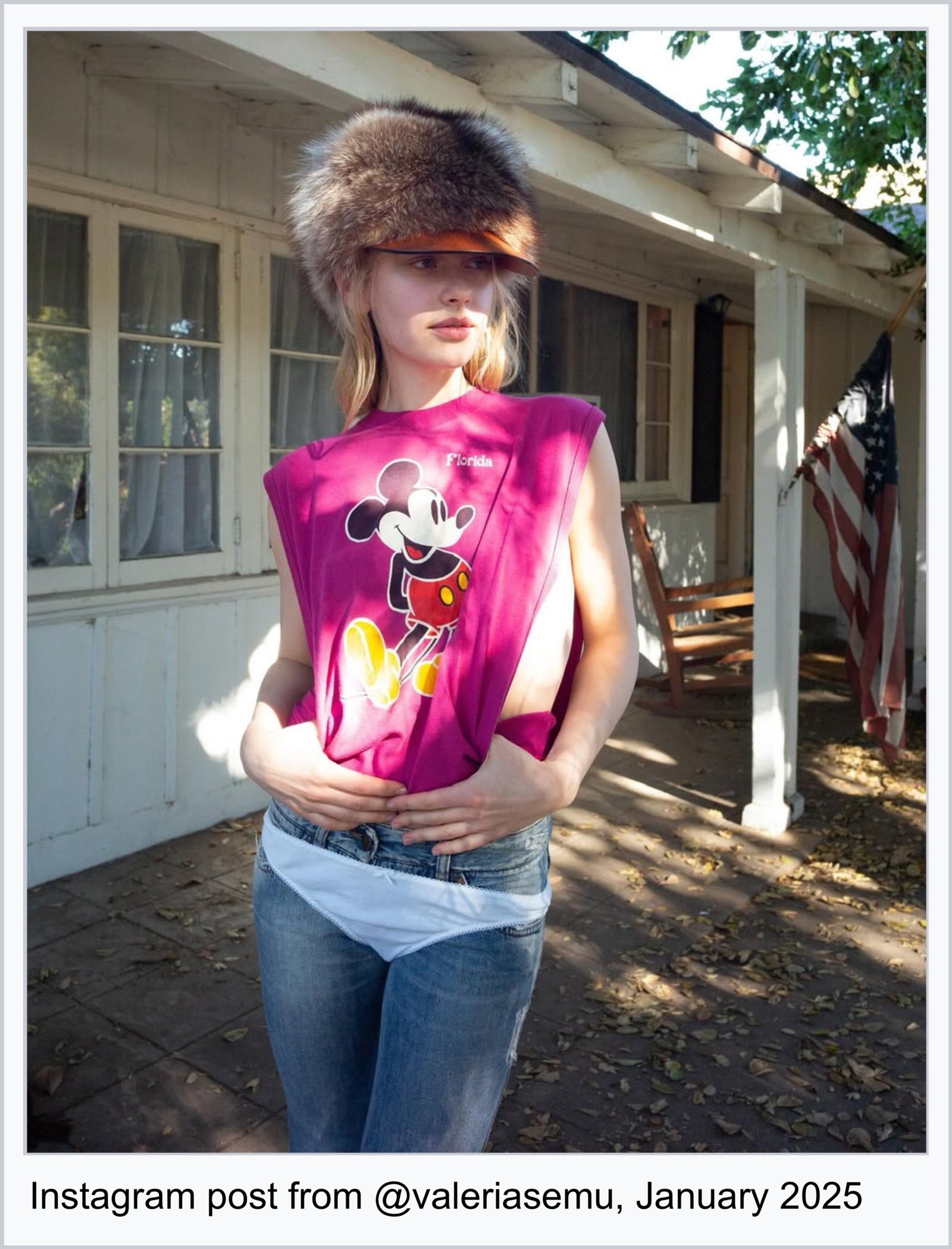
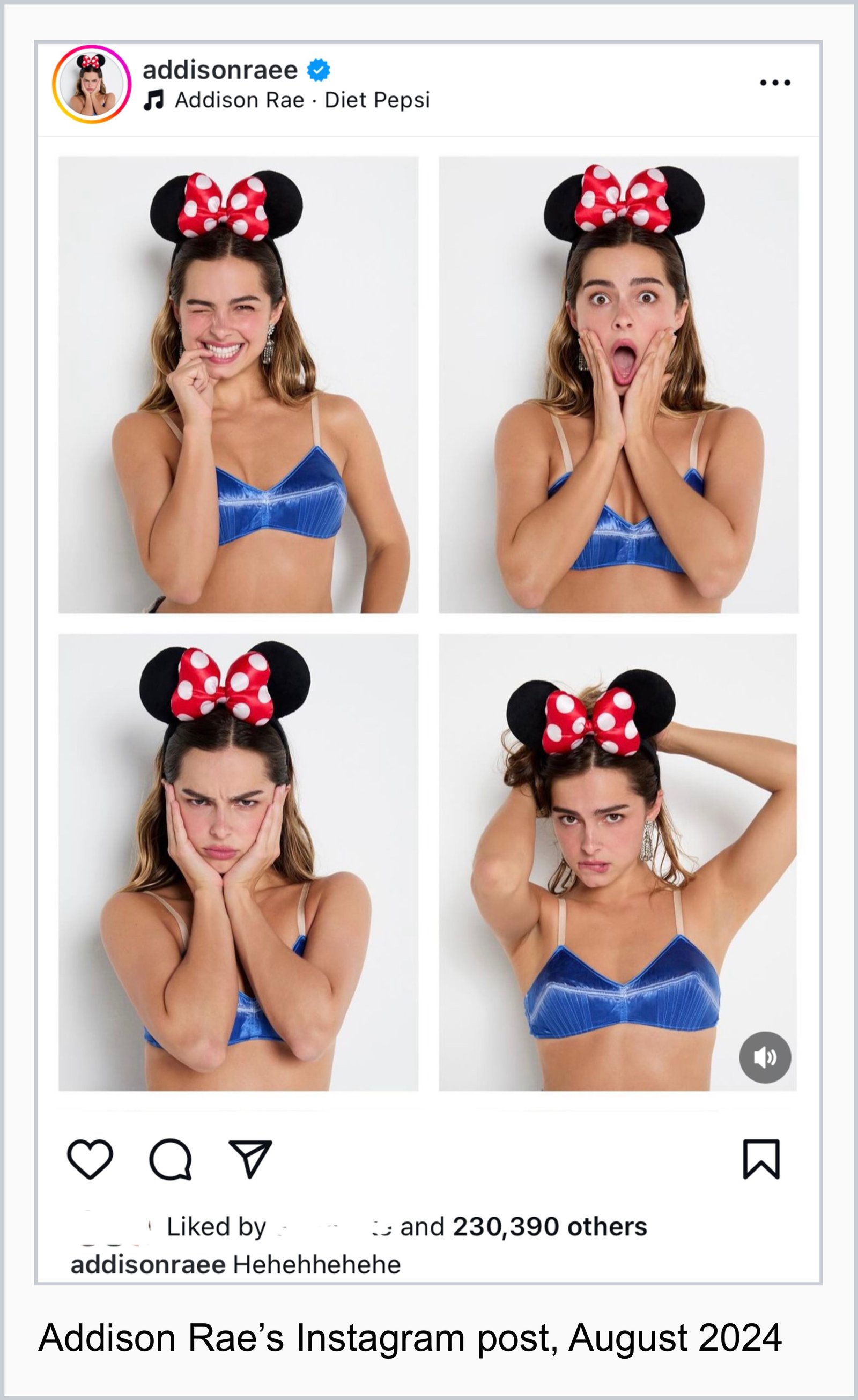
June 2025. A Reel comes up on my feed of Addison Rae wearing pink sequined Minnie Mouse ears as she talks about idyllic days in Hawaii and Maui Babe’s Browning Lotion. I watch the entire thing waiting for some verbal acknowledgment of the Minnie ears either from her or the interviewer or really anyone in the room. There’s absolutely no mention of it within the video but somebody in the comment section said “Can she let these damn minnie mouse ears GO.”
I don’t share the comment’s negativity – in fact, I thought it looked super cute because that shade of pink matched her personal color type (my guess being that she’s a Clear Winter or Bright Spring). But I had a moment of relief like, thank god somebody finally acknowledged the ears?! The presumed normalcy of it was making me feel crazy, when you would think that everybody else treating the Mickey ears as a casual outfit accessory were the ‘crazy’ ones. But is it really all that crazy? If ‘crazy’ means 1. stupid or not reasonable; 2. mentally ill; 3. annoyed or angry (according to Cambridge), then, well, the Mickey-ears-as-casual-accessory aren’t all that. They’re more ‘campy’ than they are ‘crazy,’ but even camp as a descriptive term doesn’t cut as deep as I need it to. To me, the adoption of Mickey ears as a casual styling object is beyond camp: it’s beyond a mere injection of fantasy into the mundane or an occurrence of absurdity made quotidian. It is a sartorial phenomenon that attests to the absurdities of our present milieu.
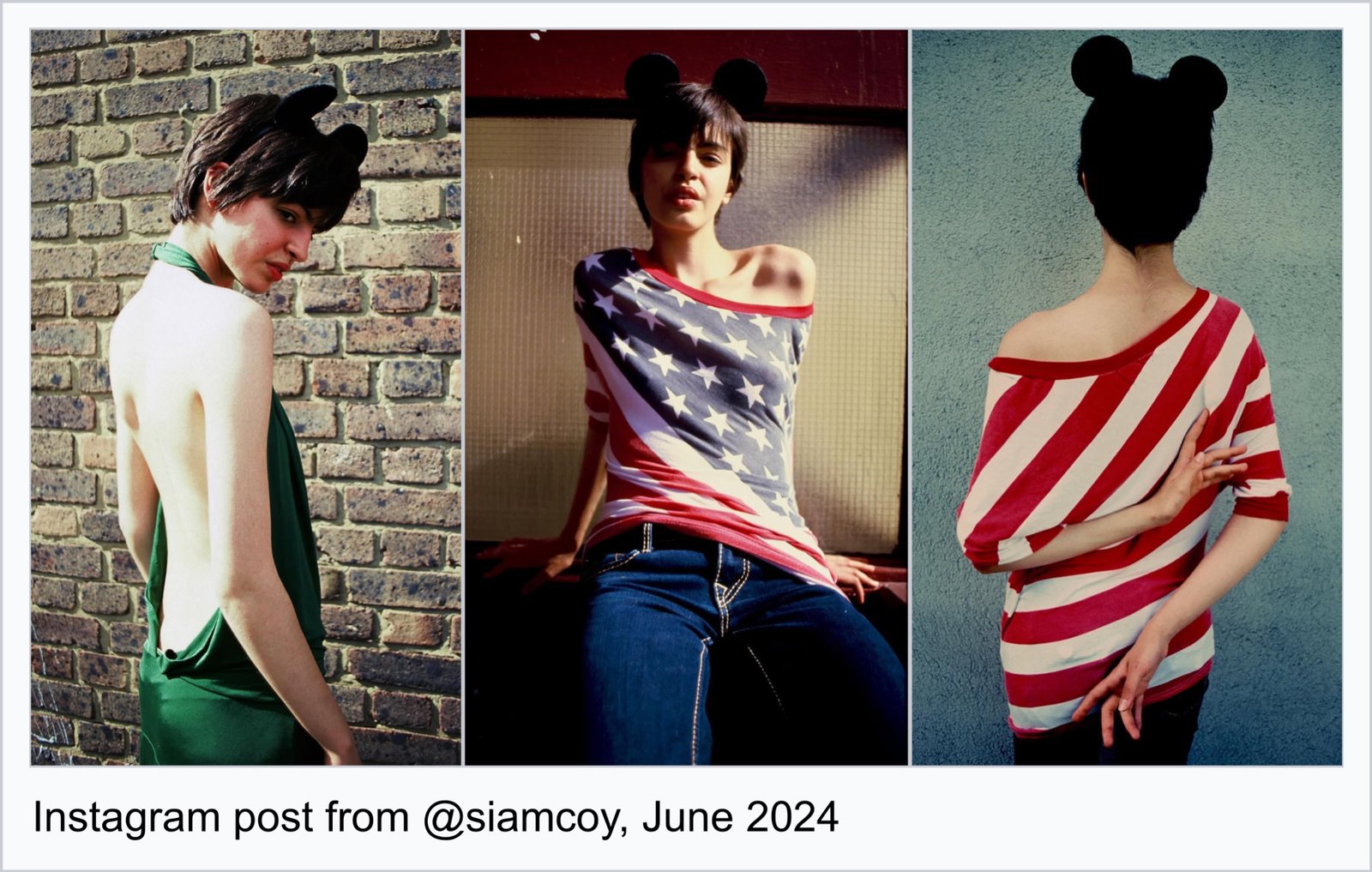
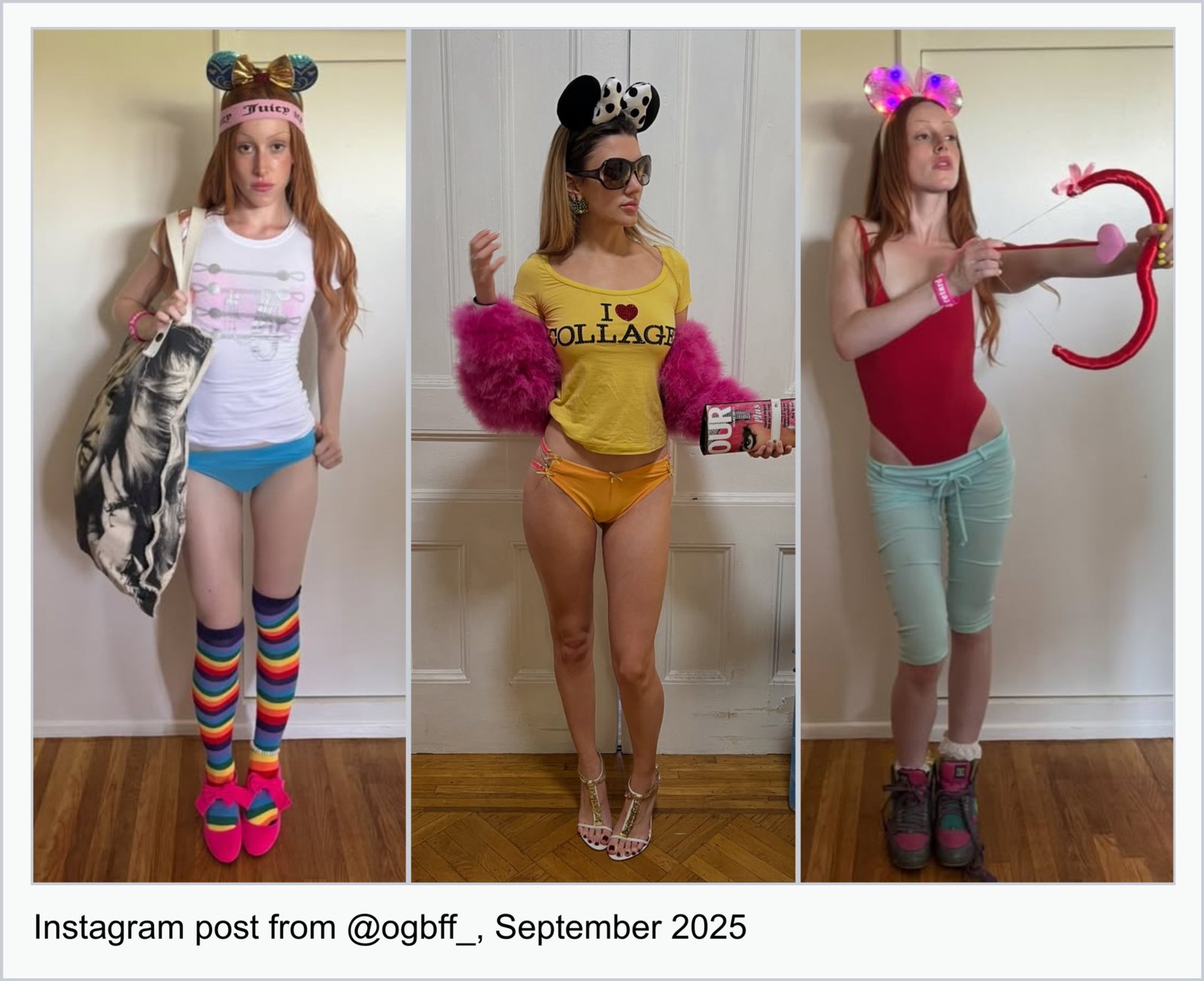
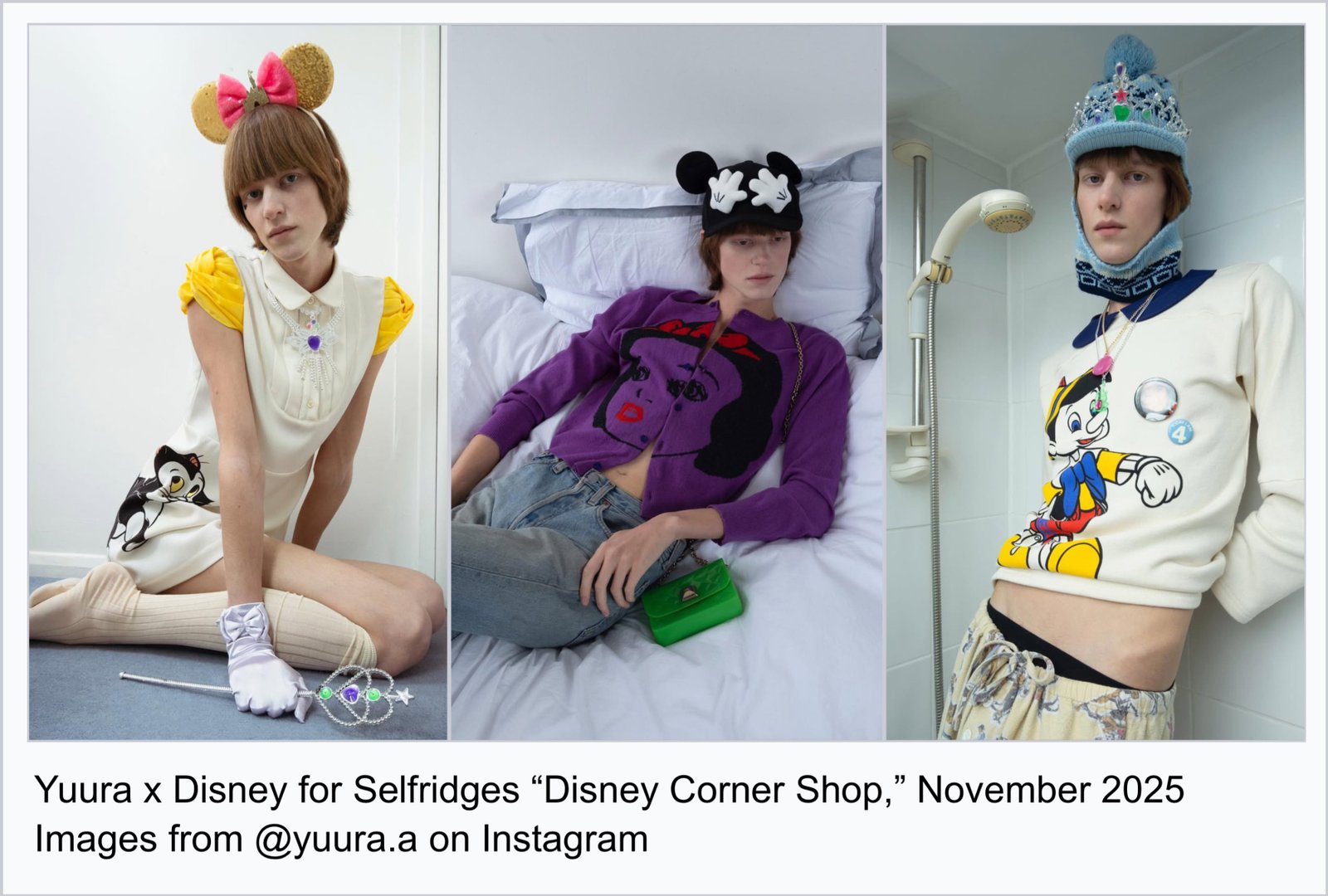
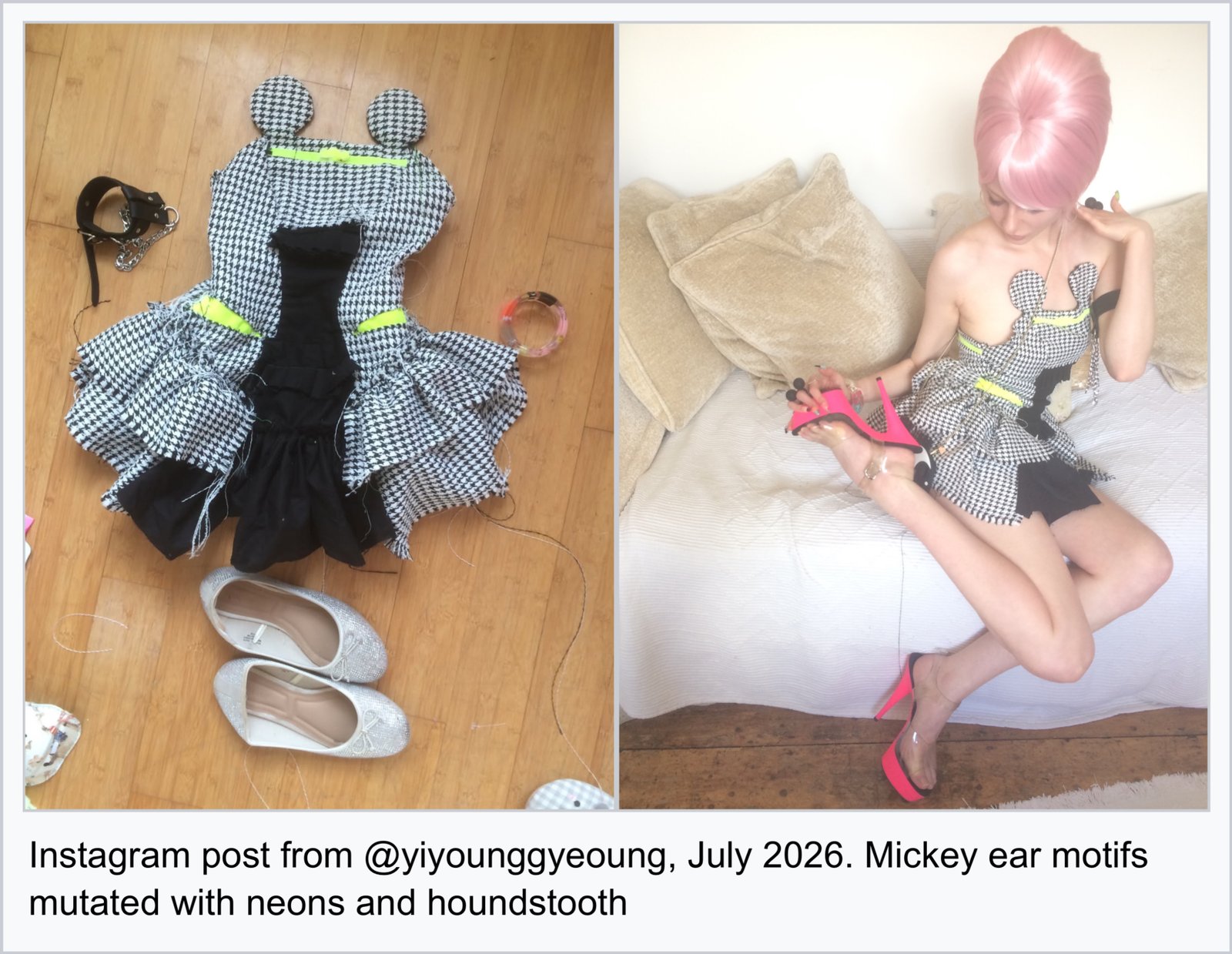
The Disneyfication of styling and contemporary art became more widely visible in the year 2025, but I’d pinpoint 2024 as the beginning of this current wave of it. At the time, I was doing research on the late Americana aesthetic – Disney of course being a significant subsection – and began saving these examples that I’d see in my corner of the Instagram Universe. Consider me your ride operator, and this to be a roughly chronological, cyberethnographic ride through the various Disney motifs that I feel define this moment – a beginning attempt to trace its aesthetic lineage and what it reflects about our cultural psyche… if you will… Seatbelts on!!!
First Stop: A Brief History…
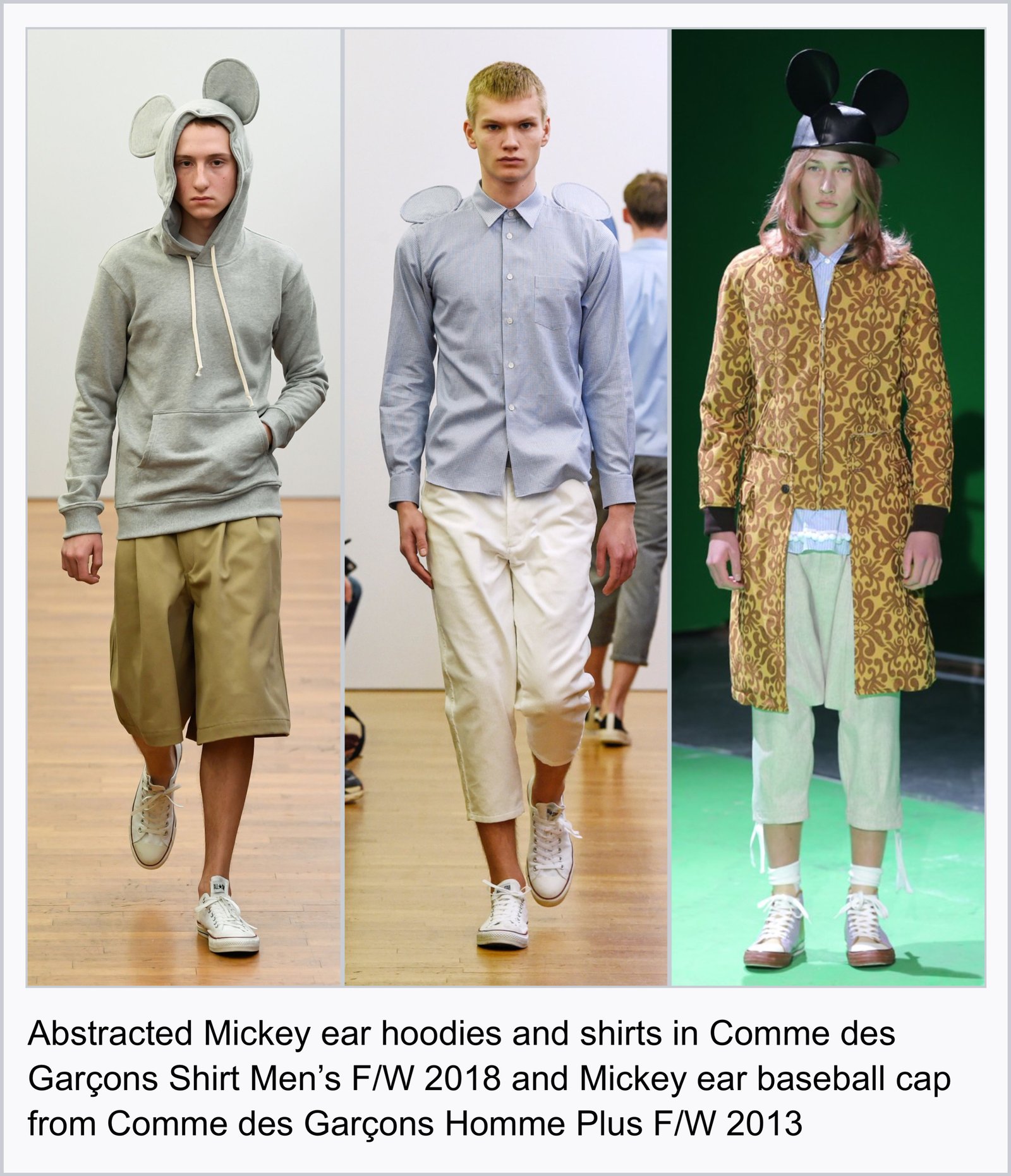
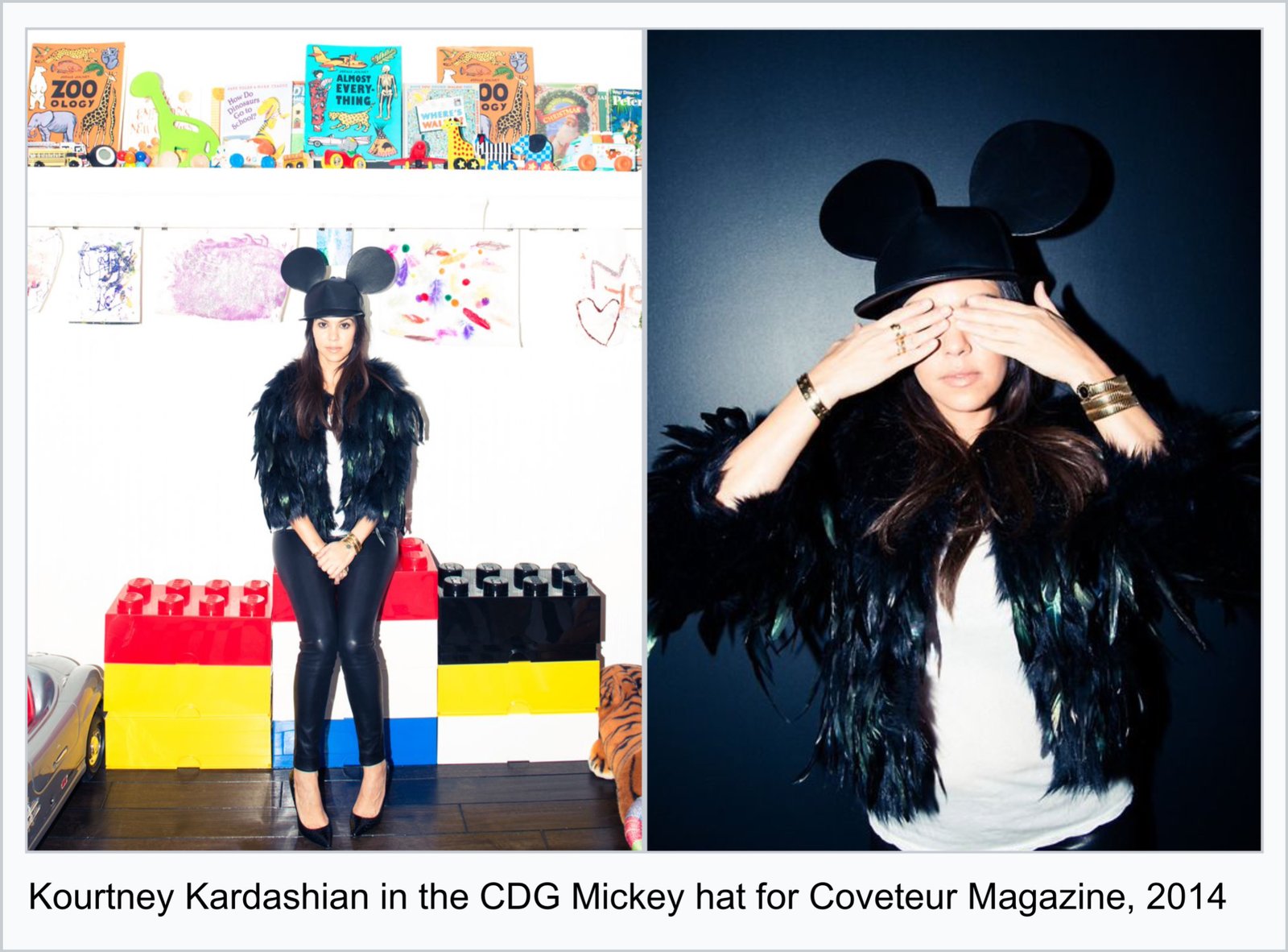
Mickey and Minnie ear headbands originate from a visual gag in the 1929 animated short, The Karnival Kid, in which Mickey Mouse does a gentlemanly tip of the ‘hat’ towards Minnie Mouse using the cap of his head. This silhouette of his ears attached to a bowl-shaped black cap was made into physical headwear for the Mouseketeers in the 1950s TV show The Mickey Mouse Club before becoming the headband we are familiar with today. In Karnival Kid fashion, Rei Kawakubo reimagined the bowl cap silhouette on a wool baseball hat for Comme des Garçons Homme Plus F/W 2013, with the Mickey ears abstracted further in a later collection on hoodies and dress shirts in Comme des Garçons Shirt Men's F/W 2018.
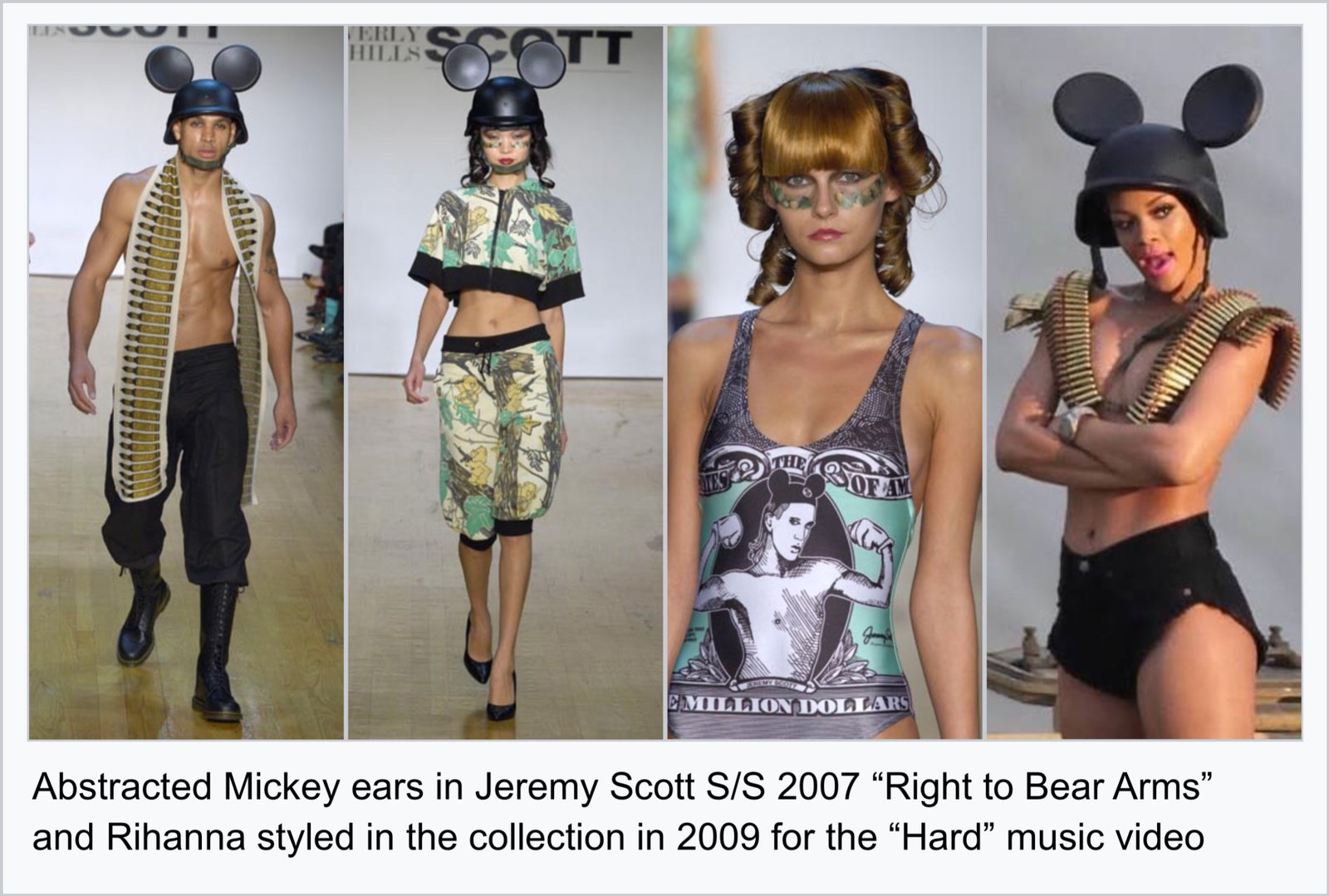
Arguably, the most iconic abstraction of the Mickey ears on the runway is Jeremy Scott’s S/S 2007 collection, “Right to Bear Arms,” which mutated Mickey iconography with militaristic symbols and garb like bandoliers (those cross-body bullet straps), ballistic helmets, and guns shooting out heart-shaped peace signs. In talking about the collection, Jeremy Scott said, “I think the use of iconography is powerful in conveying a clear message: visuals are more instant than words. An image of Mickey Mouse is understood in Mumbai, Timbuktu and Los Angeles in the same way. It’s a clear message even if you subvert it by, say, putting Mickey ears on an army helmet (as I did in 2007). People get it.” The collection is not just a testament to the potency and immediacy of Mickey’s iconography, but it is significant for how it helped set the precedent for abstracting that iconography and subverting it into an edgier, mutated aesthetic form that remains seductive today. Even now, one can post an image of Mickey Mouse with an AK-47 or mutated with some other semiotically-potent symbol like the Chanel logo or marijuana leaf and it would land with an Instagram audience. We witness these aesthetic mutations become archetypal forms in real time.
Snow White and the Tainted Princess
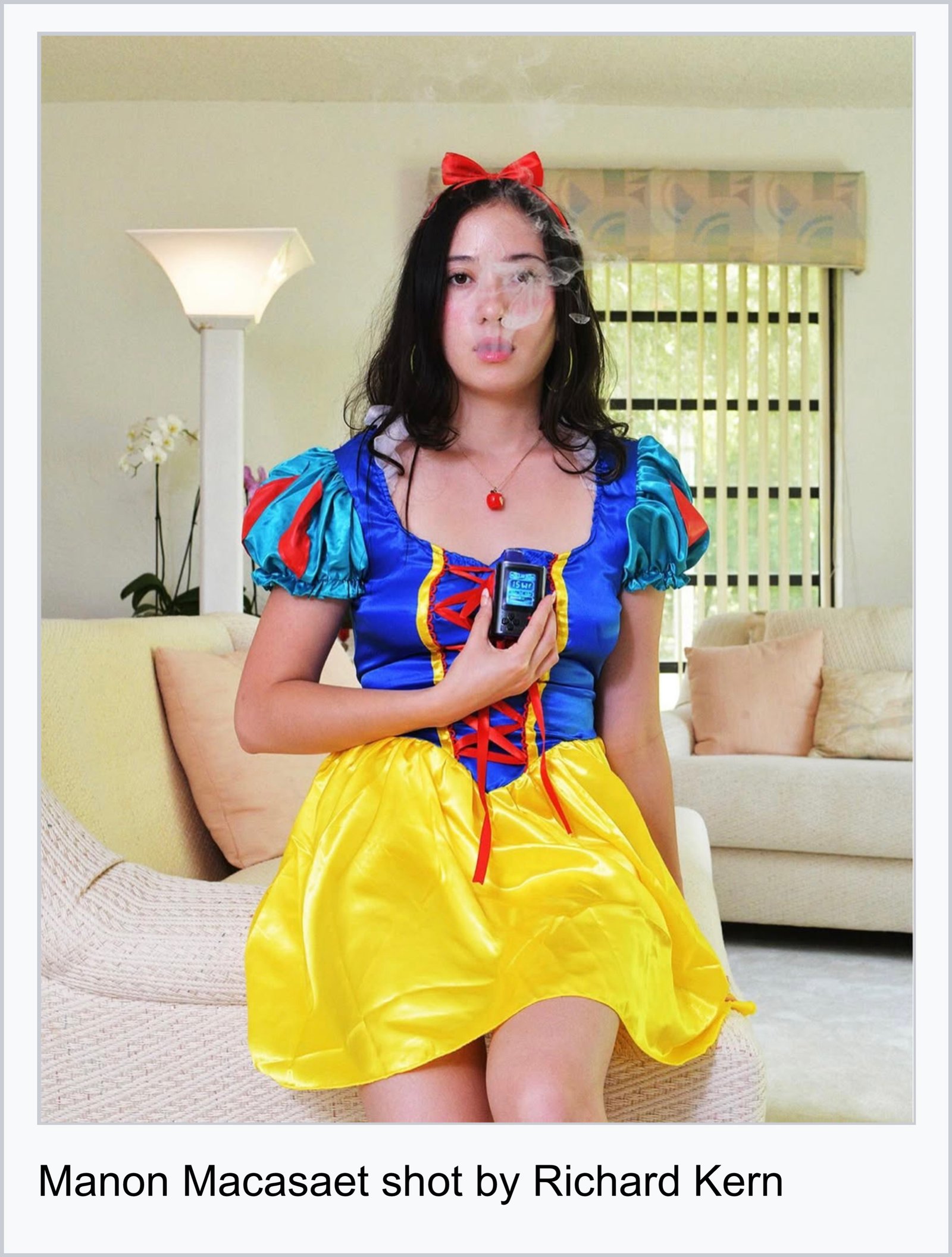
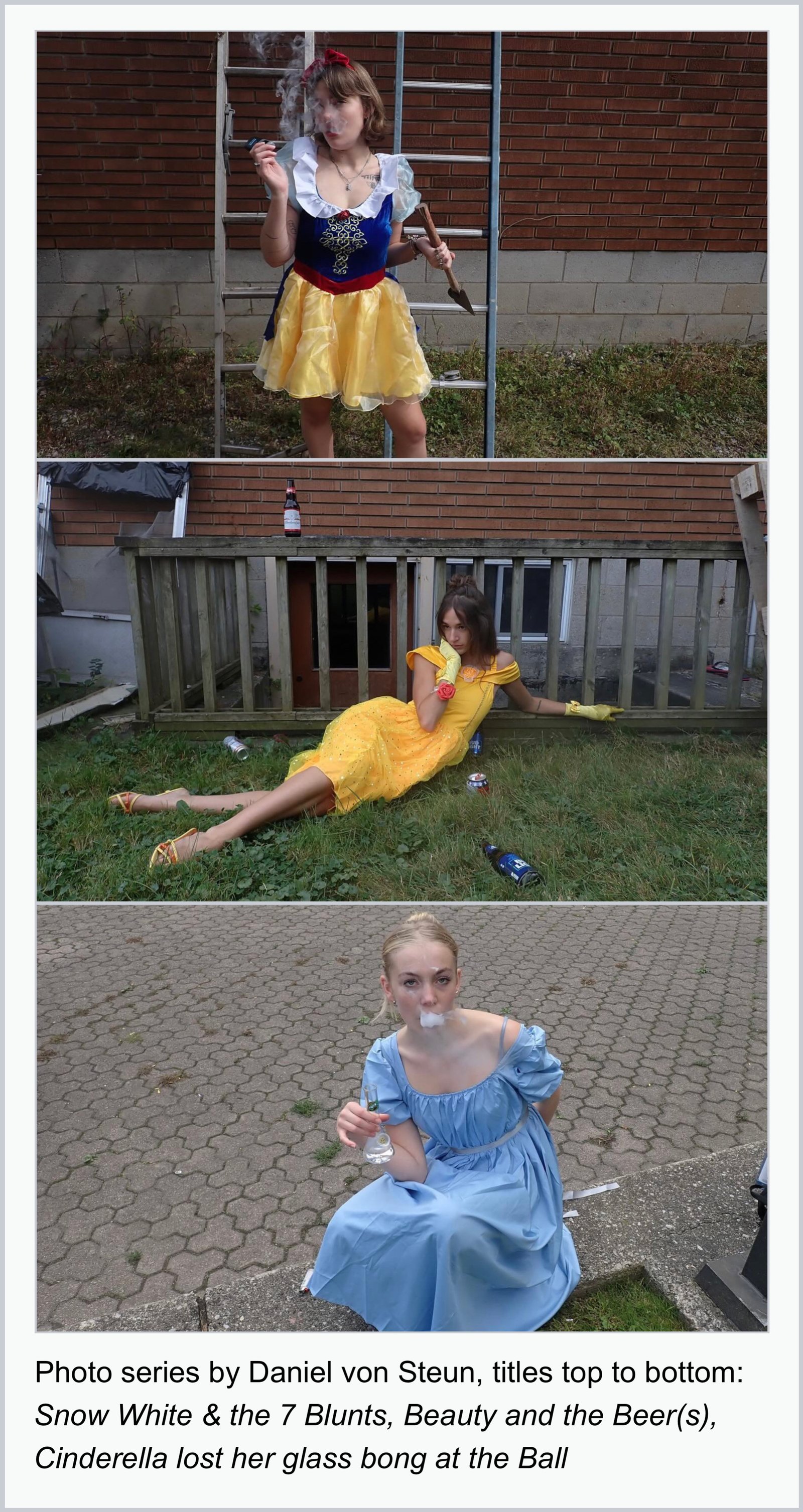
In late 2024, if your Instagram algorithm was in tune with mine, you may have seen these posts of Daniel von Steun’s photo series or Manon Macasaet in a Snow White costume shot by Richard Kern. Both Daniel and Manon’s images take Disney princesses – traditionally symbols of purity, grace and altruistic beauty – as subjects to corrupt. Snow White smoking a blunt, Belle sprawled out amidst a beer-littered post-frat-party-like scene, Cinderella who loses her glass bong instead of a glass slipper at the ball – there’s an undertone of rebellion, defiance, and sexuality. These images call into question what is and isn’t permissible when wearing a Disney costume. The simple act of wearing one as an adult to any of Disney’s theme parks is in fact strictly forbidden for reasons that you can probably imagine, but the most interesting one being for fear of disrupting the illusion and sanctity of the ‘real’ character.
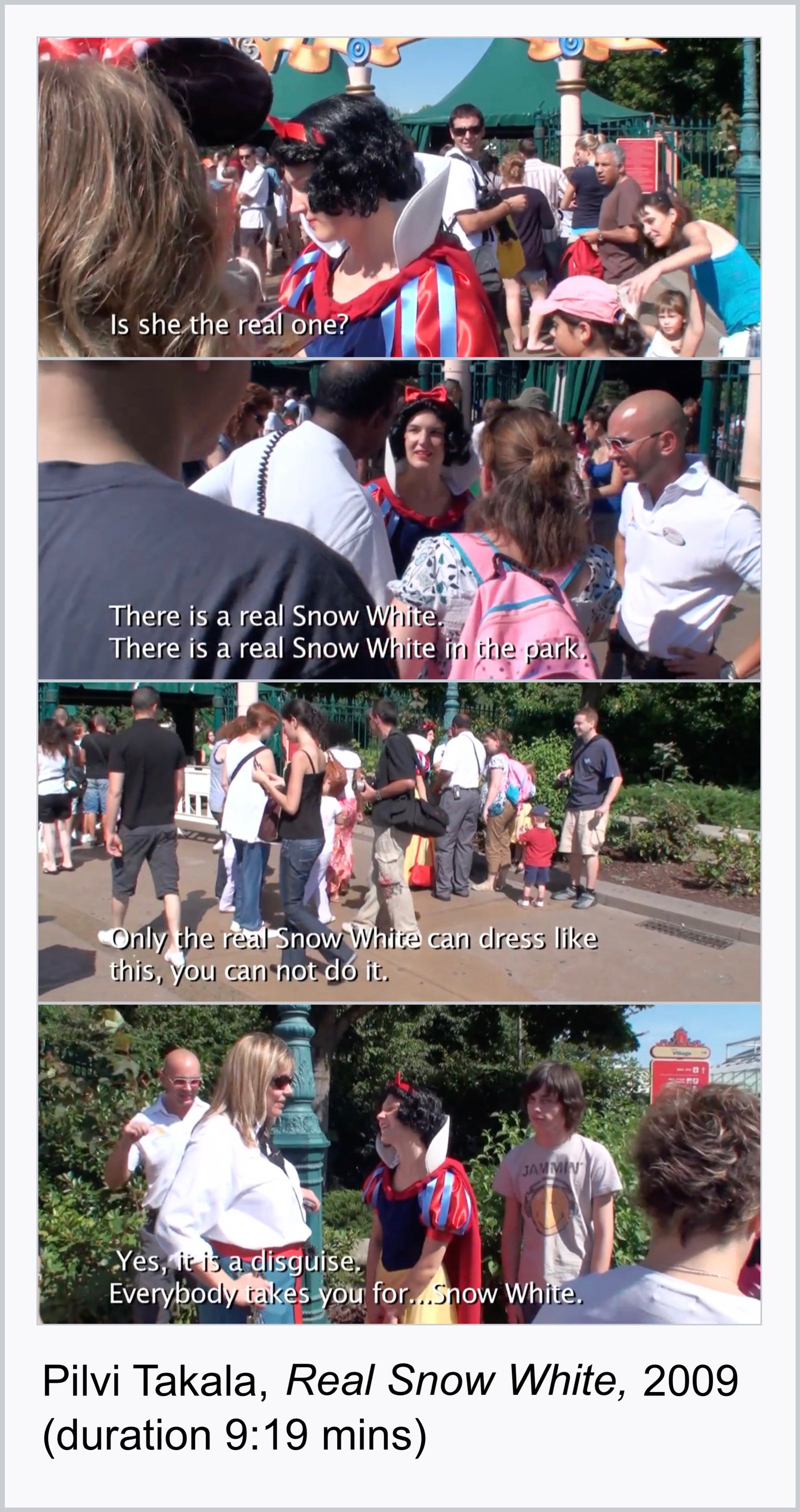
In the 2009 video art piece Real Snow White, Finnish performance artist Pilvi Takala wears a Snow White costume as she attempts to enter Disneyland Paris. Outside the ticketing gates, a crowd of parents and children form around Takala, asking for photographs and autographs. One parent asks, “Is she the real one? She’s so kind.” A guard then pulls Takala aside to explain that she isn’t allowed to enter the park because “it’s about the mix with the real… the real character working here…” More guards come to the scene to tell onlookers that “the real Snow White is inside the park.” Before being escorted to the restroom to change out of the costume, a guard adds that Takala can’t dress as Snow White because the real Snow White can not drink, smoke, or do “bad things.” The conditions of entry prevent the threat of perverting and corrupting the real Snow White, both in imagination and ‘existing’ physically within the park. The costume poses a threat to the realest fake that must eliminate anything realer or as real as it in order to be the most real. What the work best illuminates, however, is how the fantasy of the innocent Snow White doing something bad is so obviously real – realer than Snow White herself. The sartorial proliferation of Disney princess costumes within the Instagram Simulation seemingly leans into this titillation – between real and fake, moral and immoral.
Mickey as Surface Graphic and Jumping Symbol
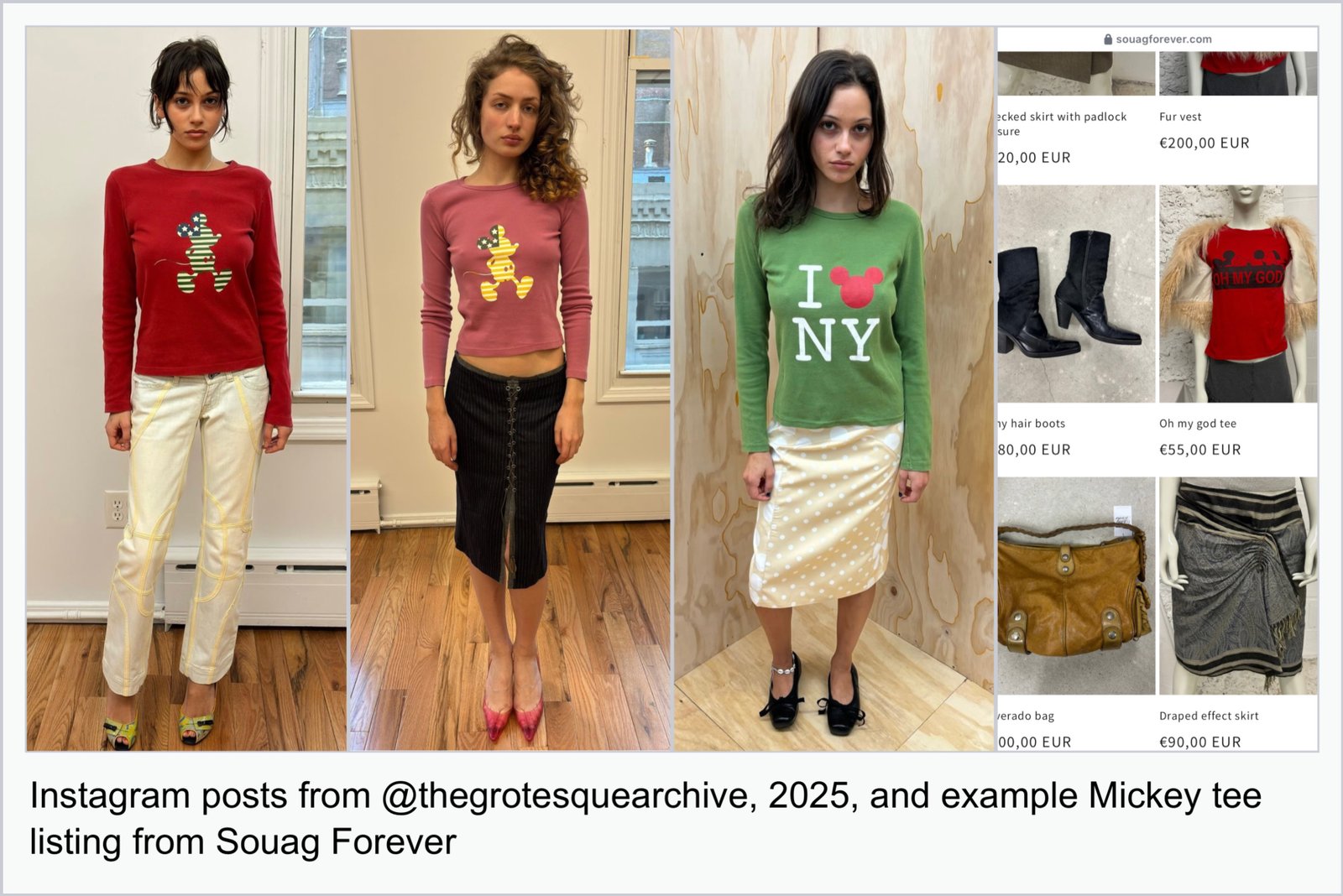
I remember the moment, circa 2025, when I began seeing popular independent stores like Desire Attire and The Grotesque Archive stocking shirts with Mickey graphics on them. Mickey and his little round ears felt like this symbol magically appearing on the surface of these clothes, and thus on the surface of these images, and therefore the surface of my Instagram Simulation in such a way that felt like residual animal tracks across a plain that I was to investigate as clues.
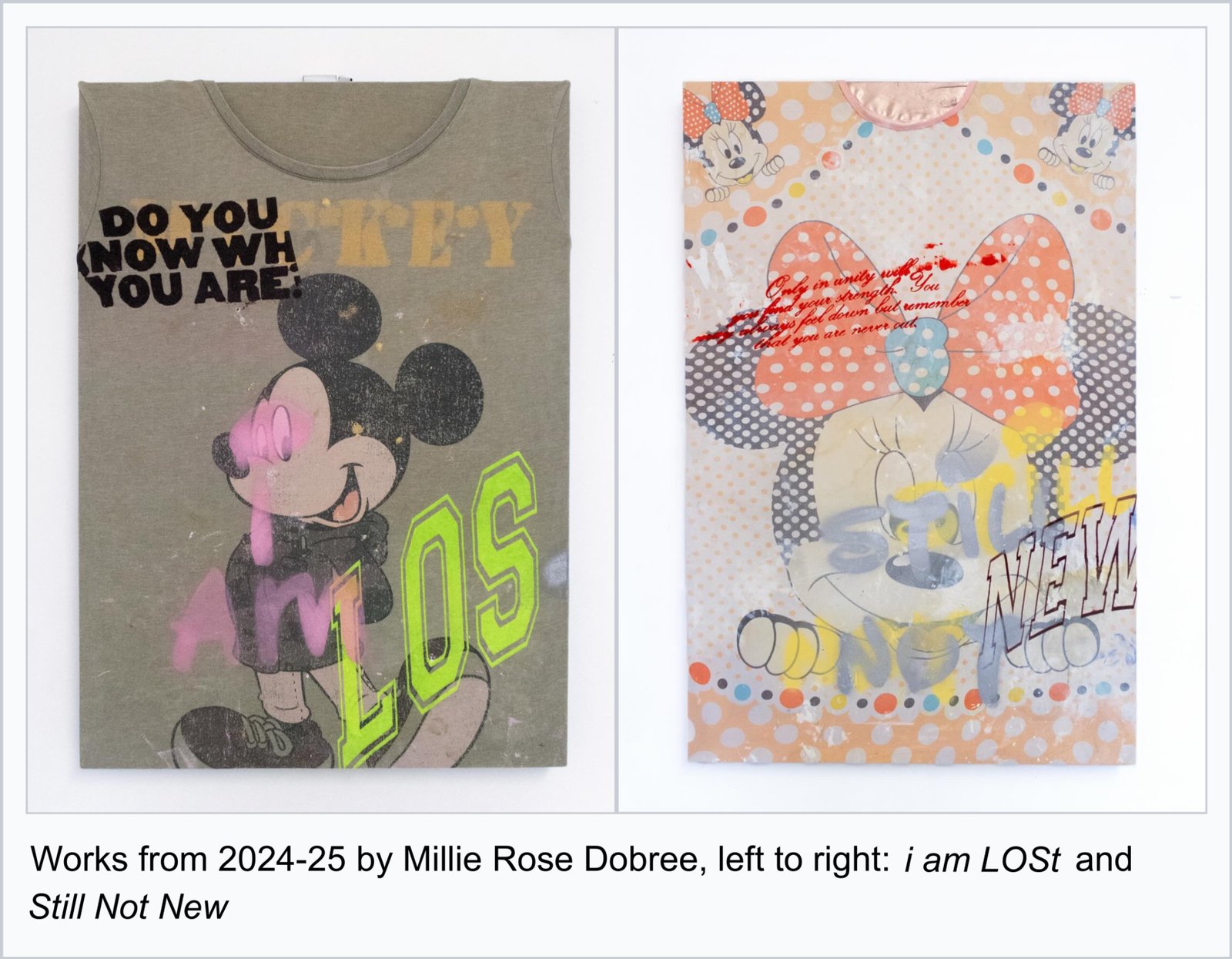
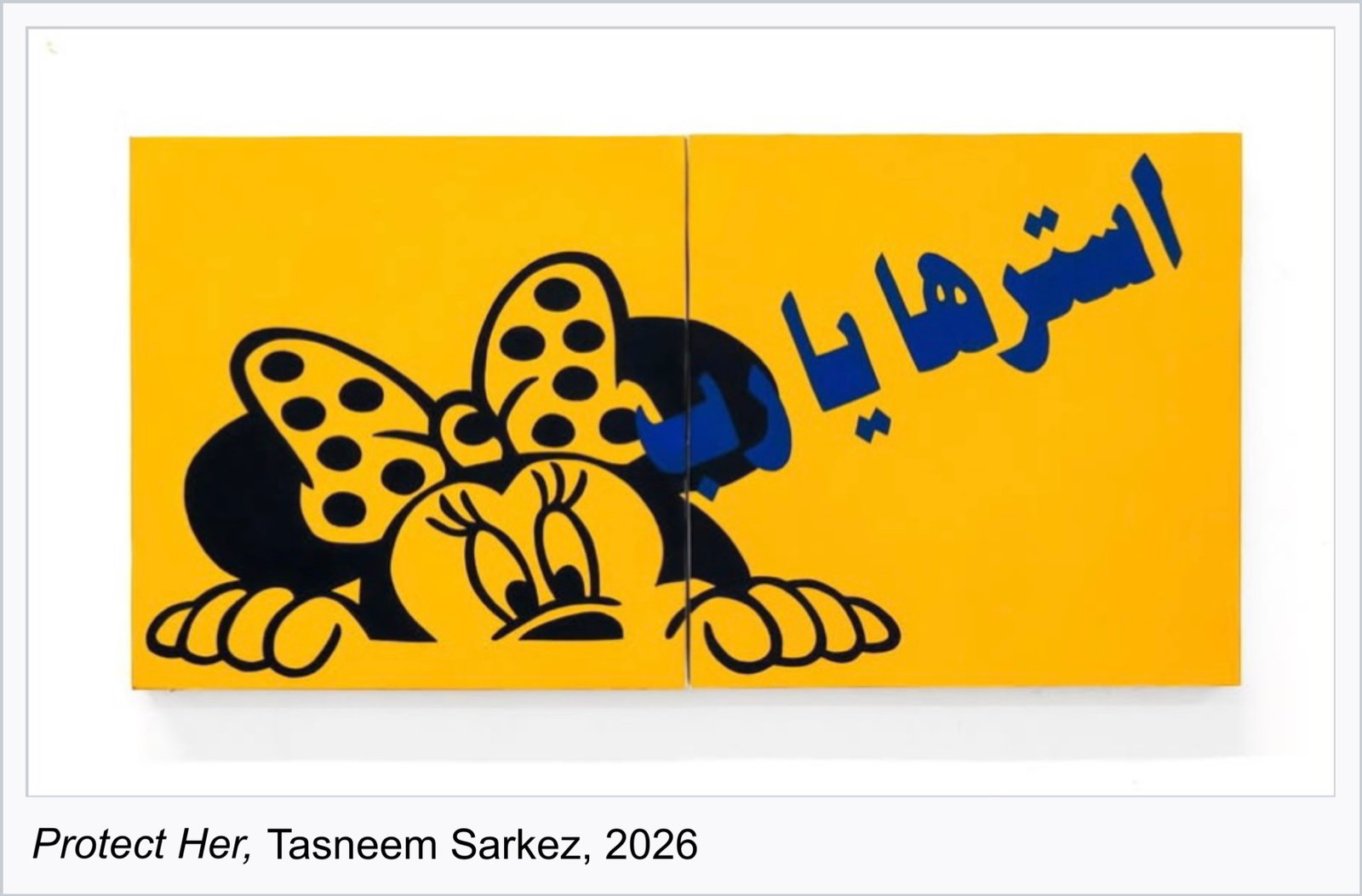
There truly is something magical about the way that a sign ‘jumps’ between material, surfacing and resurfacing out of seemingly nowhere onto vintage tees to contemporary artworks. Works like Millie Rose Dobree’s Still Not New and i am LOSt (both circa 2024-25), and Tasneem Sarkez’s Protect her (2026) pastiche Minnie and Mickey Mouse iconography on their surfaces, and disrupt the subjectivity of their characters. Dobree remixes Disney motifs as a means of remediating the objects that are “predetermined to us as happy,” while Sarkez takes and visually blends the Arabic phrase أسترها يا رب (“Protect her, O Lord”) with Minnie’s image to draw attention to the simultaneous ubiquity yet instability of these cultural registers and how their meanings are constantly recontextualised.
Growing up in Orange County, California, I was always surrounded by the spread of Disneyland’s tentacles that extend beyond its Anaheim city limits. What this materially looked like was Disney merchandise in almost every thrift store you go to, typically children’s clothes and Mickey graphic tees. In Anaheim or even Los Angeles, it’s really common to see, like, a Hispanic middle-aged woman wearing a Mickey tee as just part of her casual outfit. This distinction between Mickey-tee-as-fashion-item in a local fashion context vs. its 2024-2026 Instagram fashion context is a testament to the propensity of Mickey iconography to hold different meanings even when styled in identical ways.
This Era of Instagram Where Everyone’s in Minnie and Mickey Ear Headwear
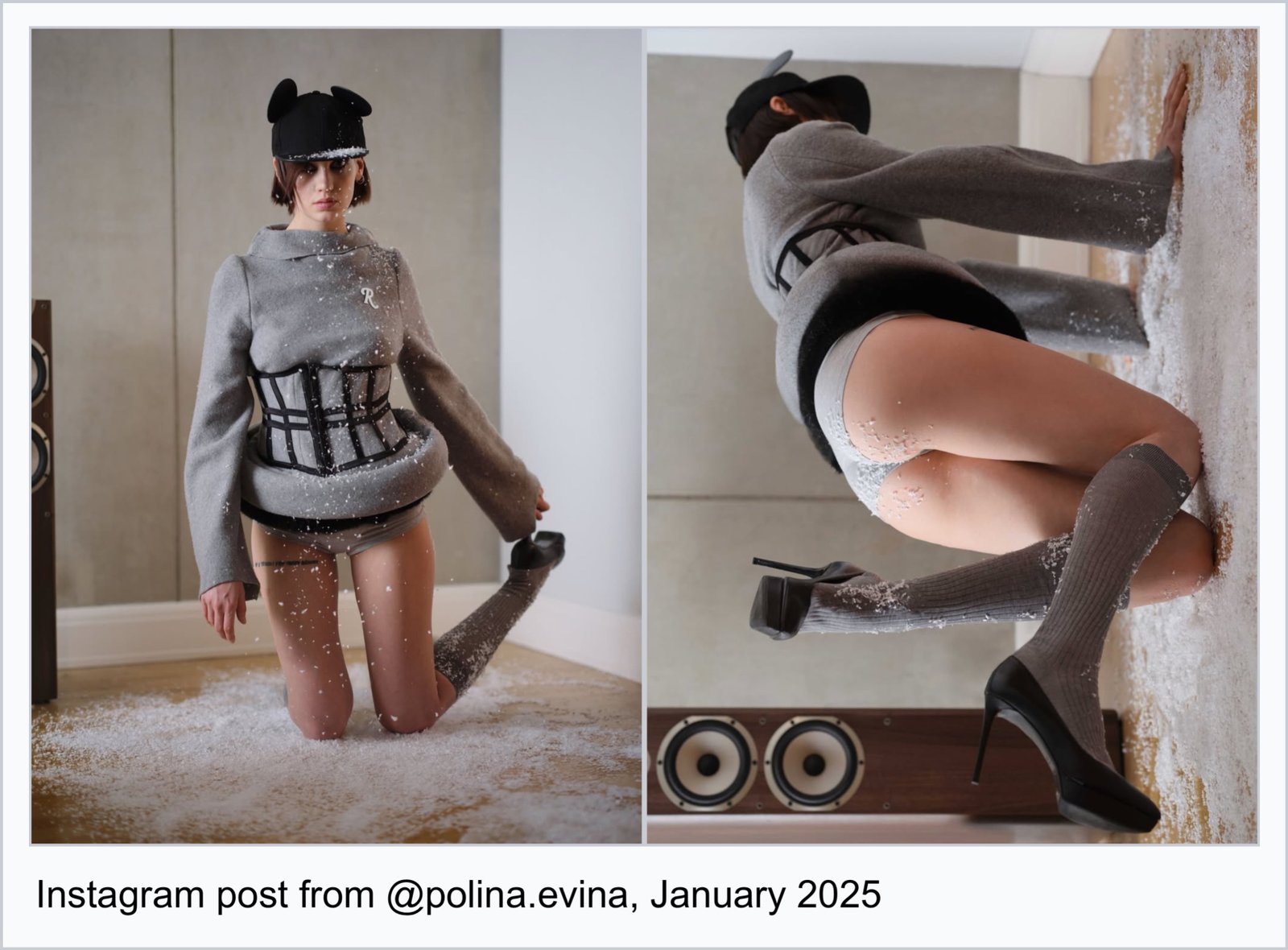
The aforementioned Instagram comment fatigued by Addison Rae in Minnie ears has most likely seen this post of hers from 2024, as I feel we all may have. Although she certainly wasn’t the first to do it, I will venture to say that there is something about how this specific image operated within the wider Instagram landscape that solidified and legitimised the Minnie ears as a legible styling object.
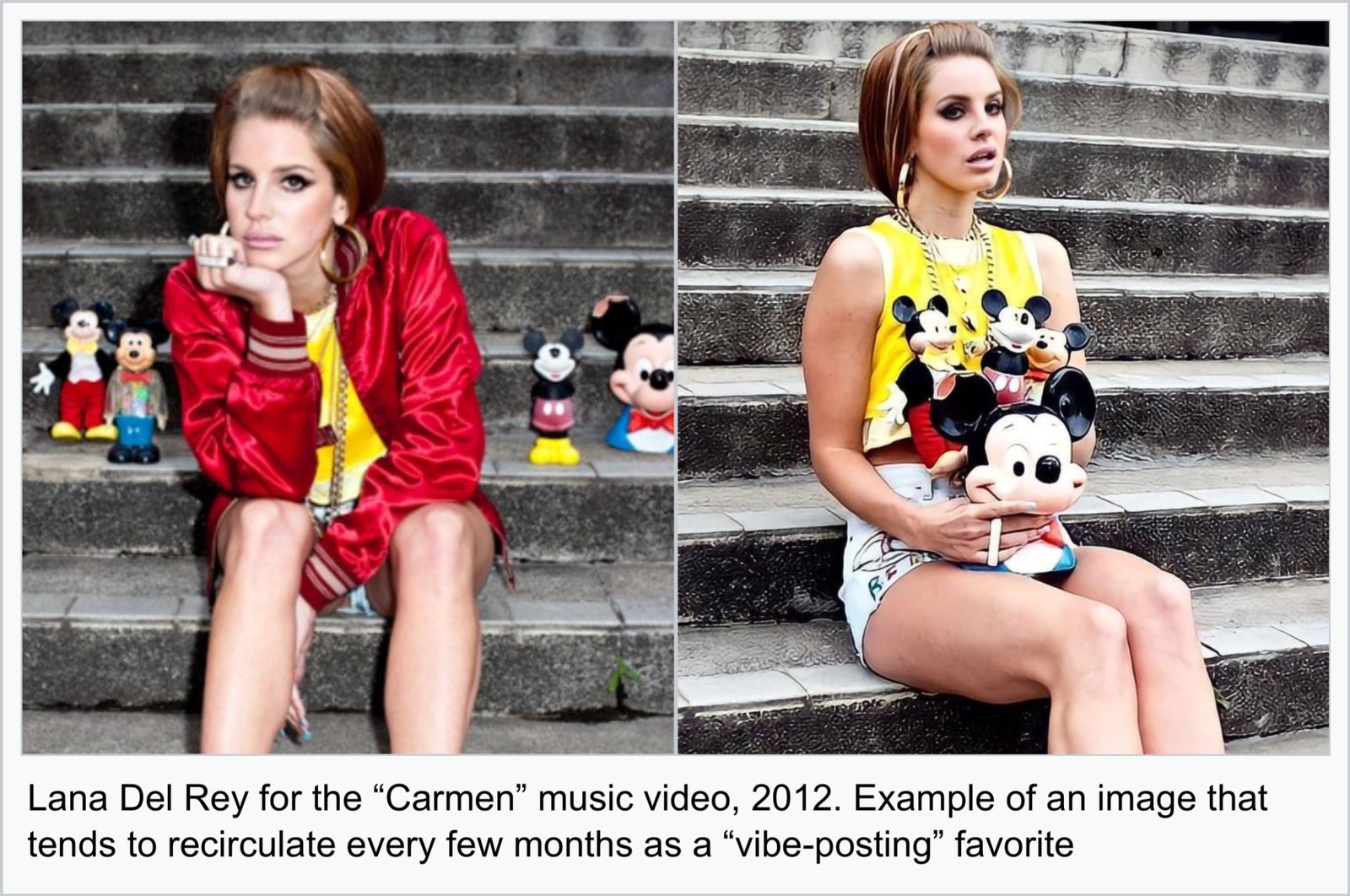
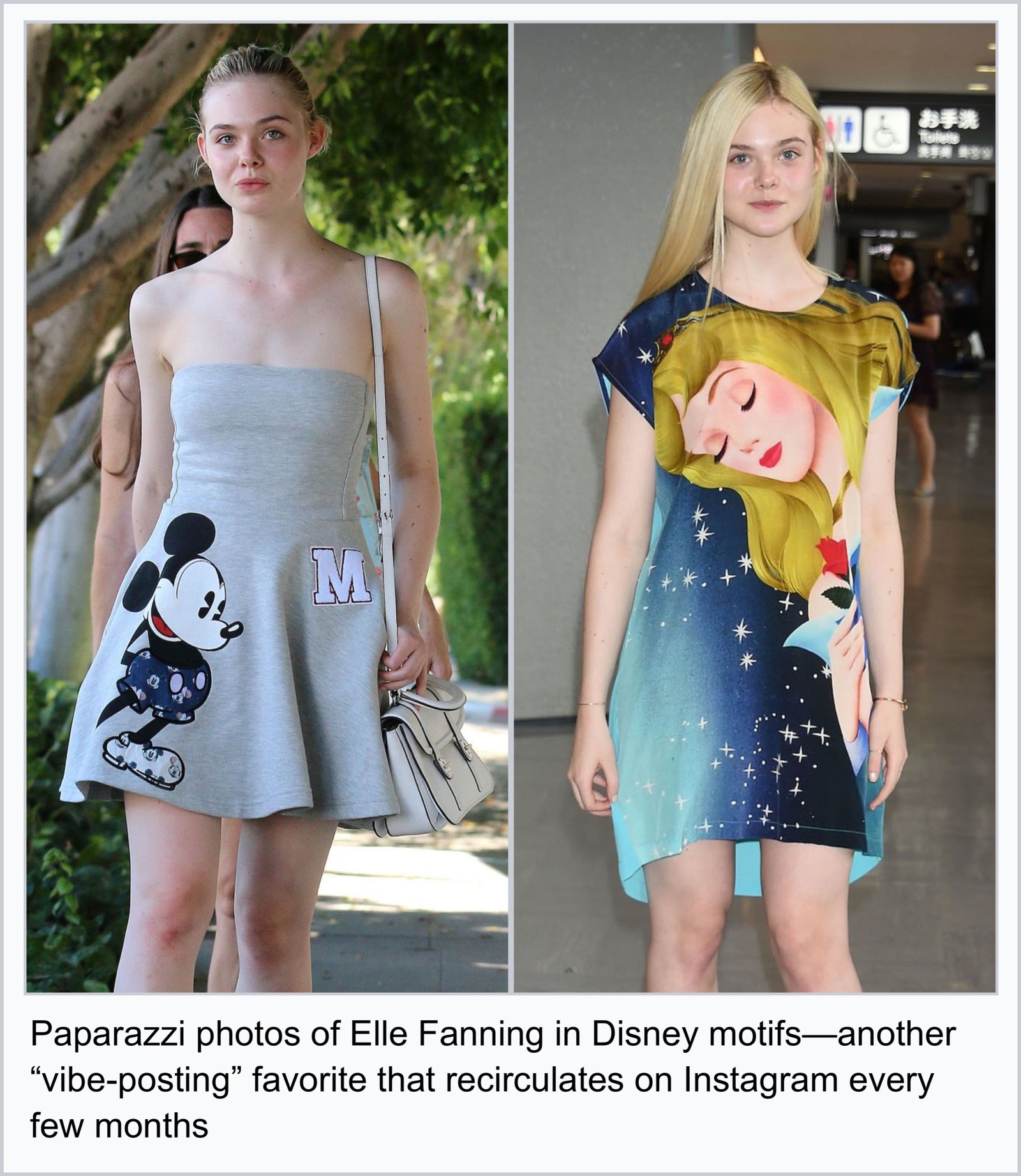
One of the ways a certain style or aesthetic (especially one that is more unconventional like this) is made permissible to a wider audience is through the power of celebrity. There are certain figures whose bodies or image can act as vessels for shifting the connotation of a particular style from weird, kitschy, lame or overly experimental to one that is cute, cool, cunty, campy, or desirable, and therefore emulatable. It’s figures like Lady Gaga, Lana Del Rey, Kate Moss (or even Mickey himself), for example, whose images often circulate within some aesthetic context (e.g. when posted by pages like @bathmat3000 or even certain ‘taste authorities’ like styling / creative directors). I feel this to be a part of the reason why we gravitate towards certain images as vibe-posting favorites like Lana’s Carmen MV outtakes or these paparazzi photos of Elle Fanning that seem to recirculate on my feed every few months. It’s less about these figures being tastemakers themselves and more about how their image functions as a taste-signalling and taste-shifting commodity.
To recirculate these images now (that nostalgically recall the 2010s era of Mickey fashion that ranged from edgy UNIF tees and being the go-to graphic top for millennial fashion bloggers to runway collections like Jean-Charles de Castelbajac's S/S 2012) becomes a way to cash in on its current revival. While I can’t speak for every so-called taste-authority’s motivation for circulating such images, I do think that this ability to be aesthetically literate and to display this image-acumen does lend oneself some form of cultural soft power. At the very least, it’s a means of signaling Yeah I see this Mickey thing happening rn too – that which this essay is admittedly the ultimate embodiment of.
It would be impossible here to cover every interesting aspect of the modern Mickey ear headband – the mind control conspiracy theories, the fervent collector culture, the customisation and knockoff economies, designer collaborations, and so on – though all imbue the ears with different meanings and connotations. In their intended function (their first-order meaning, or denotation as Roland Barthes puts it), the Mickey ear headbands are an essential accessory to wear at Disney’s theme parks. Normally, a souvenir is bought as an after-the-fact object, a token to take home to one’s everyday life to remember a particular moment or place. But the Mickey ear headband is unique as a souvenir that is not just bought after-the-fact but preemptively too, as an accessory to buy at the entrance to wear into the park. It is a peculiar souvenir that enables the ability to consume the memories before having formed them. Of all of Disney’s merchandise, the Mickey ear headbands are possibly the strongest cog in the Disney-as-nostalgia-producing-machine. Irrespective of any original function as souvenir, preemptive-memory-object, or fan accessory, the headbands in contemporary Instagram styling function most as nostalgia-perpetuating, taste-signalling costume.
The sartorial proliferation of Disney headwear in recent years evinces a widespread longing for the comfort and psychological sanctuary of the past. In Walt's Utopia: Disneyland and American Mythmaking (2015), cultural mythologist Priscilla Hobbs describes “rejuveniles” as adults who “do not desperately cling to childhood to the point of neurosis, but instead to balance the hardships and monotony of adult life with the playful happiness they remember from childhood. Adults who return to some aspect of their childhood are looking for more than a simple regression. They are hoping to rejuvenate meaning using the tools available.” While the post-2024 Disneyfication of styling isn’t necessarily a phenomenon born from some online army of rejuvenile adults, the point about “rejuvenating meaning” rings true.
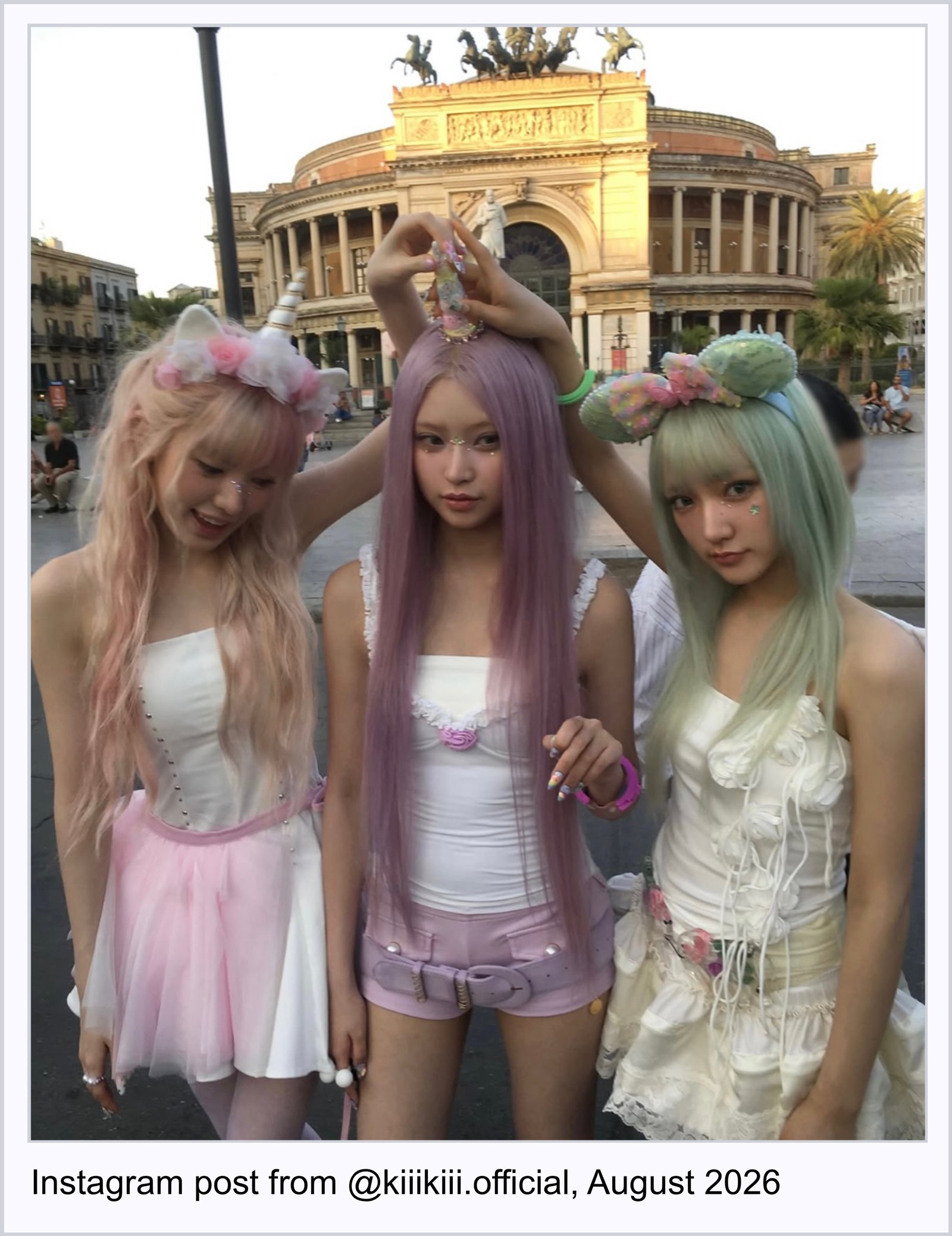
I don’t believe it to be coincidental that the Mickey-ears-as-casual-styling-accessory surfaced as a legible thing [I hate the word “trend”] in 2024 – a year characterised not just by economic stagnation and continued political unrest, but a year whose milieu felt like some post-woke, politically-fatigued rightward swing of the pendulum. All of this amidst the boom in tradwife content, the Labubu craze, Trump’s presidential election win, Brat Summer, Drake vs. Kendrick Lamar beef, and Dubai chocolate slop – a nauseating year of the Internet that felt like some kind of mass cultural psychosis. The gravitation towards a fantastical, absurd accessory makes sense to me within this surreal, blandly-extreme atmosphere. On a political level, I don’t see the Mickey headband as a direct reflection of some nostalgic longing for a ‘better’ America or state of the world (although this certainly is a part of it), but rather a reflection of a collective psyche that may have felt simultaneously manic yet jaded. Throughout 2025 and even now in 2026 (KiiiKiii just posted this pastel Mickey shoot and Cannelle is styled in them for her new Sunshine music video), it doesn’t feel like a surprise to see a new post almost every week implementing Disney motifs in some manner. Its proliferation within the Instagram Simulation is a testament to a shared image reality that speaks to and from this cultural unconscious.
Mickey I’ve Got Your Gloves… And Your Head
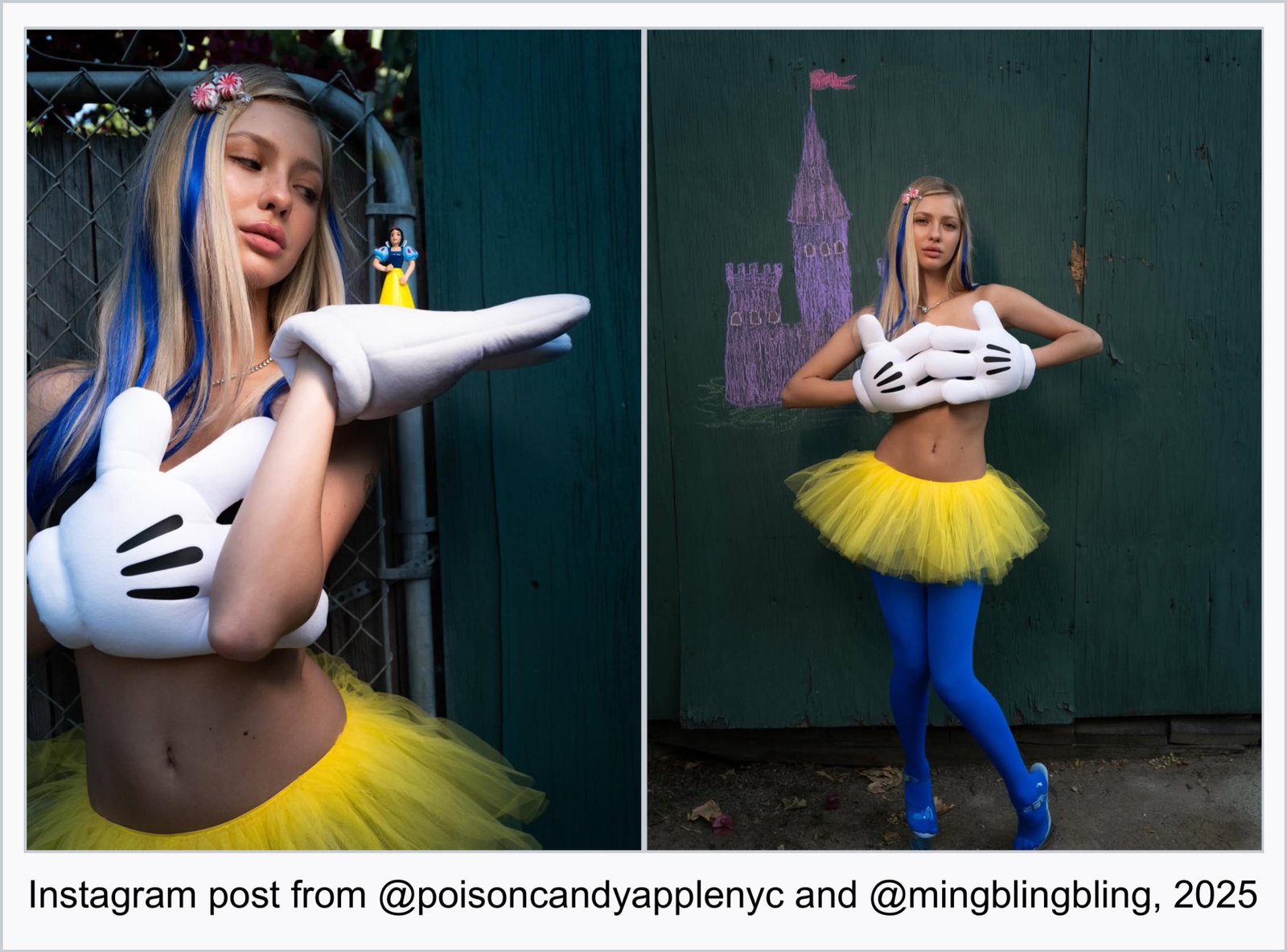
In June 2025, Poison Candy Apple (Manon Macasaet’s brand) posted images of Beanie Boylston styled in the gloves, a yellow tutu, royal blue tights, and peppermint candy hair clips as she holds a miniature figurine of Snow White in her gloved Mickey hands. The outfit’s colorblocking with Snow White’s signature royal blue and yellow is reminiscent of the Disneybounding subculture, in which adults, unable to wear ‘realistic’ costumes to Disney’s theme parks, wear some kind of vague abstraction of the character’s look. Disneybounding adults (who certainly fall into the category of the aforementioned rejuvenile) are often bullied on TikTok by Zoomers and Gen Alpha teens who think it’s cringy and embarrassing, so let me be the first Gen Z-er to come out and say that I think it’s actually really cool and endearing. I am also intrigued by the other photo in the carousel that has Boylston standing in front of a castle drawn in chalk, posed with one gloved hand with the middle finger up and the other atop her chest as if the gloves were a bandeau bra. The middle finger subverts Mickey’s innocence - but perhaps more fascinating is how the gloves visually operate like a bra and how this pose is its own semiotic form.
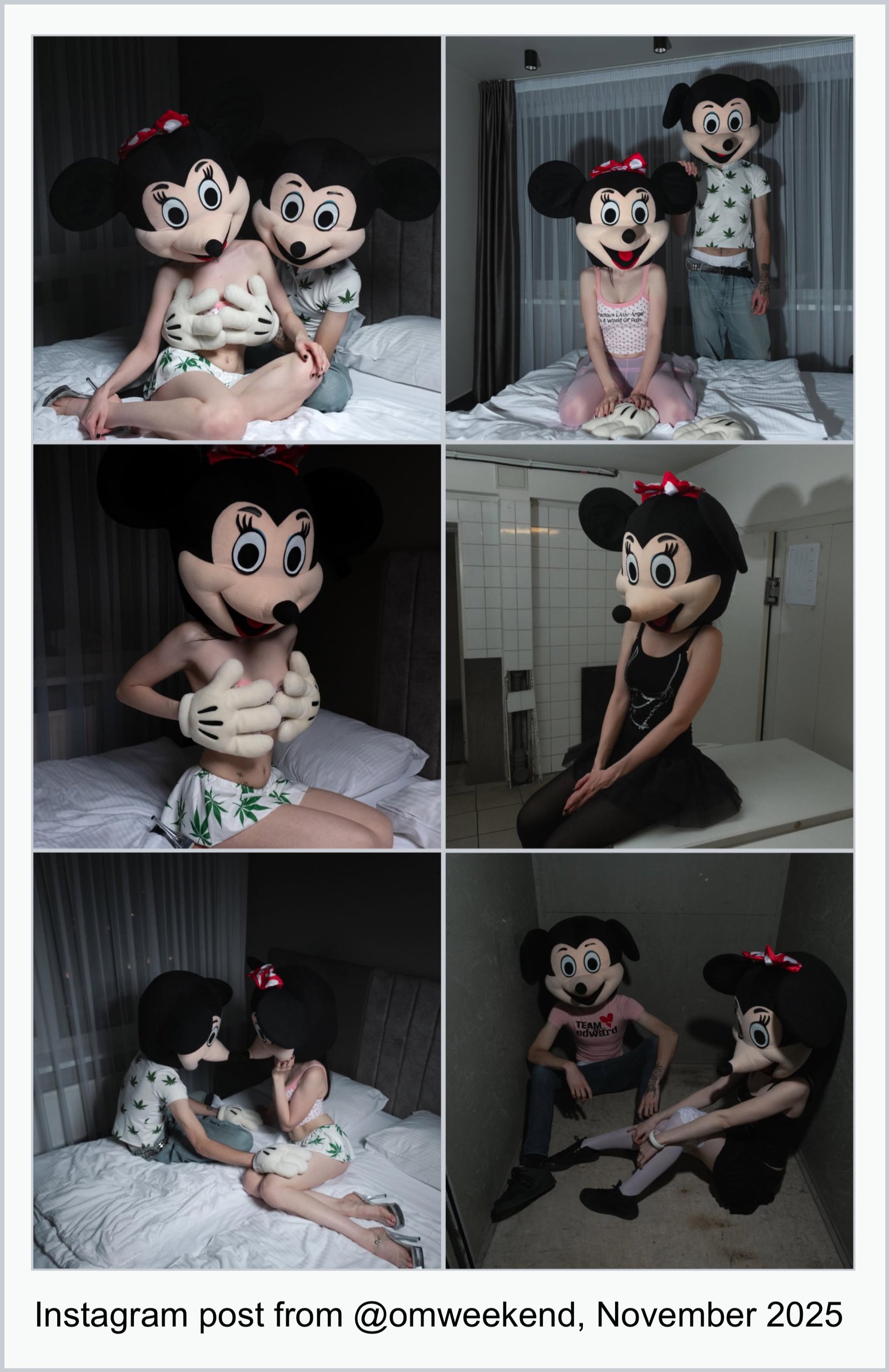
In November 2025, @omweekend posted an intimate Mickey and Minnie Mouse bedroom shoot to promote OMIGHTY’s new pieces. The models wore enlarged costume heads of Mickey and Minnie’s faces, their smiling expressions ominous and creepypasta-ish. ‘Mickey’ reaches from behind ‘Minnie’ to lay his globular, white hands over her chest. Later in the carousel, Minnie sits in a kneeling position with her gloved hands over her pink top that is barely peaking through, rendering the gloves almost into a bra. The pink OMIGHTY top underneath reads “Precious Little Angel In A World Of Pain.” Again, these images are effective because of the underlying, seductive transgression they exude and the edgy perversion of Disney characters. It is this affective quality that can solidify a pose (Mickey’s gloved hands posed over a female chest) into its own aesthetic form that is then further emulated by others.
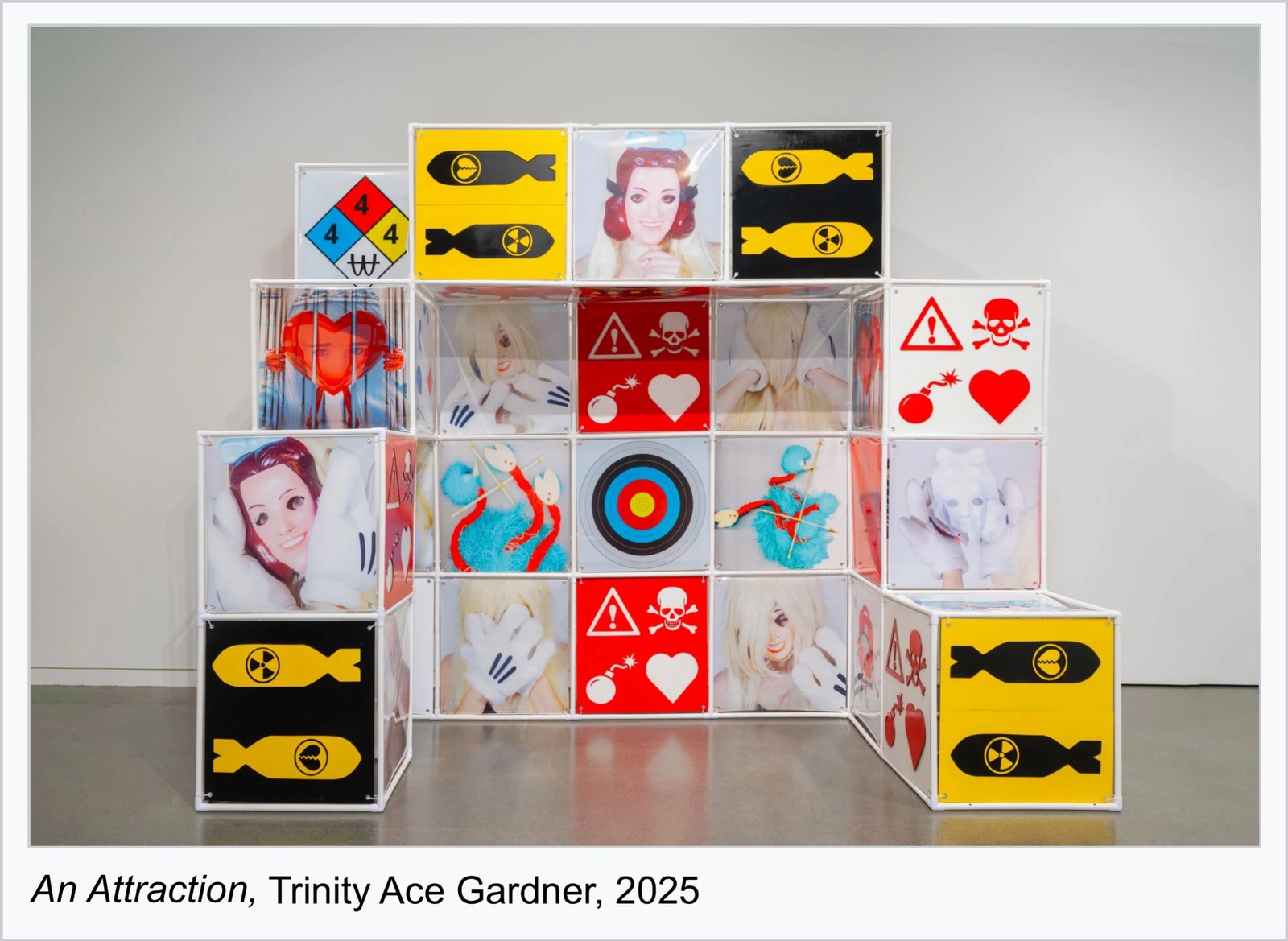
When I think about the gloves, I’m always reminded of musician and artist Trinity Ace Gardner’s work, whether it be her @dieselsugar Instagram page or image / sculpture works like Lamb (2024) or An Attraction (2025; exhibited in CAMPUS’s recent show “Terror Campaign”). I asked her about her hashtag #MickeyLifestyle, and while she says that it’s somewhat unserious as a joke, I think that its satirical nature makes #MickeyLifestyle – as a hashtag, caption, personal mantra, performance concept and phenomenon – potent.
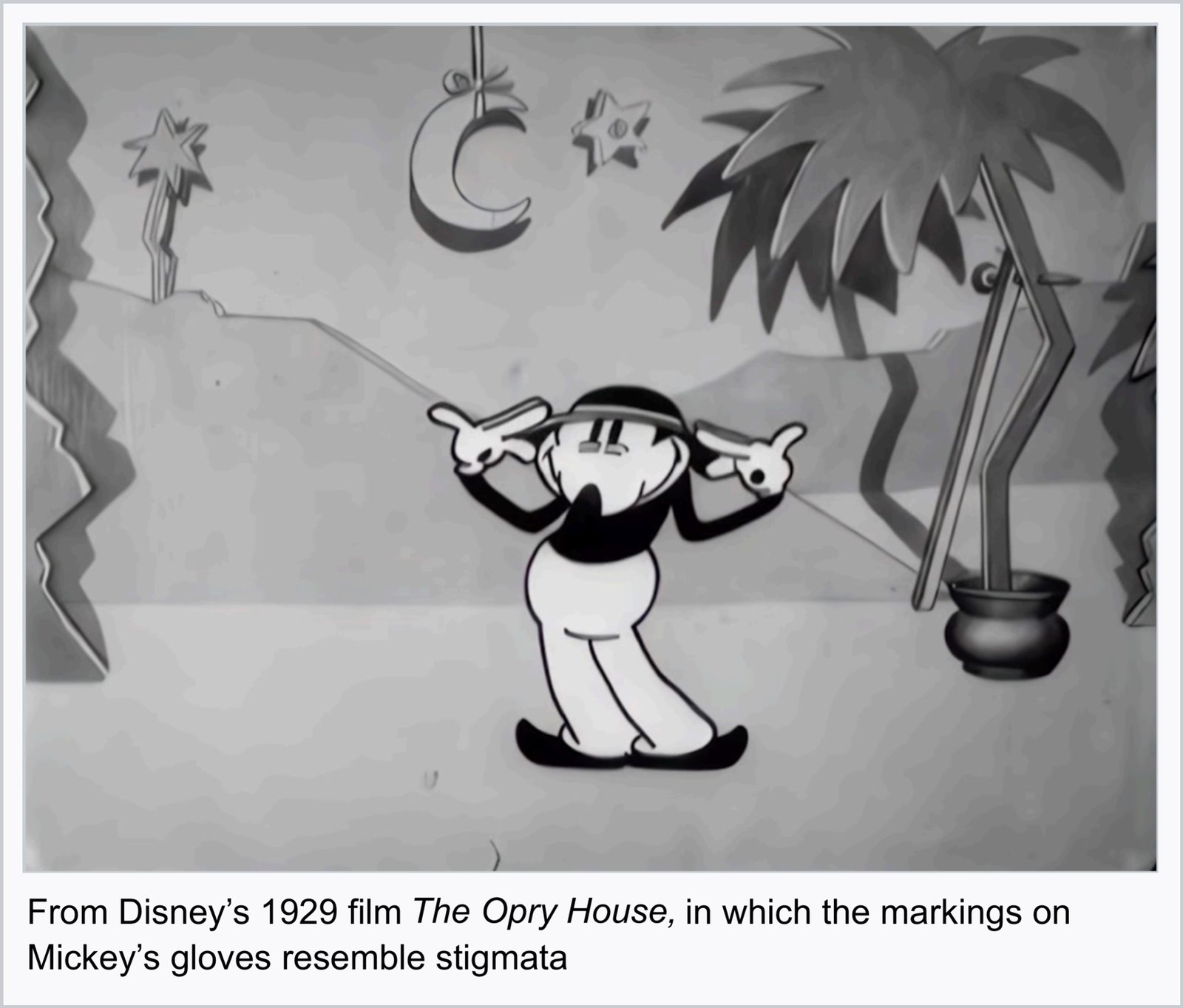
For Gardner, #MickeyLifestyle is about “living while embracing the sacrifice of performance, knowing that once you become an image, you no longer completely belong to yourself, and reveling in the beauty of that.” Mickey is one of the most proliferated icons, endlessly reproduced and projected onto, “in the same way that Christ takes on the burden of humanity… Mickey is the Jesus of America.” In using the gloves in her work, Gardner points to a particularly fascinating aspect of its origins in Disney’s 1929 film The Opry House. At the start, none of the characters are wearing the gloves but upon arrival at the Opry House, Mickey appears on stage with the gloves for the performance as he dances in contorted, bizarre ways under a hypnotic spell. At the end, Mickey awakens from the spell, immediately ashamed at the awareness of his performance, shrinking into himself with his gloved hands over his face. Gardner specifies this moment that we see large, black holes at the palms of Mickey’s gloved hands as significant for how the markings resemble stigmata – the crucifixion wounds of Jesus Christ.
After the Opry House performance, Mickey’s gloves never come off – his performance continuing into perpetuity. The psychological gravitation towards the gloves, heads, and princess costumes in contemporary styling and art are perhaps indicative of a performance fatigue we feel from the constant demands to be online and to perform a self. But it also infers a fatigue from performative wokeness and the hypervisibility of geopolitics (and the subsequent digital activism it demands): Gardner mentions our gravitation to Disney symbols as possibly being “a symptom of the prolonged exposure to the disaffected, nonchalant, irony-ridden affect dominating cultural landscapes online for the past several years. It emerged perhaps as a defensive reaction from a post-pandemic shame, in the wake of our mass cries of care and political engagement going unheard, and an oversaturation of lengthy captions from unqualified sources. Suddenly Paris Hilton, Cheez-It, and your high school bully were all weighing in on the atrocities, signaling their disavowal of the violence committed by the police during BLM. Few were left unscathed by the pressure to publicly signal their wokeness and immense care for the cause out of fear of being perceived as complacent and therefore complicit in the systemic political and racial violence taking place. While many were well-intentioned, many of these cries read as performative in retrospect. Millions who posted the Black Square will take that shit to the grave.”
On our way to the Terror Campaign closing reception, Trinity and I were in my car talking about what it feels like to sniff things out early and for them to become true (exactly as we thought), and the kinds of frustration-like feelings that may come if we feel we didn’t actualize that pseudo-clairvoyance in time, or early enough. We were individually thinking about (and even making work about) things like mint green and Mickey motifs in 2024, and to see them fully fledged in 2026 has this peculiar way of creating these insufferable feelings around publicly caching and actualizing one’s aesthetic literacy or cultural acumen ‘early’. But beyond staking some position as a taste-authority or aesthetically-attuned clairvoyant (neither of us think of ourselves as The Authority anyways and would probably identify more as merely acute observers), I think it’s important to recognise these internal frictions that come with being online—especially within these fashion, music, and art -inclined spheres where aesthetic acumen can lend one power in some way.
The Final Stop of our Ride… Closing Remarks…
While the impetus for writing this essay certainly stems from some self-indulgent motive to make known to the world that I Saw This From Miles Away, the biggest motivation was to write a response to the Dazed article “Was 2025 the year we embraced ‘whimsy’?” The proliferation of Disney motifs in Internet culture is certainly an embrace of whimsy, its softness, hopefulness, and playfulness, and that article associates the trap of nostalgic aestheticism with “whimsy capitalism.” However, we can go beyond mere whimsy. 2025 was the year that the state of our surreal world began to make itself known to us. The Disneyfication of styling can be read as a manifestation of our cultural psyche – one whose delirious, overexposed, hyperconscious, fatigued and jaded unconscious is soothed by the fantastical and the familiar. It is a system of signs at work, materialising themselves in our shared image reality as the residue of our disorienting contemporary life. To look at these images is an attempt to decipher and begin to grasp what it means to observe the surreal milieu of the 21st Century—to feel as if you must be dreaming… Or simply living in Disneyland…
"I CAN TELL BY YOUR SOUND THAT YOU DO IT BECAUSE IT'S IN RIGHT NOW"
"300SkullsAndCounting doesn't care for analysis of his music. HSR are the hipsters he wants to dismember. But we like that! Idk how Jenny Sparks, bassline curator, feels about it. Taylor Richardson played his harlem spartans bassline remix at our party last Friday- cue the crowd going wild. Hollywood Superstar is recognising that there is a tendency of screamo to be the sound glue that brings the new together? Teo our music reporter, comments on the nature of generational tastes and the 'buy low, sell high' approach to culture...
“if you scream loud enough... the culture might drift towards you.”
300SkullsAndCounting and Jenny Sparks want to incinerate London venues and assault hipster sensibilities. It seems that the only thing they revile more than trendy music is boring music- that is if the two aren’t synonymous. And not being trendy, or worse, boring is a game that they are particularly good at; their gambit being a carnivalesque genre collision that is the exact intersection of the 300skulls' chip-tune screamer and Jenny Spark's bassline curator’s solo work and taste.
Perhaps what marks London’s current underground as the epicentre of new musical output is that its most eminent contributors share an ethos rather than an underlying sound; namely, the consensus that as an artist, you ought to give yourself total and utter permission to do whatever you want, no matter how outdated or uncool- bassline, screamo etc…The idea that anyone would even try to replicate this sound is hilarious, but not so unlikely at a time when x publication can say something about laptop twee and all of a sudden everyone is making music that sounds like belle and sebastian processed through a calculator. So 300 screams the sheep away; “kill you in the bace” narrates an altercation with kids at Ormside, “I can tеll by your sound that you do it 'cause it's in right now” sounds like a cry from the weird kids at school trying to scare away the popular kids. And “You can tell that I do it 'cause I'm out of touch” assumes a new meaning considering the duet's newfound virality. On paper, they’re bitingly out of step with today’s easily reiteratable, monocultural, musical fads; but 300 and Jenny suggest that if you scream loud enough, persevere, and dare to stick to your emo-and-bassline-loving guns well enough, the culture might drift towards you.
Both bassline and screamo originated as countercultures led by teens who didn’t have much else; kids who sought to turn the barest of sounds into sounding outrageous- pantomime-esque, artificial caricatures of EDM and hardcore respectively; and so the combination is doubly outrageous. The two sounds are antagonistic throughout, but what threads them together is 300 and Jenny’s seeming brotherhood. A bit like their ex’s, the femcels, the new album is packed with teases into their studio and real-life antics; 2 of the tracks being phone calls, placing ribeye orders, and the artists giving live comments on the music throughout. You can imitate chord progressions but you can’t imitate the zany synergy of the split-brain these two seem to share. Accidents and inside jokes are it; beyond anything, they’re making music for themselves, which is probably why everyone loves it.
“Use a fucking cymbal; to decapitate a hipster” is a gorey image that sums things up pretty well; splitting ears as much as emotion, 300SkullsAndCounting and Jenny Sparks’ music feels like an emblem of the unconformity and audacity that is required of artists to make music in London.
Artist Take
/ 11 October 2026 / By: Sydney Sweeney
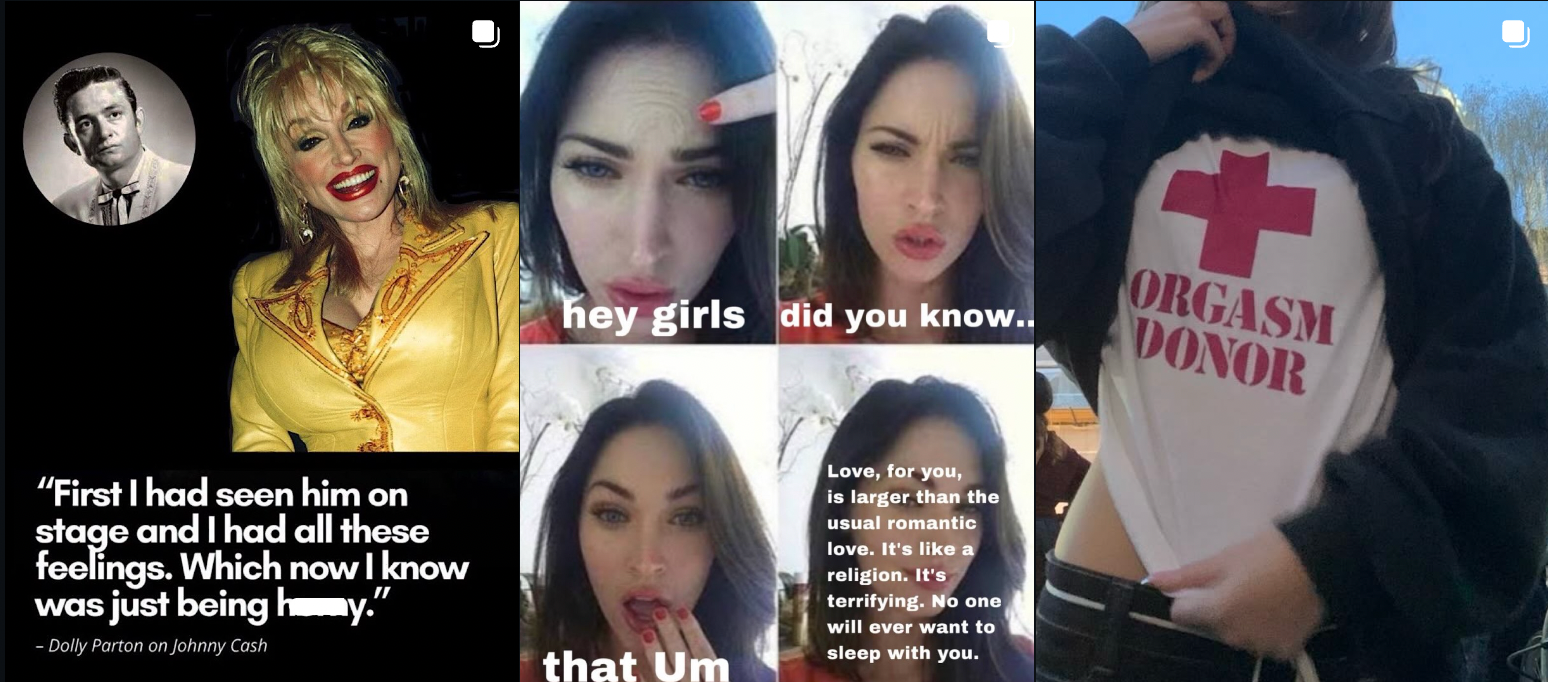
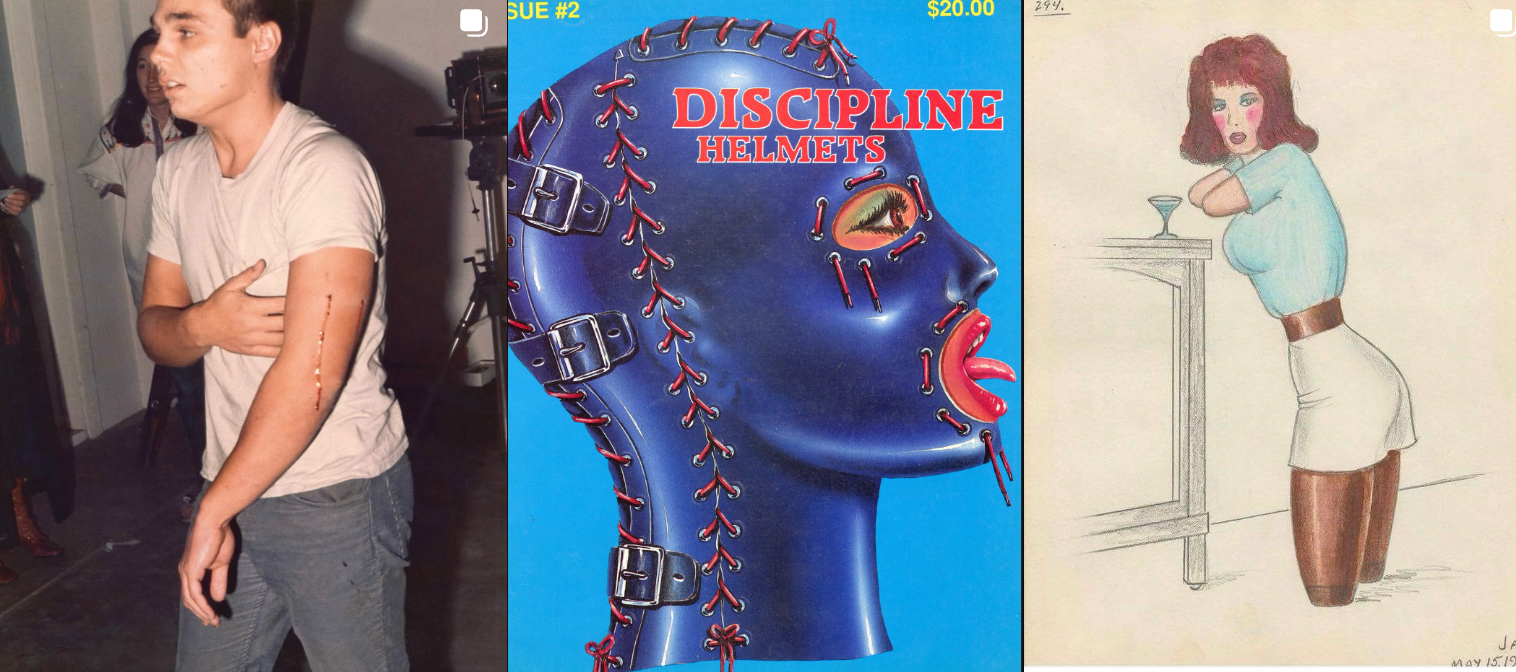
T.Archivist is an instagram page that epitomises what we here in HOLLYWOOD call "The heydey of the instagram archival impulse".
Following on from our piece with @BATHMAT3000 Hollywood is attempting to understand the affect of estoteric knowledge and book collecting upon the now-all-powerful-algorithimically-dictated explore page.
T.archivist also runs Pinakotheca shop - where they sell actual rare books, some of which form the content for the page itself.
As seen in Artforum's lifting of articles from its archive to post to its instagram, the fetishisation of the past is very **en vogue: an archive page will post an image of Klee's "angel of history" next to a batch of post-war japanese erotic illustration.
If you're cult event/erotic book/ political assasination/far left leaning exhibition isnt chronicled in a series of slides, did it even occur?
In 2050 your children will run an archive page that places images of Luigi Mangione leaving court alongside photographs of Mazzy Joya by Richard Kern.
Is the archive a response to loneliness? Is the archive a house of ghosts?
The whole of the internet is a house of ghosts. When you die on the internet, you die on repeat for eternity everytime you death is shared again.
Is life what you expected when you were a kid?
I didn’t really have many expectations for the future as a child, but I would say I never would have came up with what I do now, or the people I have met, or the places I have been.
What do you think about storing stuff on the cloud?
I don’t have an issue with storing things on the cloud, I will say it isn’t very safe or reliable but for stuff like 100s of gigabytes of high res scans, it can be pretty useful.
What is ur relationship to your schizophrenic device?
Conspiracy theory/ cultural event you would want dramatised.
https://gideonkeys.wikidot.com/
While this doesn’t exactly fit the confines of conspiracy theory, The Gideon Keys is probably my favorite thought experiment/ work of internet fiction. What if every major city in the world had a bunch of magical phenomena that you could interact with or witness? What if a certain record under a shelf at an antique store would give you a live feed of someone's thoughts when you play it. As long as you put it back when you are done, nothing bad will happen to you. Or what if every blood transfusion done in your county comes from the same donor? The donor being an endlessly bleeding headless corpse that has been held by the district hospital in a secret room since the 1870s. Much of this phenomenon is localized and presents itself through regional institutions, unique to your area.
Is there anything that separates erotica and pornography?
Erotica is made with artistic intent in mind, whereas pornography can only have art as an afterthought. Porn must be explicit; erotica is suggestive. Pornography is seldom ‘tasteful,’ but erotica relies on taste, and is typically presented as a cultural work, fashion, literature, or, again, art itself.
Favourite books on your erotica section of your website?
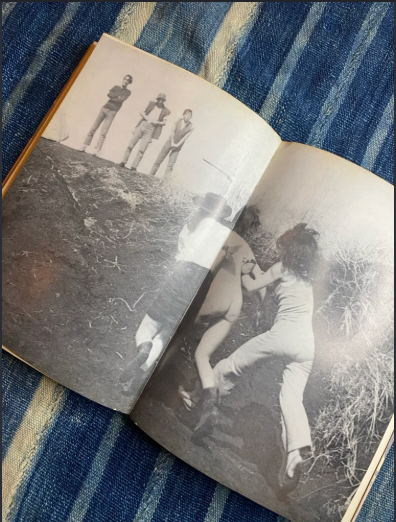
Koji Wakamatsu- Pink Film Collection: My Eros Feast, 1970. A collection of stills by the highly acclaimed Japanese director.
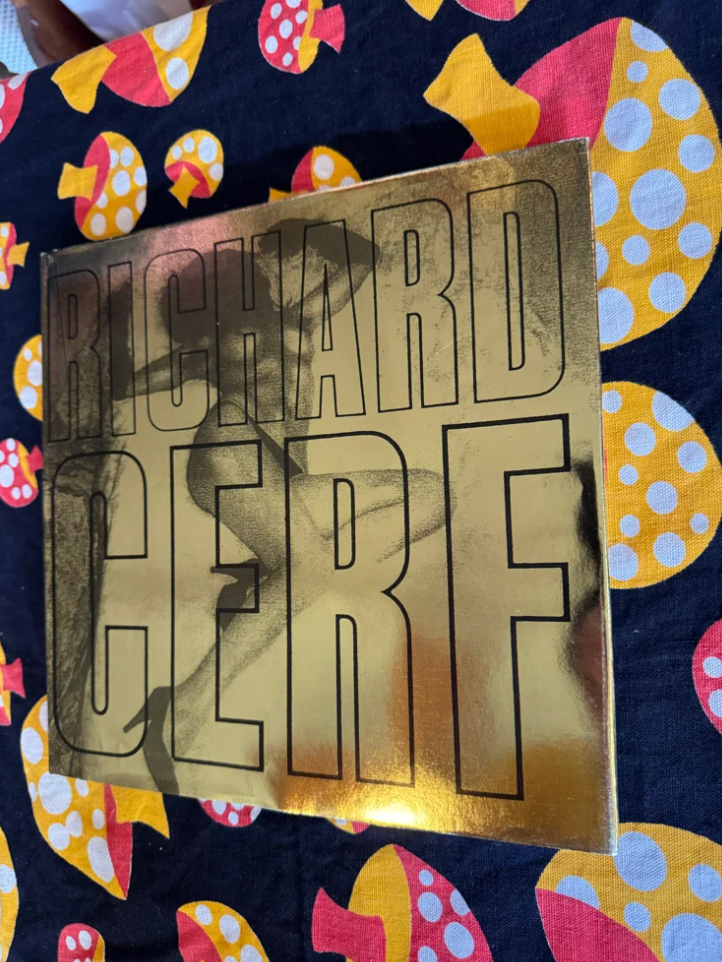
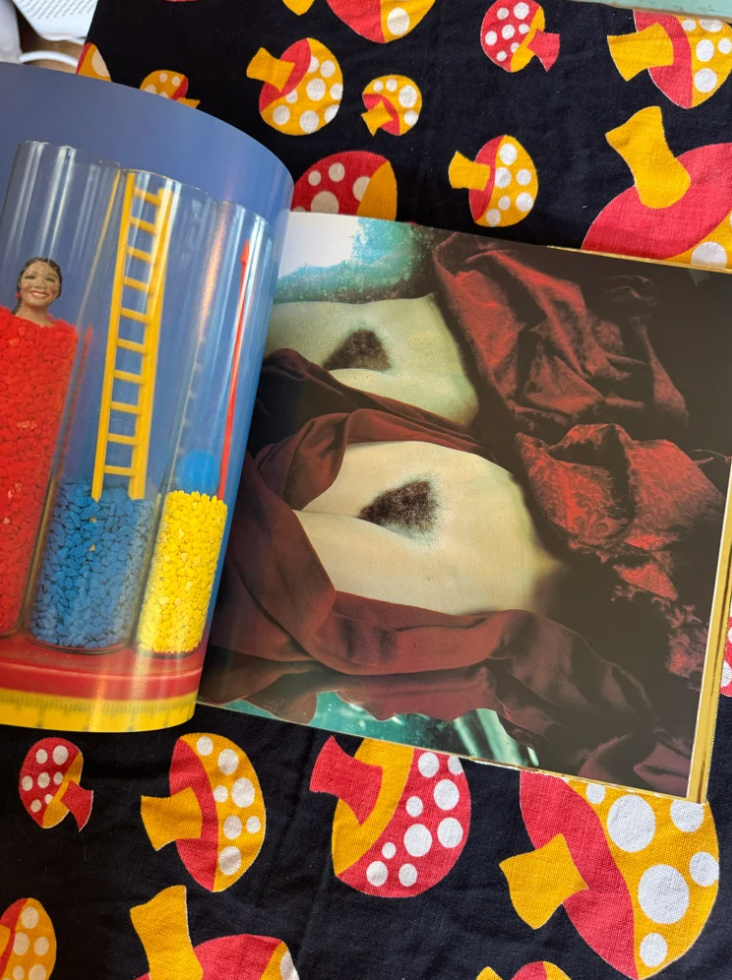
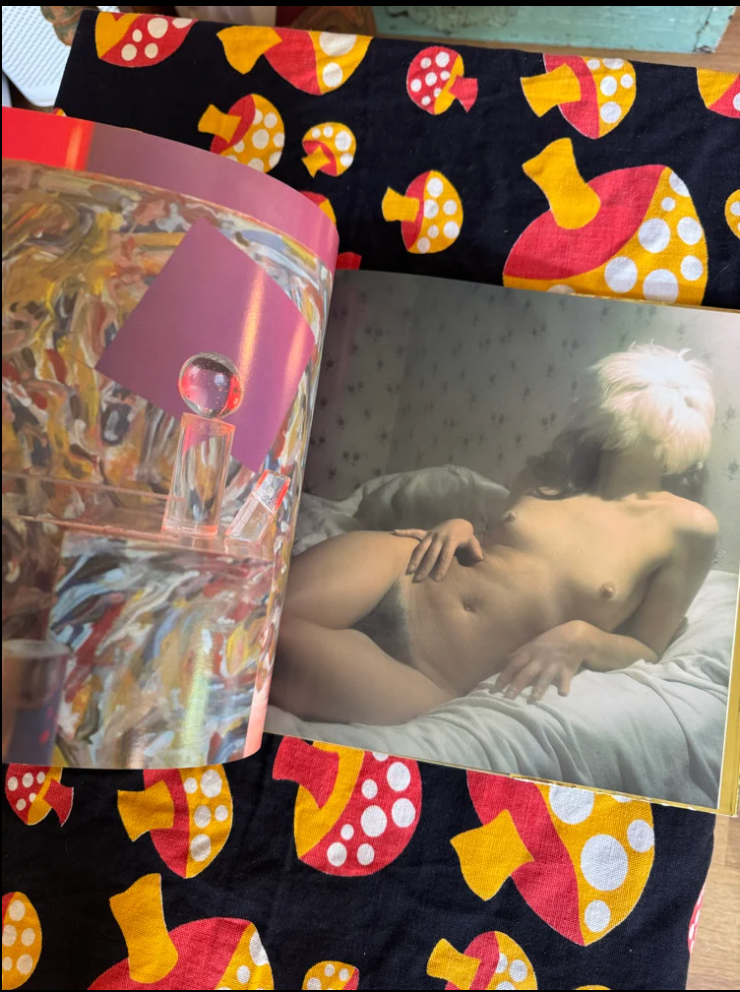
Richard Cerf, S/T, 1990. Amazing and unique artistic direction.
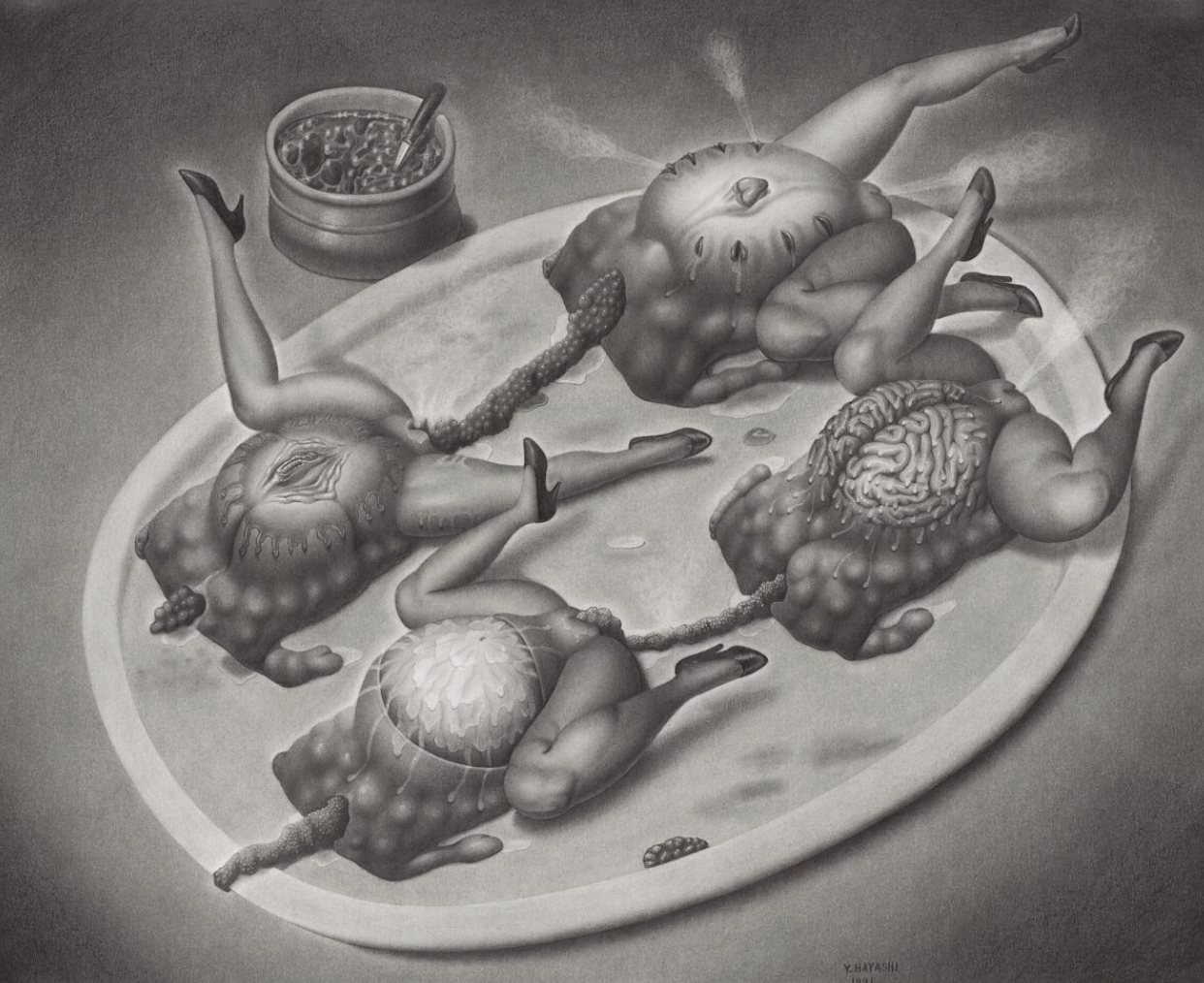
Yoshifumi Hayashi - La Jeune Mariee D'un Materialiste Enceinte De Cerveaux, 1994. Morbid and incredible drawings.
Koji Wakamatsu- Pink Film Collection: My Eros Feast, 1970.
Richard Cerf, S/T, 1990.
Yoshifumi Hayashi - La Jeune Mariee D'un Materialiste Enceinte De Cerveaux, 1994
Favourite erotica book in general
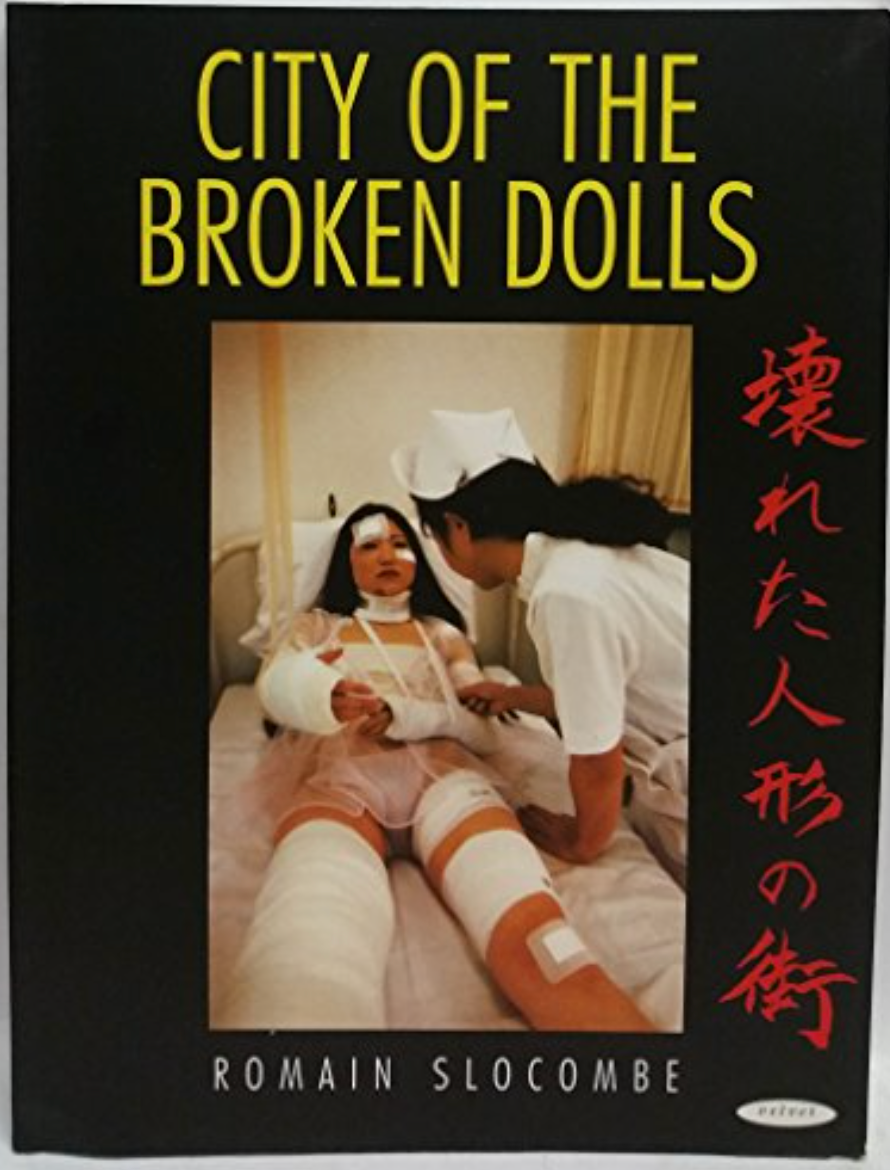
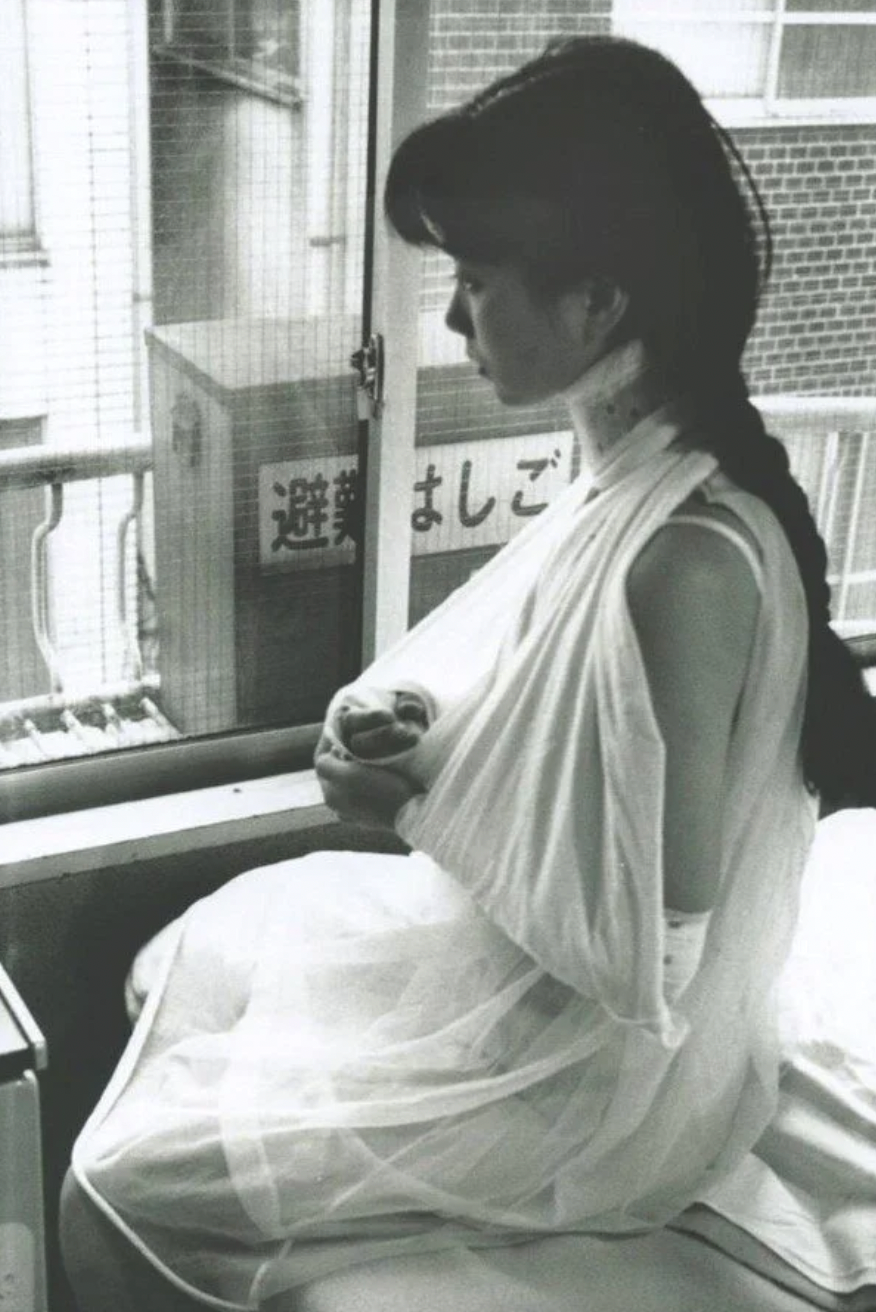
Romain Slocombe, City Of the Broken Dolls, 1997. All of Slocombe’s books focus on paintings or photos of women wearing casts. Eyepatches, bandages, and crutches, usually bound to hospital beds or under bright neon lights as they would walk through the city's dark underbelly. Healing and trauma as fetishism.
An artwork you would own? Do you have a dream group show you would curate? (artistic dream blunt rotation)
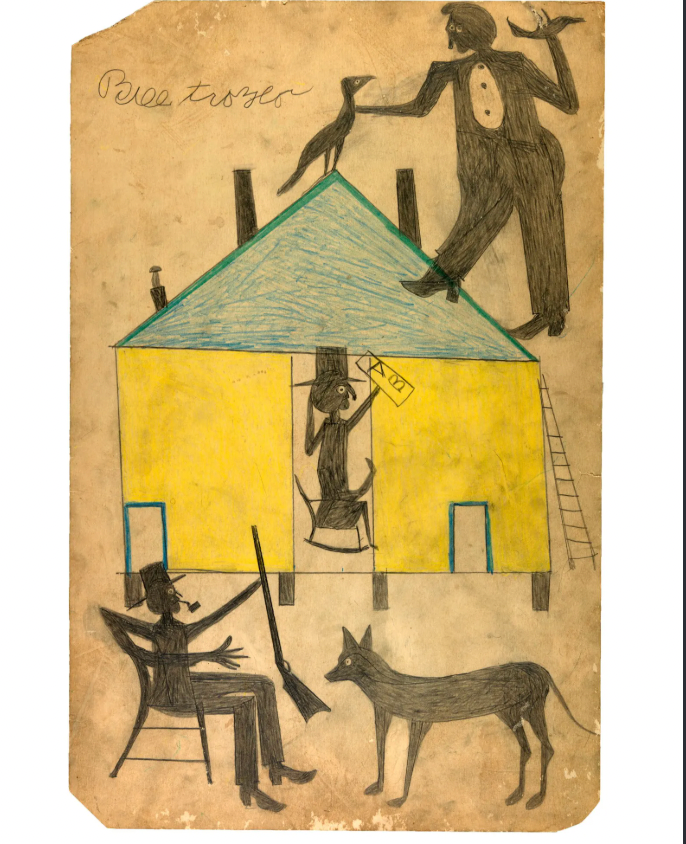
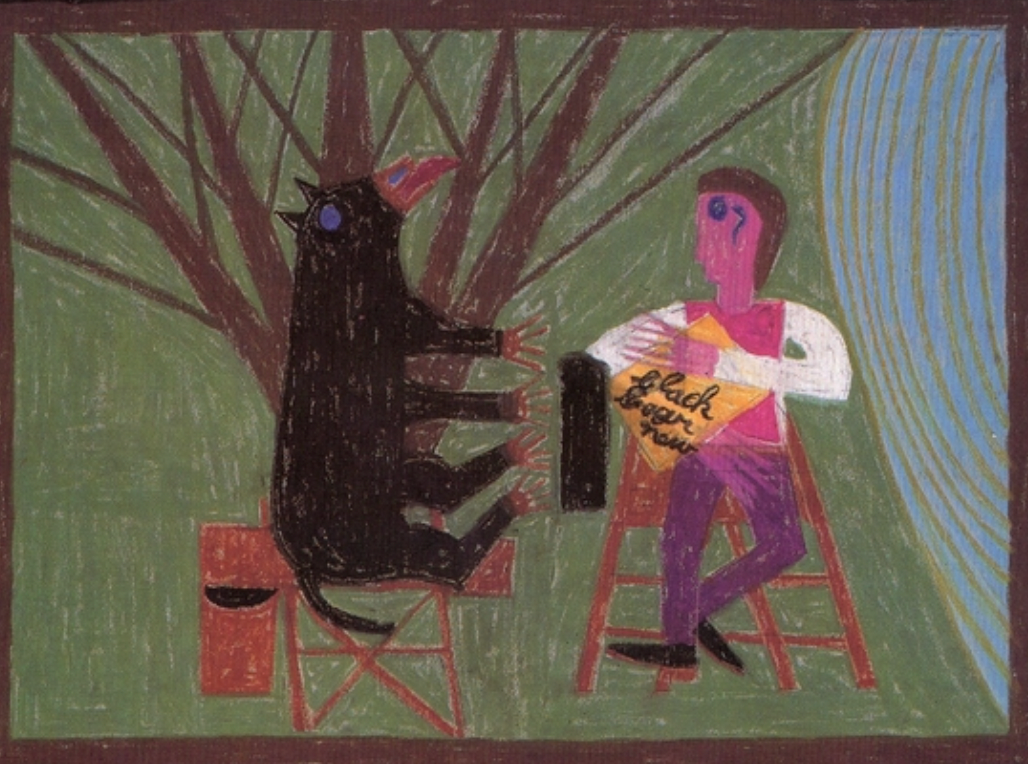
When it comes to works that I would exhibit in my house, I strongly prefer American folk art. Bill Traylor, Howard Finster, Eddie Arning, any sort of objects adorned in the Tole painting style (of which my great-grandmother was internationally famous for making), tramp art carvings, antique 1920s quilts and 1800s primitive chairs and frames. Things that, outside the artists who I name-dropped, with some dedication and persistence, I can curate myself through estate sales and abandoned houses.
How do we protect physical media?
Make copies.
How does your archive influence other people? How would you like it to?
I have had a lot of people tell me I had introduced them to something that changed their worldview, or influenced them to make their own art or curate their own collection. That’s what I want to do.
Favourite architectural style: Post-modernism, Gothic revivalism or Playboy mansion.
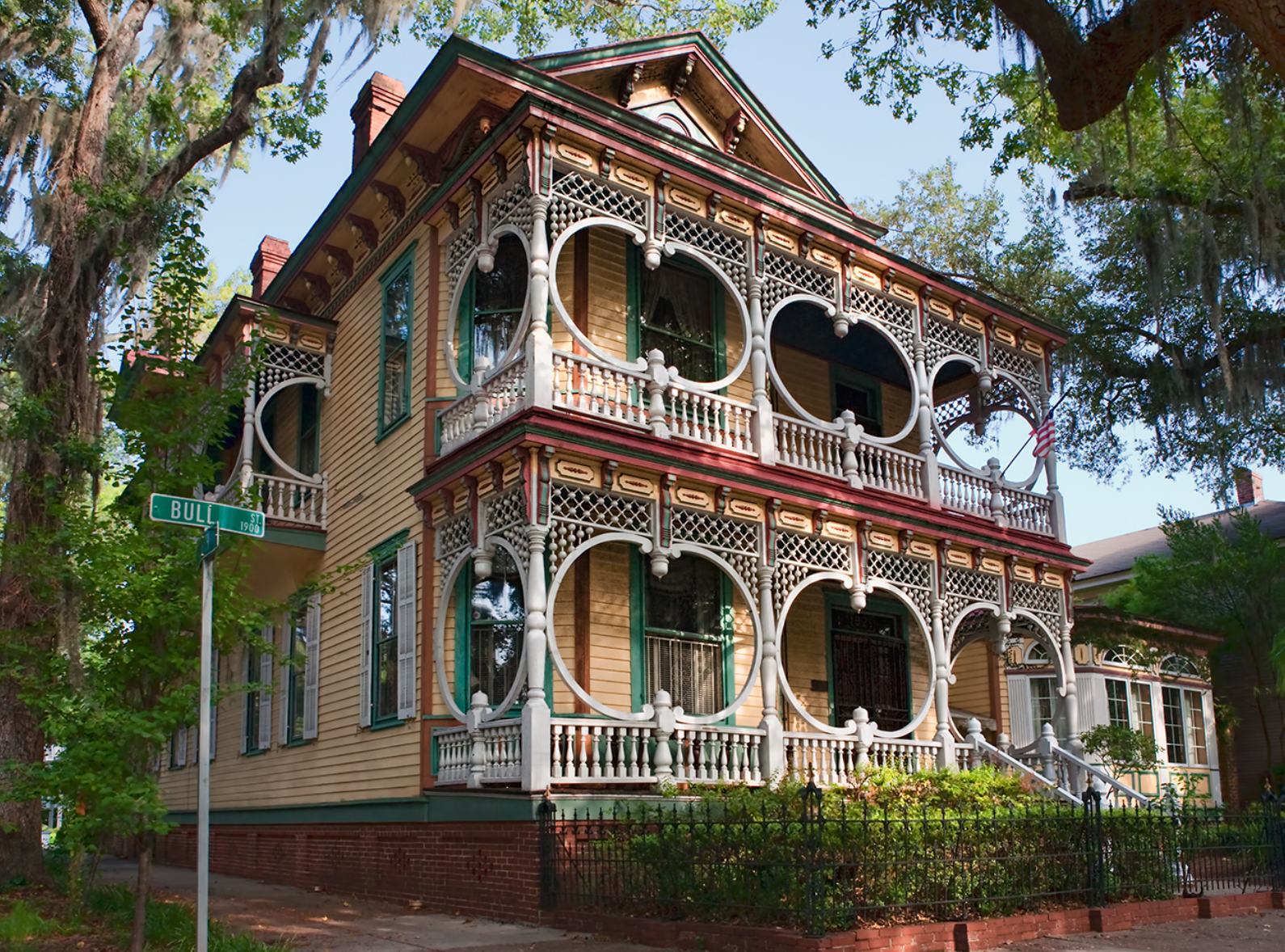
I enjoy a lot of Federalism, Georgian, Gothic Revivalism, Greek Revivalism, and Victorian architecture that can be seen in the coastal southeast.
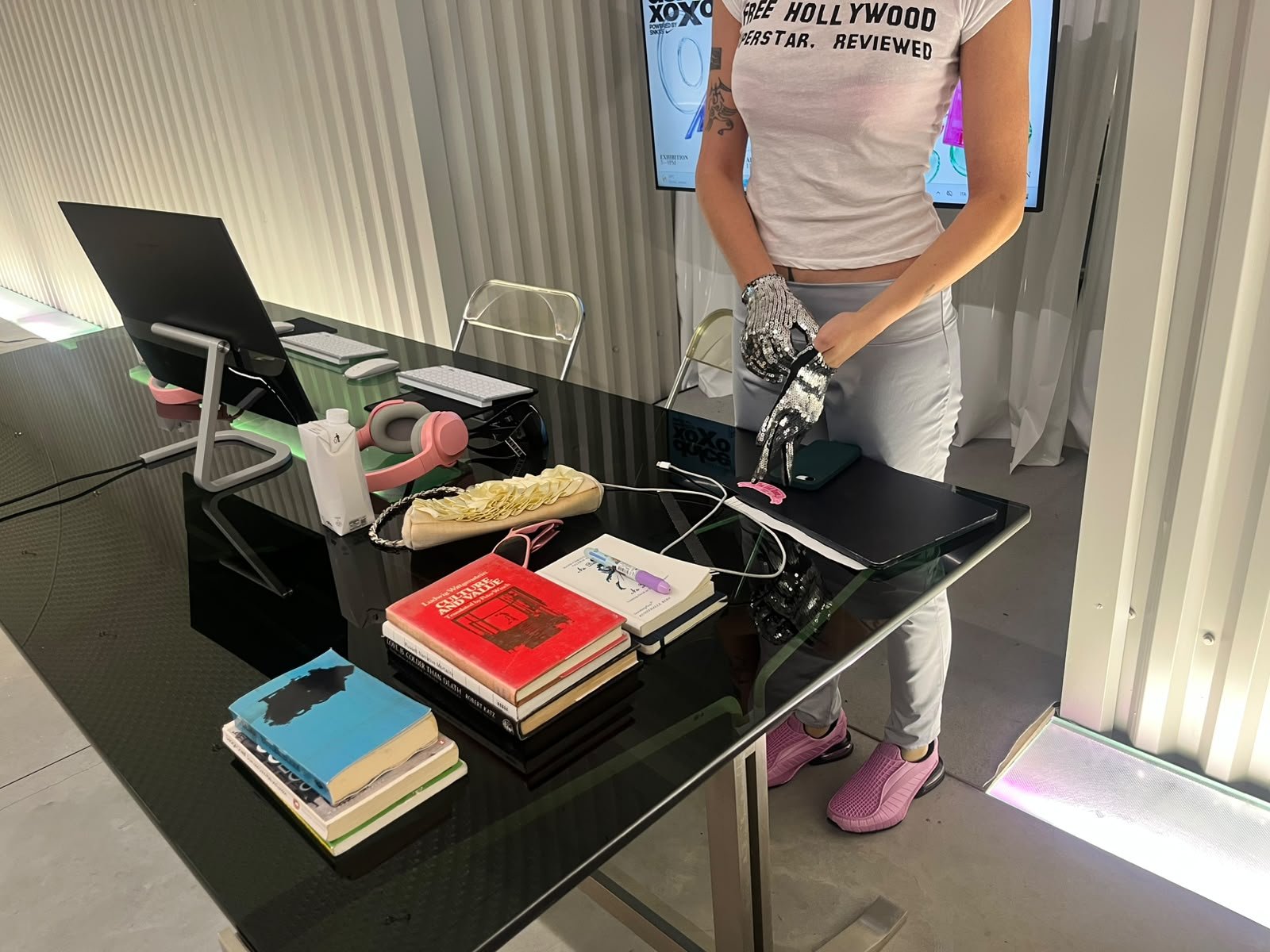
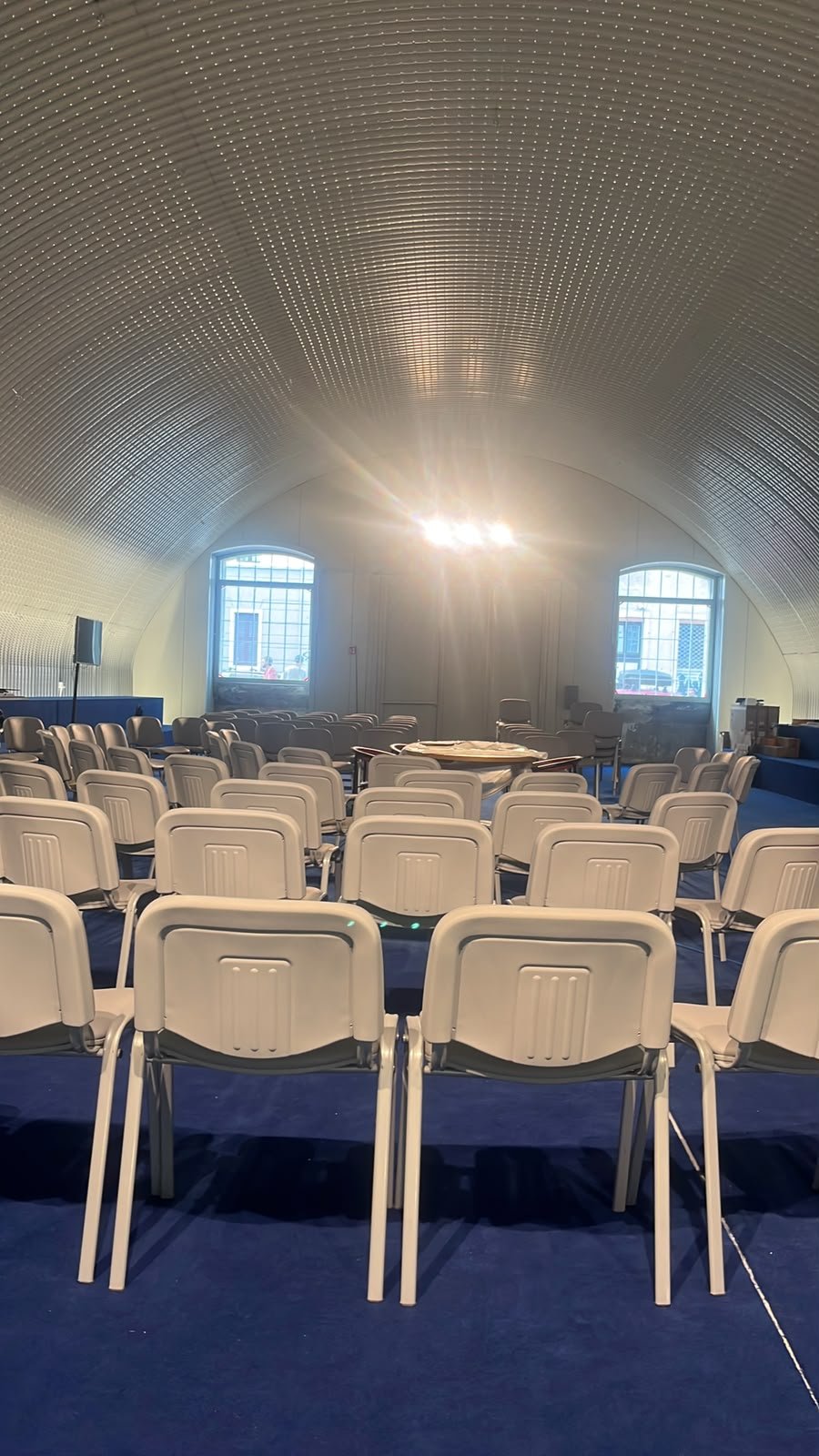
This was written as part of the "One-Day Cultural Takeover and Exhibition Powered By Nike SNKRS on September 12, 2026, in Milan, Celebrating The Archival Air Max Dolce sneaker." We were pleased to perform as Hollywood Superstar Review.
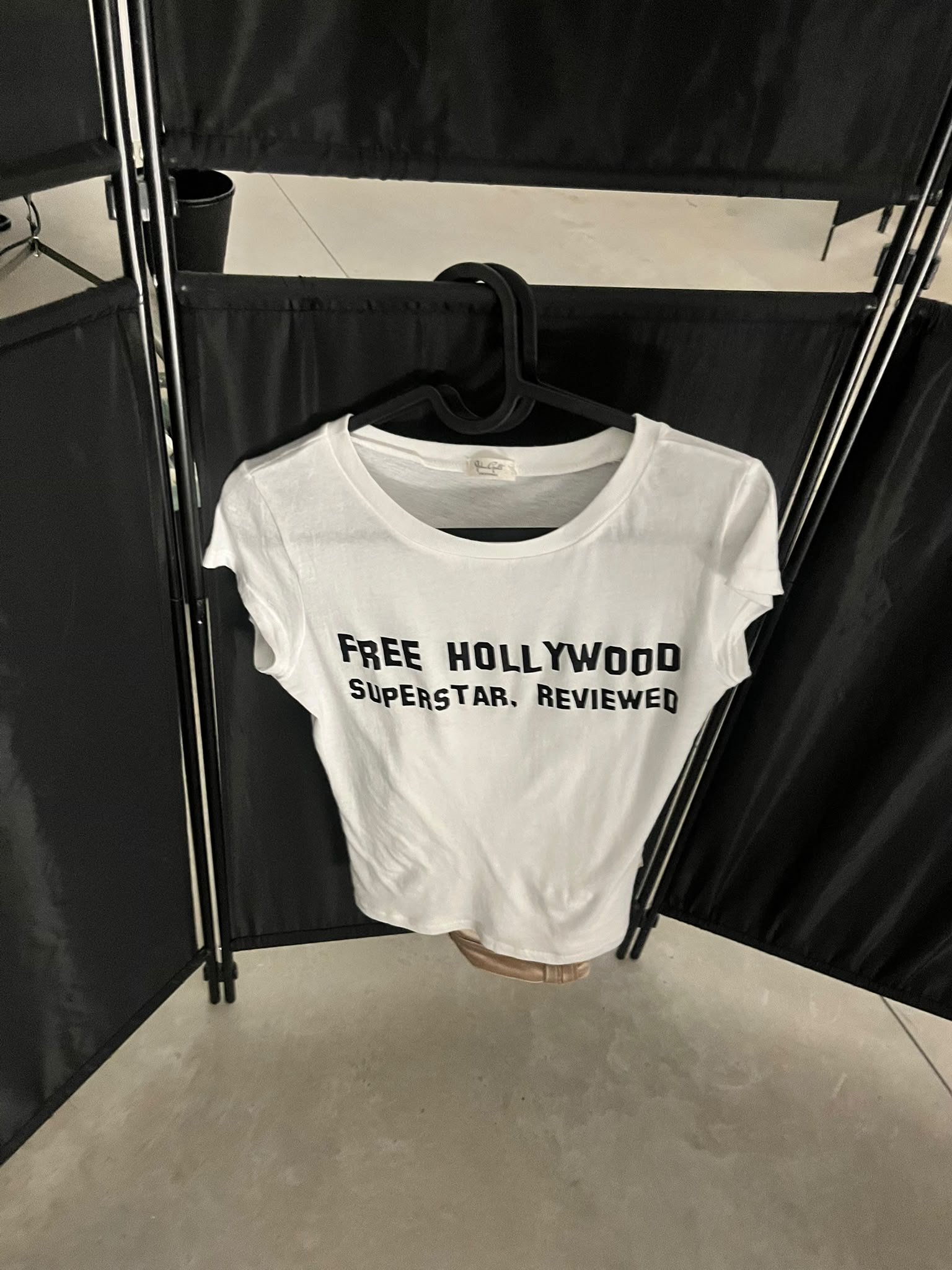
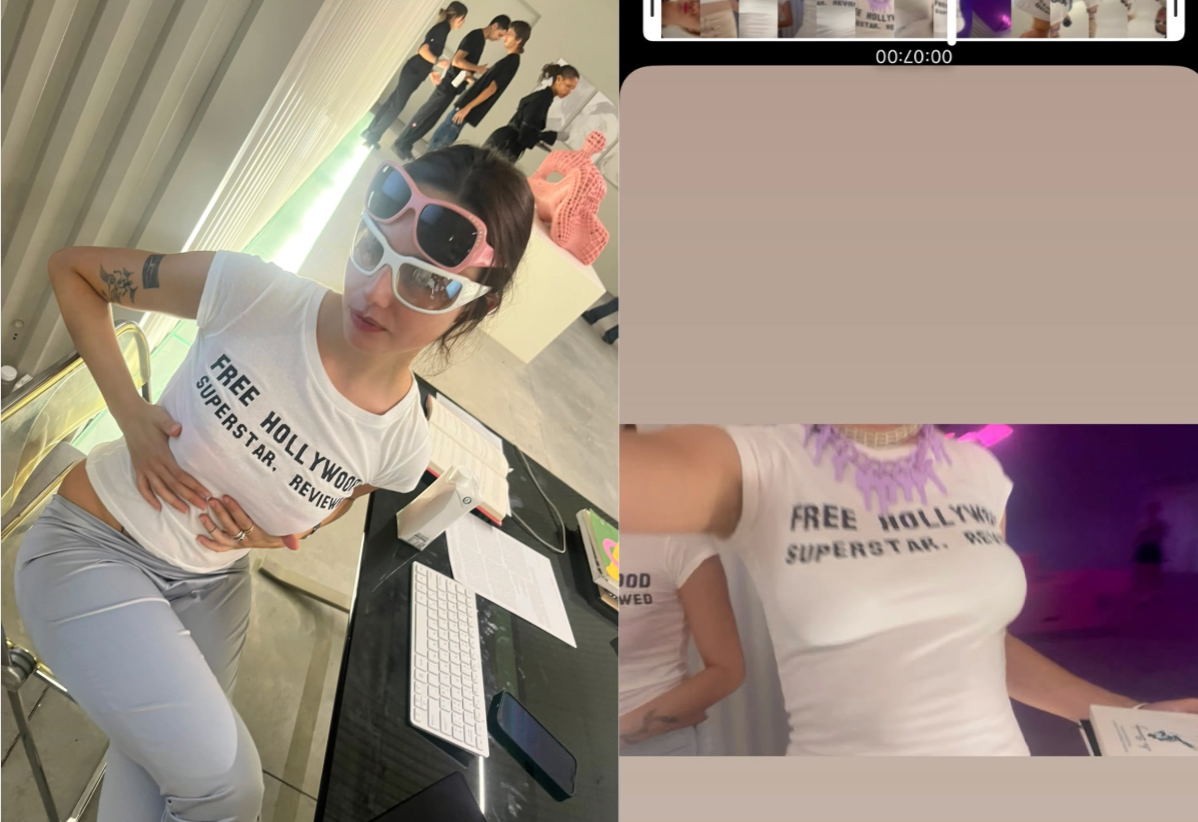
For six hours, two actresses read out passages from their assembled books while answering questions from the public. For six hours we wore T-shirts and clothes that matched the assembled art as styled by an archive Dolce XOXO had found for us. For six hours, all we ate was the rice crackers hidden in a 3-D printed pink futuristic 3D printed henry moore, desk while flanked by two besuited security guards.
HOLLYWOOD SUPERSTAR LIVE BLOGGING 6 HOUR PERFORMANCE TYPE TYPE
More institutions, please!
On our screen visitors saw displayed:
‘After the post-avant garde’ article by Sean Tatol
The Hollywood superstar website
Pitches we receive
PR emails we receive
Text messages to one another.
And also the following books on our desk:
Culture and Value: Ludwig Wittgenstein, ed. G. H. von Wright (1977; English 1980)
The Damned: Joris-Karl Huysmans (1891; Penguin Classics, trans. Terry Hale, 2001)
Narrative Mortality: Catherine Russell (University of Minnesota Press, 1995)
"Dear Superstar, there are many men with means, and there are a few men with taste, and there are about forty-five men with means and taste, and none of them are doing what they need to do- which is to solve the socio-econo-ethico conditions of my thirst.
On the fact that there are no good bars to drink in, in London, perhaps we can say that these men ought to be a change in this department. And before you protest, please don’t fool yourself: when I say that there is nowhere to drink in London, I am not saying there is no cherished drinking institutions. I am talking about the overabundance of mediocrity that leaves me absolutely parched of meaning. Why is there nowhere that has the design element, the exclusivity of clientele, the mystery that is necessary in order to make something like this work out?"*
In any case, we have two things to say right now on the decorative state of the domestic:
The post-internet age is one in which the bar has been left behind. We are programming and broadcasting from our bedrooms, homemade negroni in hand, pint can in hand. We proceed to socialise domestically because of zoning laws prohibiting live music and late nights, because a drink costs an hour of minimum wage work, because we can already see everyone we need to see on Instagram. We invite people into our homes physically because the rigour demanded by public space is too much when the social contract has been worn so thin.
After all, since we were young we had the history of the entire world shot into our brain as we were wrapped up in our barbie/superman/nonbinary bedspread.
The domestic has already been so public for all of us that the ‘reveal’ in person (because of course there is no such thing as a blind date) becomes about subtlety. It is fitting that London bars are a blank relief of anonymity, when so much of life is lived looking at usernames and overly curated online worlds. The great relief of Wetherspoons, the great relief of their lack of music. The even greater relief, sometimes hipster relief, sometimes not so hipster relief of a Samuel Smith pub, and their similar lack of music. All of these places are amazing places where you can go and be nothing, as a relief from the supreme individualising process of creating a private property authorship of your own life. But these places are only open for so long, unless you have a daddy/company card: we only have so much money, but we all really love to hear the sound of our own voice as we trail off into the night. So we invite people inside, for economic and social reasons.
Those whose lives are not overdetermined by the social or the economic are the errant, arrogant sons of financiers and those navel-gazing daughters who did not want to become consultants. The unprofessional trustafarians, distracted and stimulated into becoming artists as an excuse for their own failed identities. What else? What else is there for them to do? I have an idea- how about instead of making your lives so incredibly boring, you might want to fall out of love with your punk, industrial teenage heroes and become a Malcolm McClaren. Perhaps I am leaning too far into familial, socially reproductive determinism here, but I can’t help but wish for some people to be the businessmen their fathers wished for them to be.
Dear Superstar, when I was being educated at the finest school in all the land, I was taught the most incisive, cutting, high level of the snake-eating-itself of institutional critique. This level of meta-critique means that I might have been put into this situation in which we find ourselves writing at this very moment, which is wearing sneakers to promote a shoe in the city of fashion, Milano. At this very second, we have been installed in a small fashion institution in the railway arches, 200 meters from Milano Centrale Station.
When I was taught to criticise, it was always as if I were inside the railway arches, in the bright white of an installed space. Clean, white, pink. Promotional and perfect, my feet fit exactly in these shoes. This is where I am meant to be. This place is good; we are tucked away in the centre of the exhibition. At this very second, people are looking at me writing, half-pretending to be writing. LaLaLa. We are here performing for six hours, and the lighting is fluorescent but perfect; everyone’s skin shines expensive like the sweat on an Arabian horse. Men come up to me and ask those obvious kinds of questions that you forget people use to flirt: “Are you an artist?”
No, we say. We are bloggers. We are here to blog about the topic: why we should be having more guys design places like Max’s Kansas City- we need more restaurateurs in London. Restaurateurs who don’t care about food. Food is what you care about to care about your body, but if you go too far along that road, you end up like Bateman. If there is anything that we learnt from American Psycho, it's that restaurants were invented so business people could prevent themselves from disclosing the true brutality of their fantasies!
Lets have a restaurant where you can only see each other from quite close up, red lights and a band in the next room. Let’s have a bowl of chicken wings for the table and a large bucket of Sangria. Let’s have it as a chain; as a public members’ club that wouldn’t have you as a member. If you got money, come talk to us. But first: let's collect ourselves.
Essay
/ 8 October 2026 / By: Hollywood Superstar Editorial
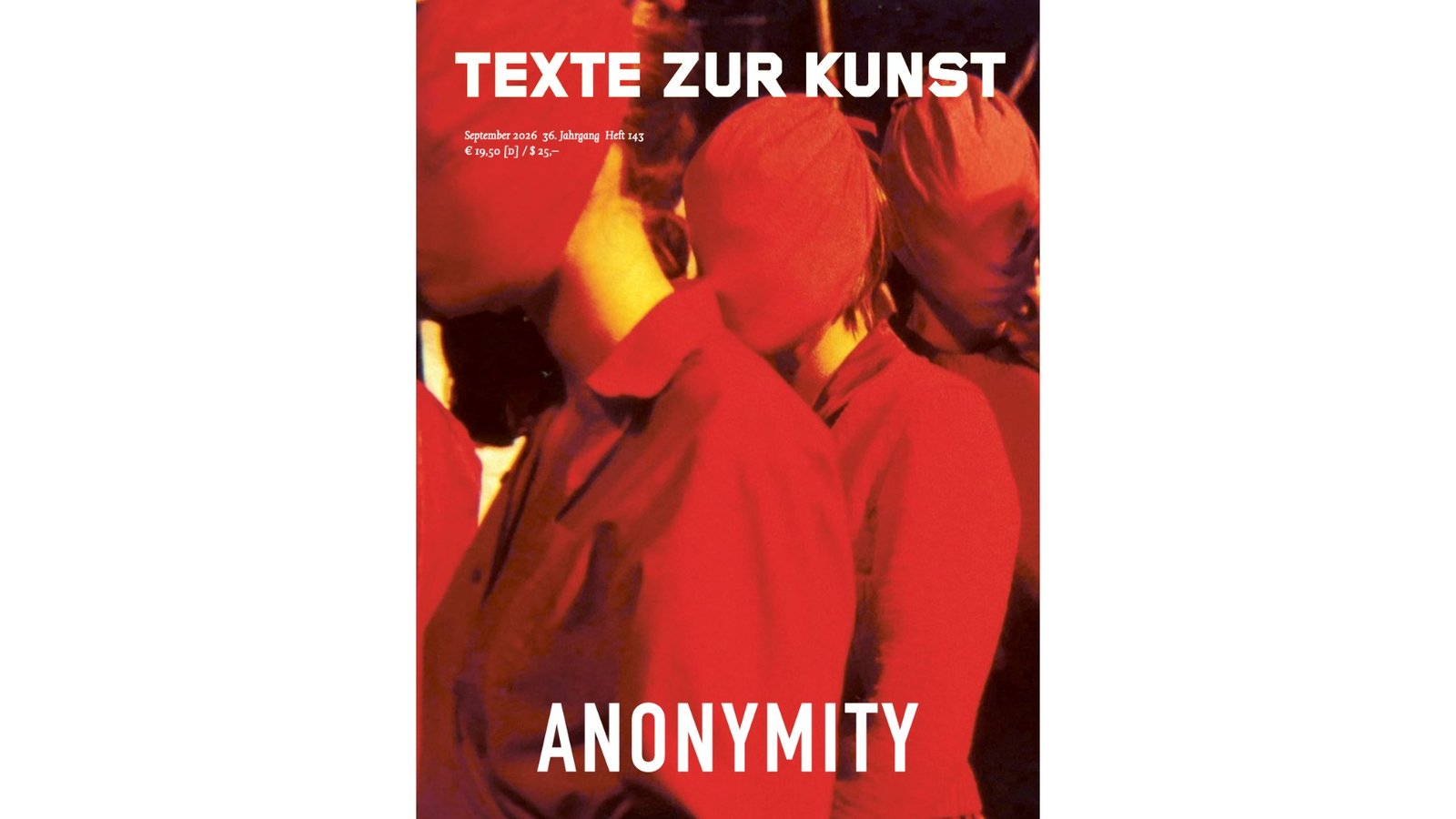
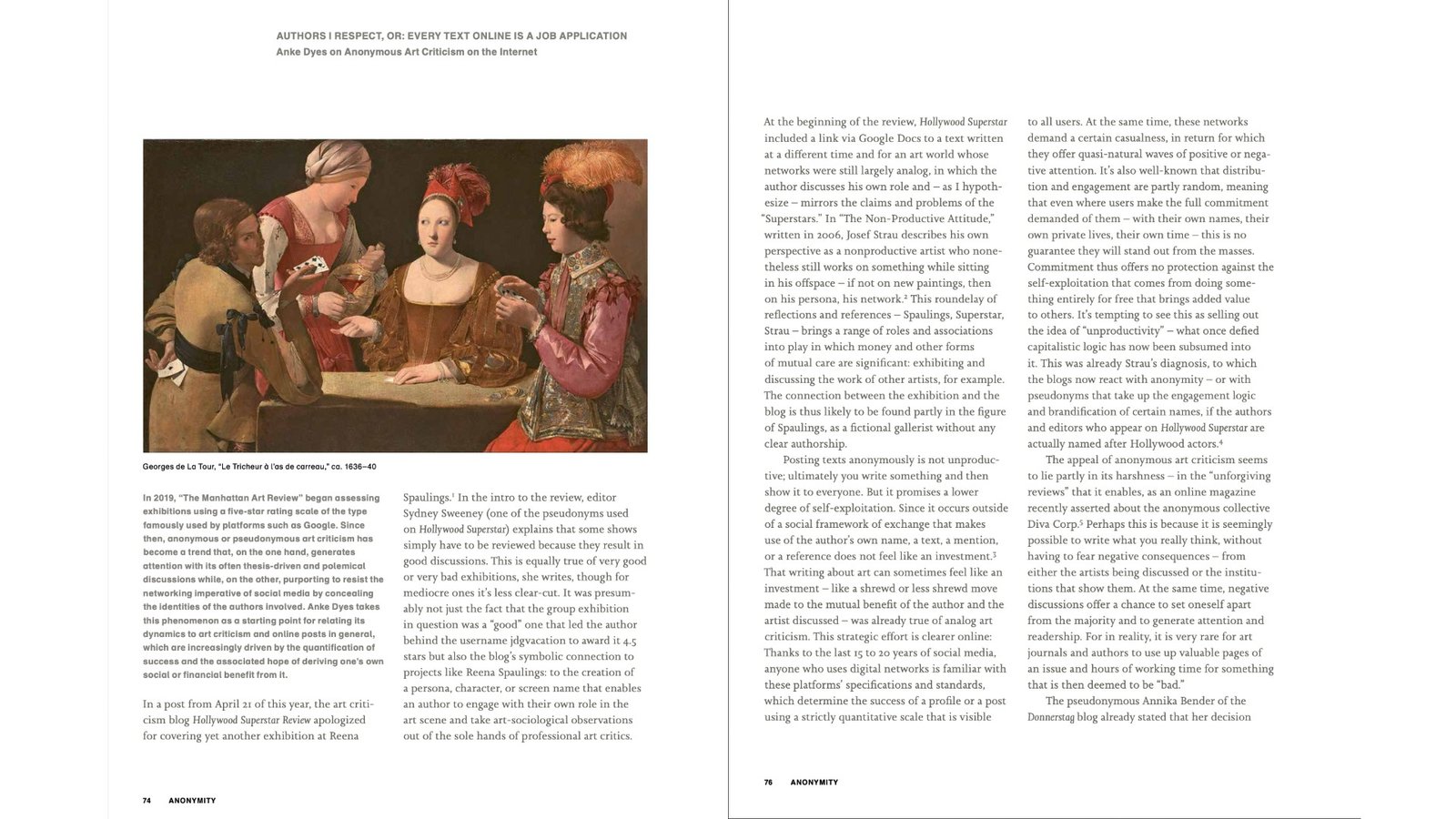
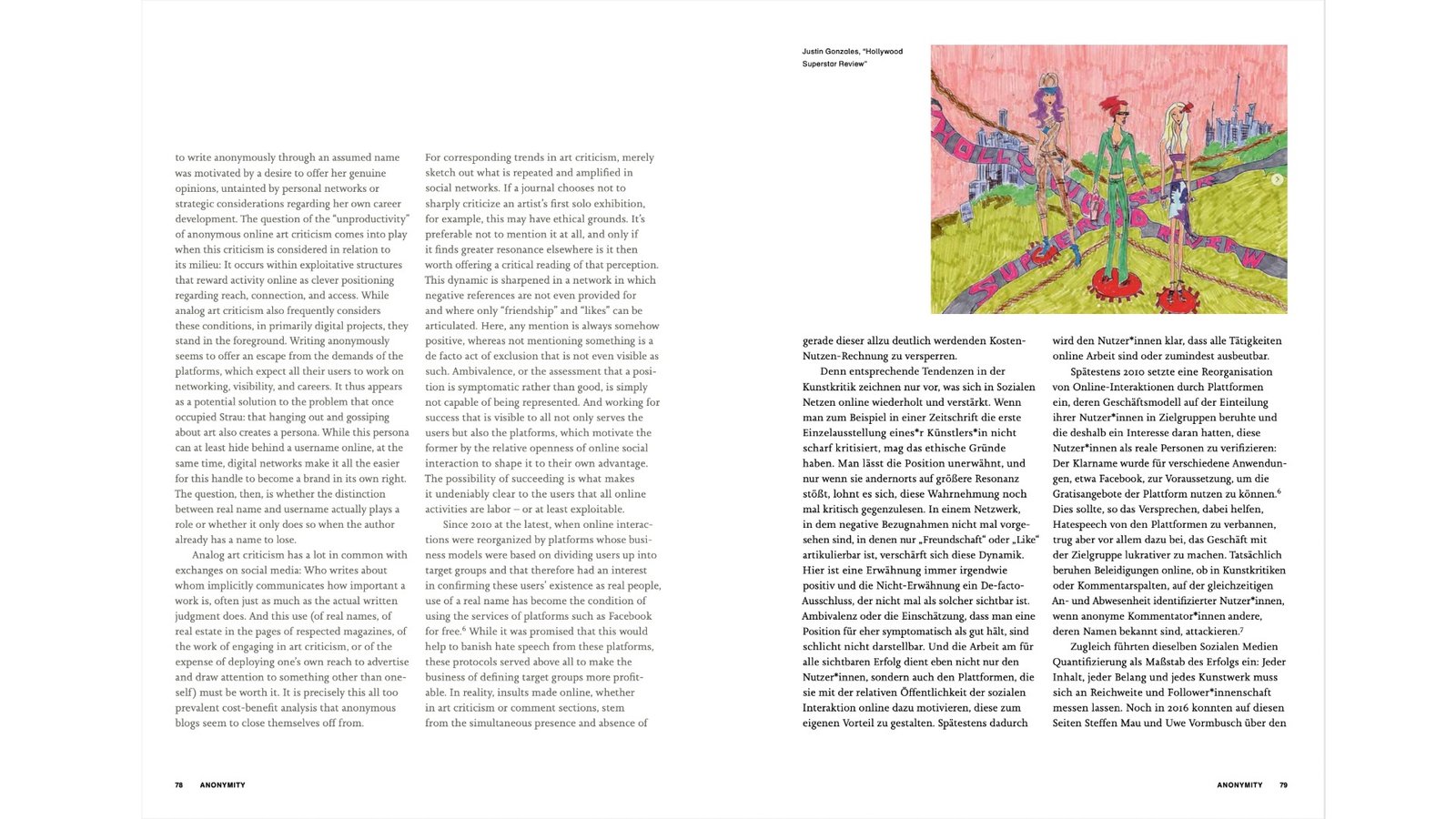
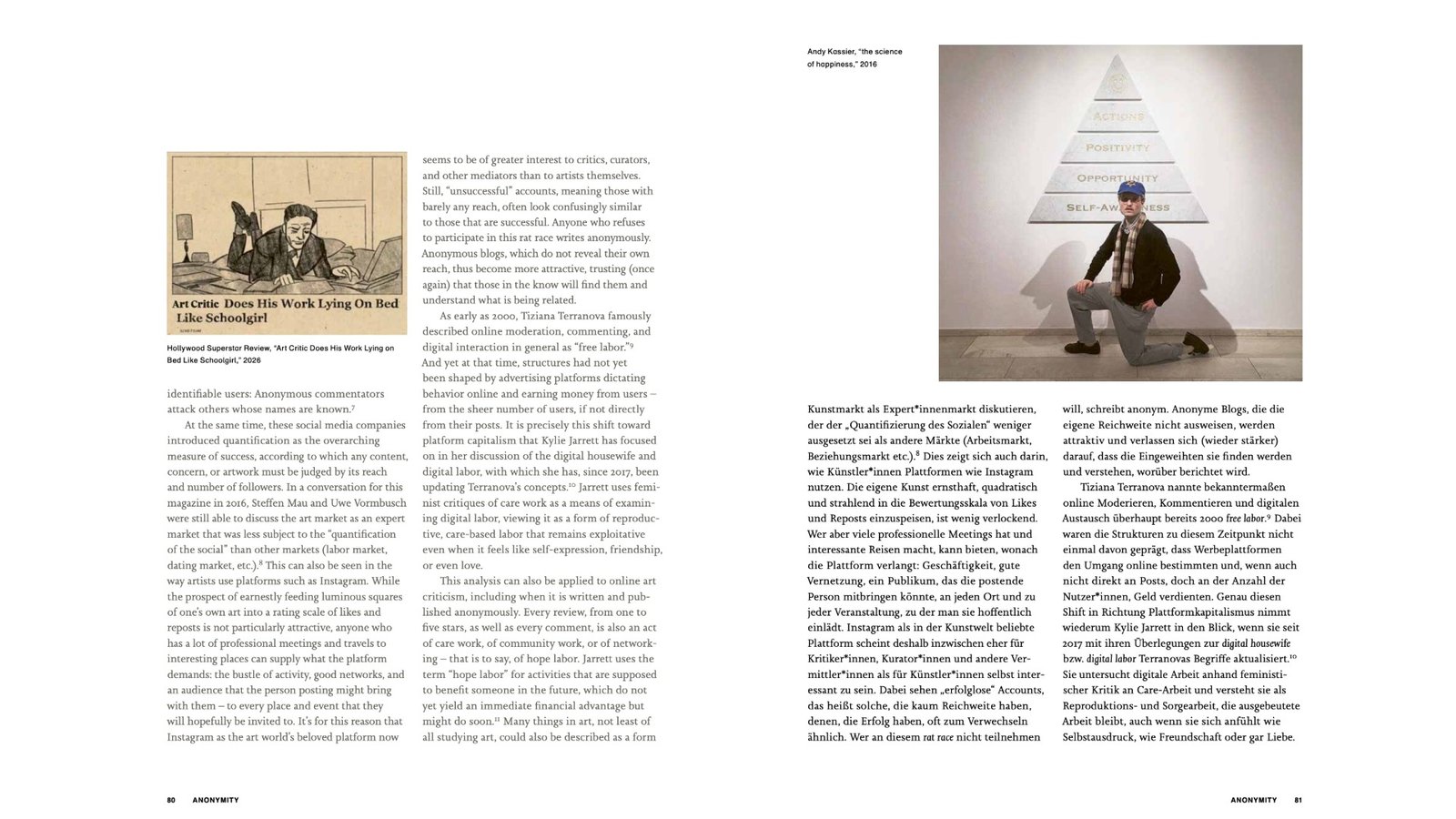
Hollywood Superstar Review gets a bit more than a mention probably more a Segway into a broader argument in the new “ANONYMOUS” issue of Texte Zur Kunst alongside @divacorp_usa.
The piece is called “AUTHORS I RESPECT, OR; EVERY TEXT ONLINE IS A JOB APPLICATION” By Anke Dyes.
“In a post from April 21 of this year, the art criti- cism blog Hollywood Superstar Review apologized for covering yet another exhibition at @reena_spaulings. In the intro to the review, editor Sydney Sweeney (one of the pseudonyms used on Hollywood Superstar) explains that some shows simply have to be reviewed because they result in good discussions.”
Gloria Steinem died last week, or was it the week before? Famously glamorous, she was what many might call a 'blueprint', in the sense that she went undercover to expose the predictably misogynistic practices involved in the hiring of playboy mansion cocktail waitresses in the late 60's.
Today, there is an endless production and consumption of pale imitations of her real risk-taking (the infamy from Steinem's groundbreaking '68 piece prevented her from publishing for years)- all of it so much less hardcore and in this editor's opinion a complete waste of time: bla bla bla "I am an middle-class 'intellectual' woman read about my secret masquerade behind the scenes of [INSERT RIDICULOUS SLEAZY ENVIRONMENT]'. ETC.
I like, many others, am her igloo sister in the erotics of investigative feminist journalism. The most fantastic thing about risk-taking journalism is that it is an excuse to pretend, lie, and fuck one's life for little to no reward. And still the temptation for pretty girls to go disguise-mode remains; perhaps it's something about Hollywood.
So, in honour of her famous disguises and dressing up, we honour you Gloria, by publishing the work of someone completely different: Edit DeAk. In the same year Gloria Steinem published her playboy piece,1968, Edit DeAk escaped from Hungary to reach New York and all that it offered, freedom-wise.
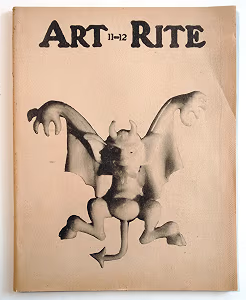
In 1973 DeAk founded downtown art magazine Art-Rite, which she ran with Walter Robinson until 1978. One of her strengths was her gravitational pull to the sensations and performances of the night club. In November 1980 she organised Dubbed In Glamour, bringing outrageous party-glamour-artists from the Mudd Club to perform in Official Art Area, The Kitchen. Cookie Mueller, Debbie Harry, Vivienne Dick, Tina L'Hotsky, DJ Anita Sarko, Mary Lemley. ETC.
We present here a bit of editorial from DeAk from Art Rite issue 11, 1976. It's about the 'Intellectual Whore', and how you might Hollywood yourself by drawing on a moustache. Performing stardom, performing masculinity.
-- Eileen Slightly
"PENCIL MOUSTACHE MAKES UP"
ART RITE ISSUE 11. COVER BY ED RUSCHA.
The pencil thin moustache is part of the trappings of a certain kind of masculinity, residually based in the Hollywood of the 30's, certainly a cosmopolitan place, rather ubiquitous in reverse (everyone was there). Any man who would be suave or swashbuckling or sinister in the '30s would wear it; yes the '30s, ten cents a dream and the time of the pencil moustache and the performer as mass hero.
There is more than coincidence for this moustache to appear then as an interclass fashion. Movies were a mass medium. This fashion strangely enough celebrates the star as a new hero with is allusion to the performer by "denoting" a "kind of" masculinity, which was really an indicated masculinity, which can only be meant positively in the world of artificially created reality, that is, the performer's. You do not have to be anything, better that you have a presence. Presence- as the new commodity popularised by the star industry- was in fact easier to get across without the "noise" of the whole thing, with the "real" personality left out.
The movies, through the stars, made role-playing a mass phenomena of the '30s, the decade with more great style than ever, and no reality; when regular people excepting the weird types borrowed the visual jargon of the movie world; the pencil moustache which started as a symbol for morally questionable characters was developed to its purest to represent those esthetes of gangstership, the gigolos. The gigolos were flourishing like never before, at supper clubs, on ocean cruises, by the poolside, in the cafes and on the boulevards, both on and off the silver screen, because they were a style.
It's nothing for a man to wear such a moustache; a certain vanity perhaps. But now women- women do not grow moustaches. They must paint them on. Groucho painted them on.
After I had just finished growing up I was subjected to those "measuring up the entity" type glances. It was during this phrase that my mother remarked: "You have legs like a whore's" . In no time I was slapped again on my other cheek to turn, the combination remained restricted. This gave me a real perspective on Marlene Deitrich. A whore in a man's suit is the intellectual whore, for years the only legitimate style for talent in a woman.
I don't really mean whore, but a woman who takes as a chosen character the branded woman (i.e women are branded by an inherited pile of assumptions made about womanhood, and when a woman consciously assumes this stereotyped role, she impersonates the collective character traits of what is expected of her, the “desired” woman, which is simply the same as the branded woman or simply the whore) so that through her desirability she gains leeway, freedom to sell, to finesse some ideas through a social anti-climate.
The intellectual whore, just like the whore, is going to do that with the support of a self-made and made-from-self structure. Except while the whore might turn all of the way around with a pirouette to refer back to her femininity as a commodity to use as a support structure, the intellectual whore would do that as a double entendre: the intellectual woman plays the whore as a style and then puts that very image in a man’s suit- evoking a simultaneous desirability and distilled sexual imagery of intellect. Social conventions are confused this way. Imitate them a bit, and dress like them.
Since I realised that I had to operate between images of my legs, I tried not to think of my legs. But Busby Berkely really liked shooting under the bridge made from like 100 girls’ legs and Carmen Miranda was sporting a 30 foot high headdress of bananas and still no offense in hollywood.
But do it when its not a pattern not a hundred girls, but you and your life. The images between your legs have to be dealth so that your ideas can find a channel to come out. And how to get them out in a performing situation, without the other 99 girls?
Performers looking for a ‘stage’ persona to distance them from their audience and temper their “true” image, need something to function as a mask, but one of minimal means, since the projected persona must also be a person.
The pencil moustache is such an adhoc style (the sort of thing Style is all about- just pick one to drive them crazy), a kind of minimal cosmetics that is deeply intuitive- an accommodating balance of the intellectual woman artist performer and the sensibility of the gigolo, the utmost of the male stud exploitation roles. The motif generates sexual attention (shades of the new sexuality- female aggression) and is armor at the same time (as cooly ambiguous as wearing sunglasses), or as the slippery hearted gigolo).
The intellectual whore finds a new power and security in the sphere of her oppression- her cool sexual turbulence is disconcerting to her loyal opposition. As a reaction to external cues, to oppression (the flesh market), the thin moustache is surface politics that encapsulates a neurotic adjustment to a neurotic social climate. Out of the movies, the pencil moustache is the subject of a reversed focus, the center of the diffusion of personhood; that is it seems the manifestation of endless different conscious and unconscious structures (sexuality, bisexual chic, self-revelation and self-concealment, presence and role control, etc). Through two carefully applied strokes which indicate the entity as they fail to describe it.”
No one goes to an art fair to fall in love with art. Or to fall in love. Yoona went because she was in Korea to get a colonoscopy. At the fair, she identitfied that she "Reeks of American individualistic guilt" to her motherland amongst what she labels the condition of uniformity amongst Frieze Go-ers, clothing wise.
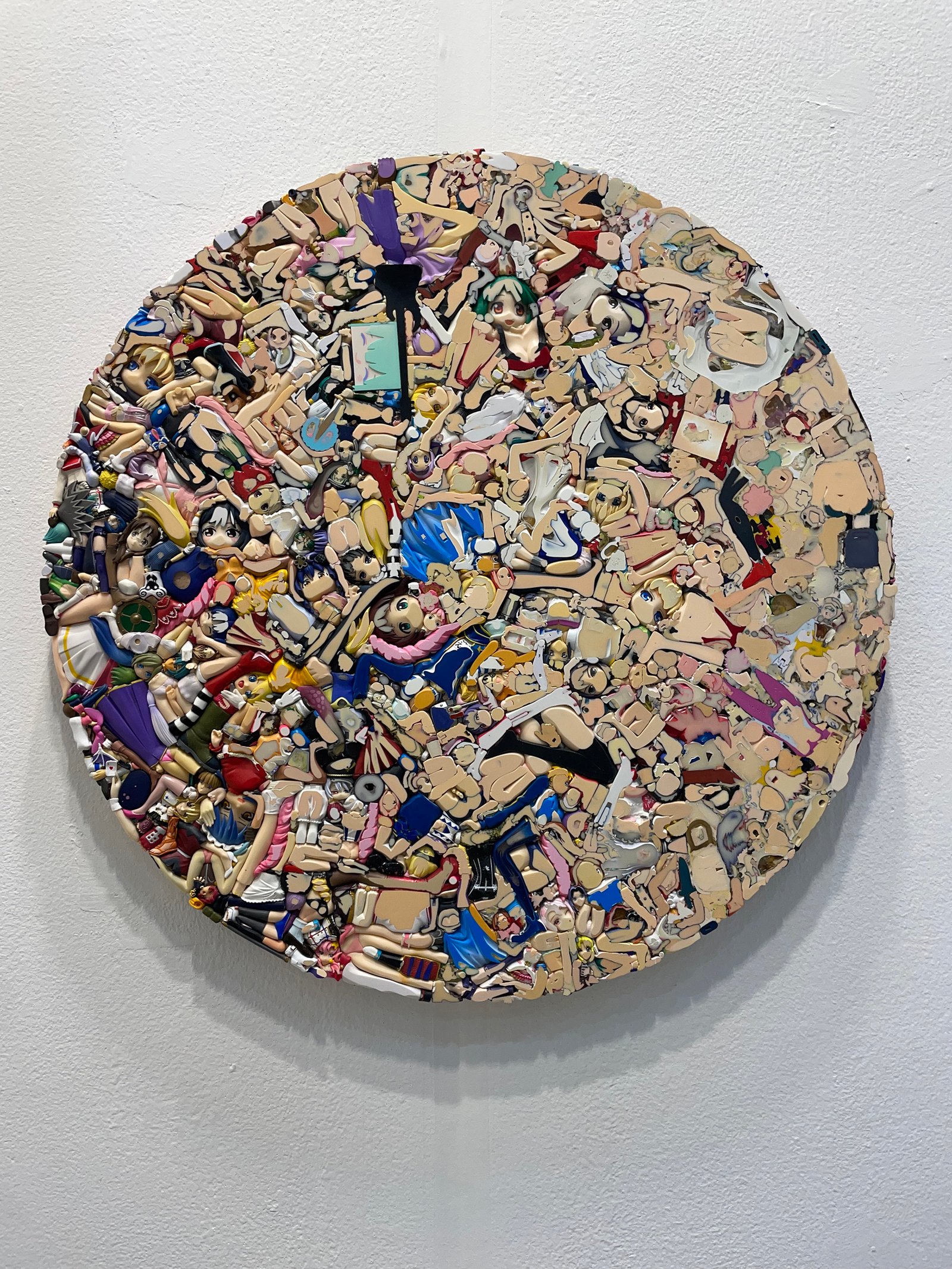
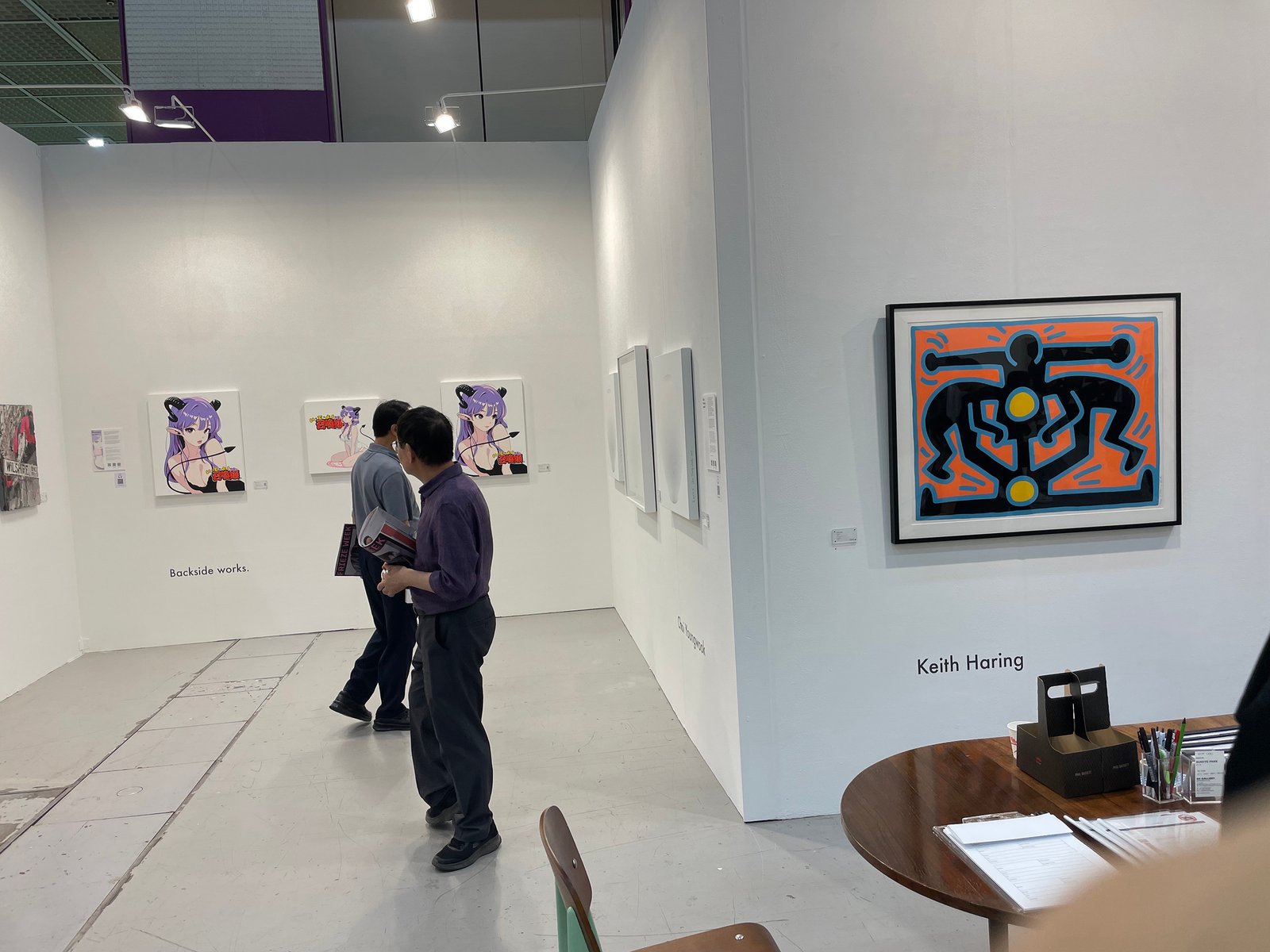
Frieze Seoul achieved a level of absurd Frieze anywhere else (™) could never: "They juxtaposed Keith Haring works with hentai cat girl paintings and it was all just so abominable that it brought a genuine smile to my face."
The essence:
Does the amount of complimentary consumables at an art event accurately indicate its wider art scene’s health?
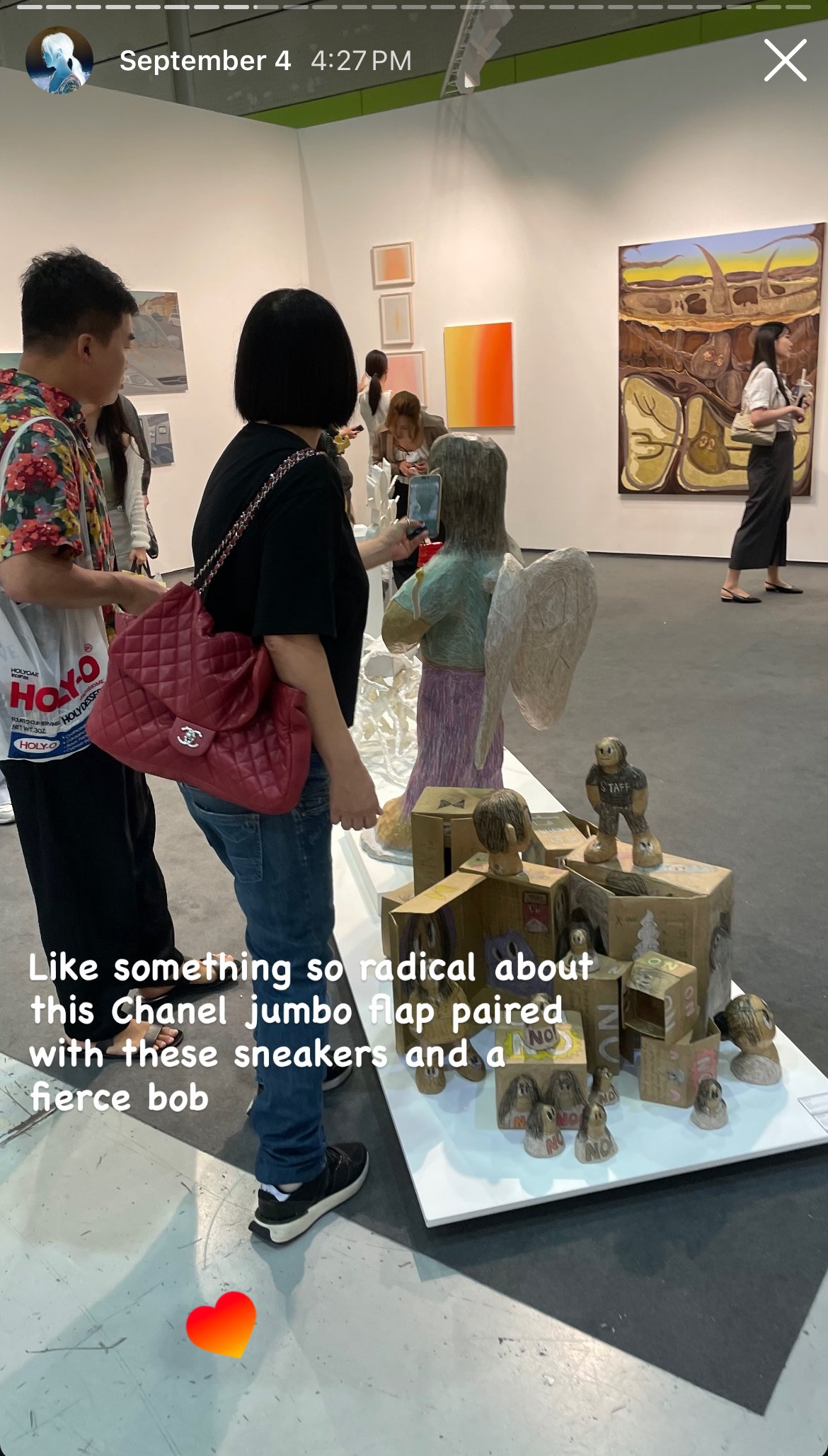
Chanel Bag count: 40
Birkin Count: 4
Non Classic Flap Chanel: 26
keeping an open heart, mind, and eye to whatever piques your interest – which, for me, tends to be works that lean heavily on a certain feminine sensibility.
⋆ ˚。⋆୨୧˚ 슈퍼스타가 말한다. UwU . ݁₊ ⊹ . ݁˖ . ݁
I arrived in Korea in time to catch the last 48 hours of Frieze Seoul. The week is: gallery nights, cocktail receptions, and performances organized by neighborhood: Euljiro Night on Monday, Hannam Night on Tuesday, Cheongdam Night on Wednesday, and Samcheong Night on Thursday. I missed Euljiro, Hannam, and Cheongdam Night because I was sedated in a hospital bed getting my endoscopy, colonoscopy, bloodwork, and a million other tests done, but as soon as I got out of the hospital Thursday morning it was game time.
Thursday: Afternoon at MMCA (the National Museum of Modern and Contemporary Art) aka my favorite museum in all of South Korea that you just have to visit if you’re ever here. I came for the newly opened Do Ho Suh exhibition and waited in line for an hour, keeping myself entertained with people-watching – as one does – visually surveying those around me for a general sense of current Seoul fashions. The monochromatic ‘safe’ outfit (which ranges in normalcy between Uniqlo mannequin and how you’d maybe see Hyein Seo pieces styled on SSENSE) generally rules the city. For better or for worse, it’s a symptom of the overall culture of social conformity here. That should, in theory, make me feel some type of way standing in that line with my hot pink dip-dye hair and Halloween-hued geometric print L.A.M.B. bag, but I’m no longer fazed by these things because I’m a mildly self-absorbed girl who thinks my outfit is the most tasteful in the room anyways and who has accepted the fact that, to my motherland kin, I probably reek of an American individualistic spirit.
The monochromatic ‘safe’ outfit (which ranges in normalcy between Uniqlo mannequin and how you’d maybe see Hyein Seo pieces styled on SSENSE) generally rules the city.
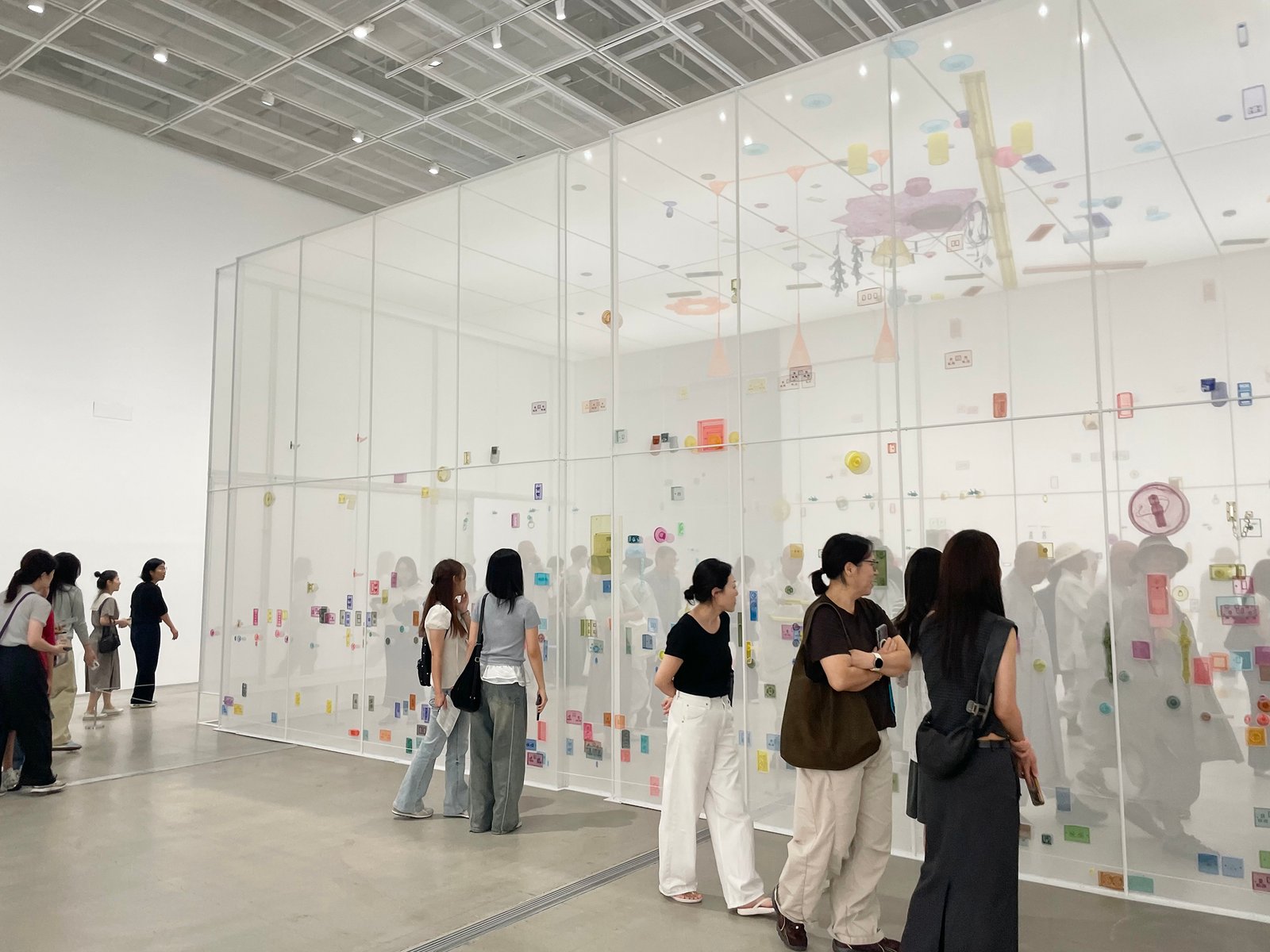
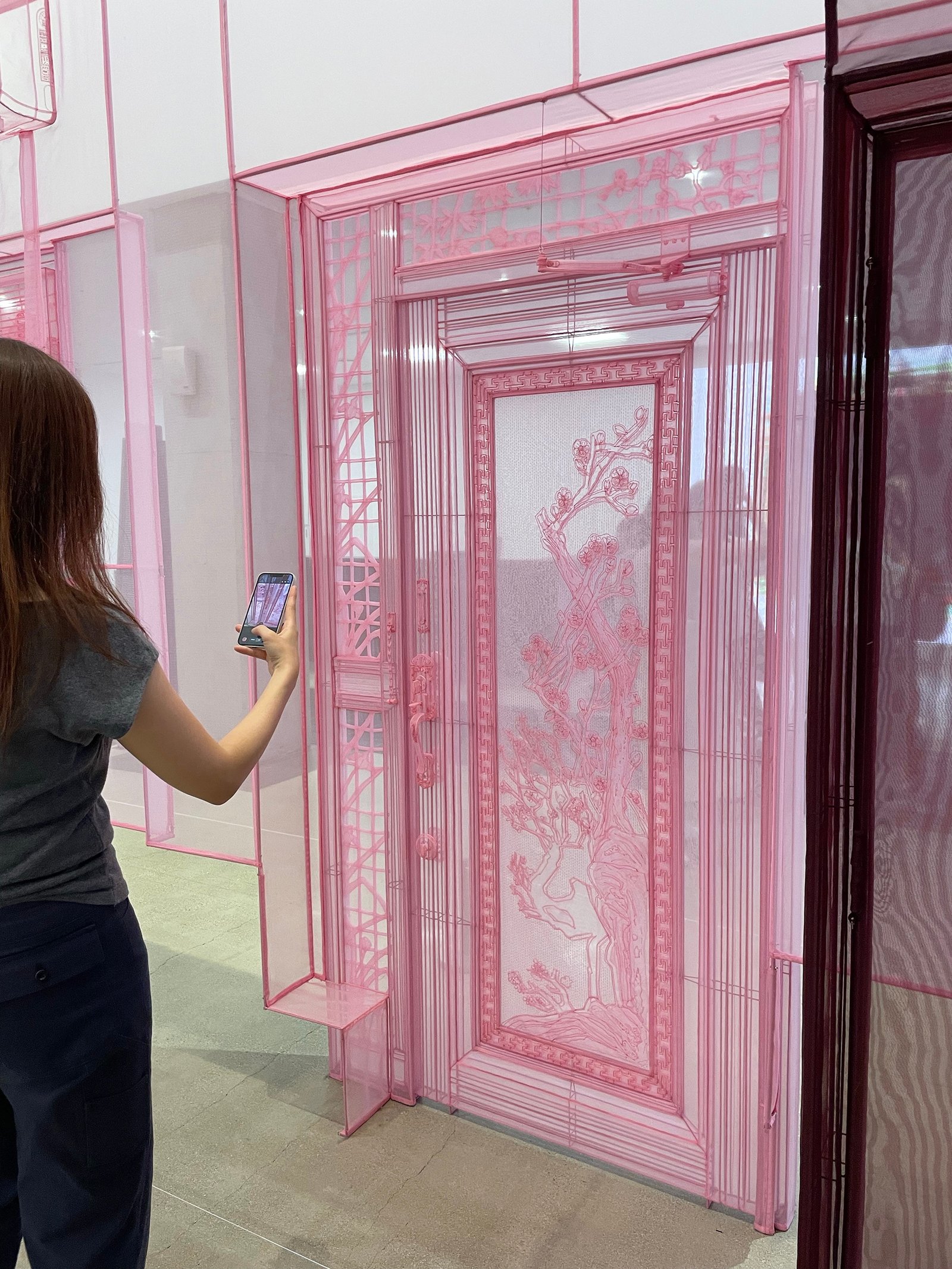
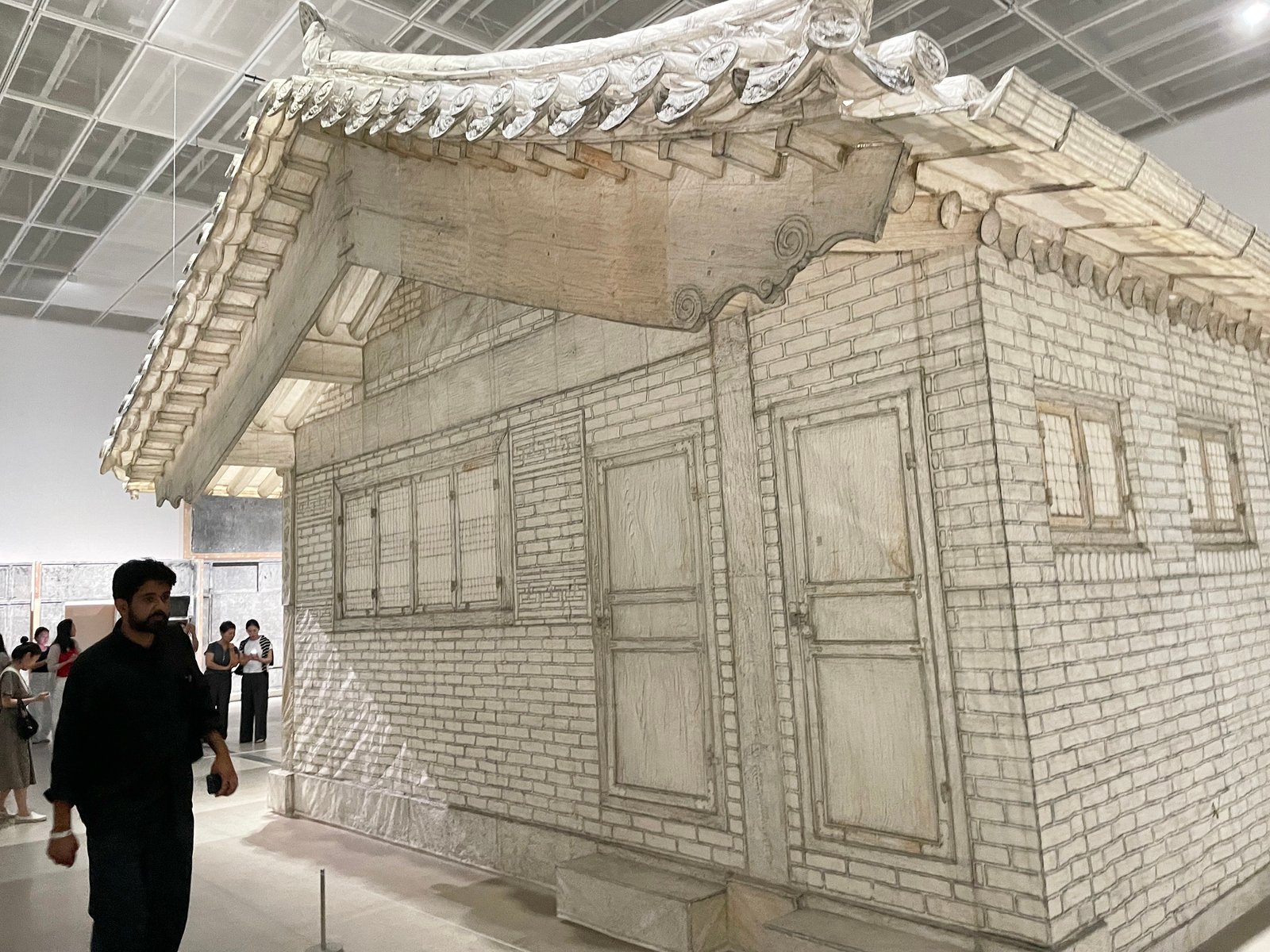
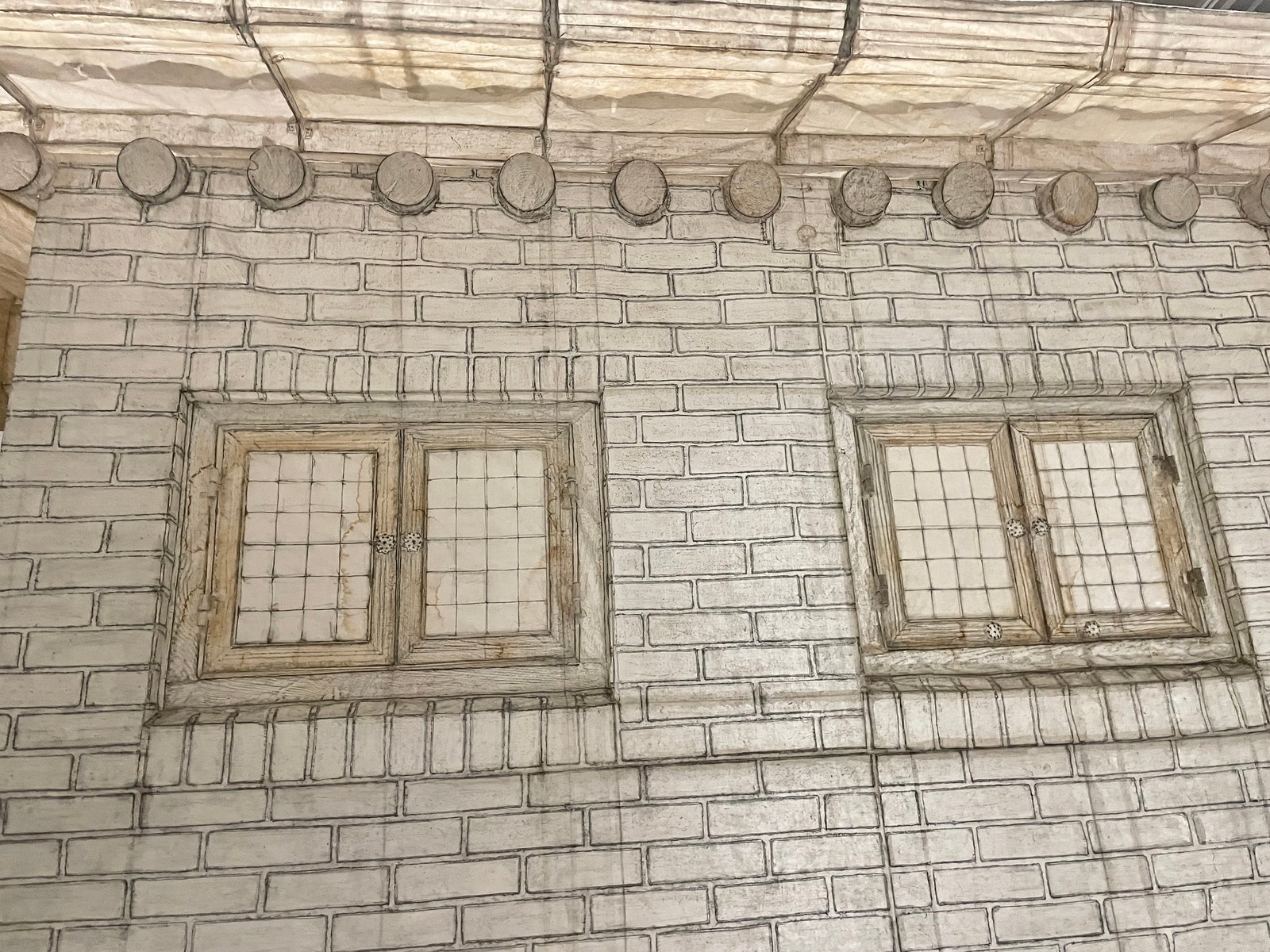
In short, the Do Ho Suh exhibition was kinda life changing. Suh (born in Seoul; lives and works in London) is best known for his irl-scale sheer fabric sculptures that reconstruct the various homes he has lived in during his lifetime — the home being a space that comes to contain a certain psychospatial energy. And let me tell you, I was Psychospatially Energized. Every plane of Perfect Home: London, Horsham, New York, Berlin, Providence, Seoul (2024), including the ceiling, is adorned with doorknobs, wall phones, outlets, lamps, and other home fixtures from Suh’s life, all lifesize in delicate, bright fabric. It felt like being inside a giant bowl of Lucky Charms cereal. I know the word whimsical is a bit of a touchy word right now but that’s truly what it was. Seeing Rubbing/Loving Project: Seoul Home (2013–2022) in person, I genuinely thought I might cry. The work is made entirely of paper rubbings of the hanok home where Suh grew up, constructed to scale in the gallery space. Rubbing as an act of love is the main conceptual crux of the work, but there’s also this bilingual wordplay with how “rubbing” and “loving” sound the same in English when pronounced by a native Korean speaker. There’s something about that that will always make me emotional… Probably something having to do with some sort of diasporic grief… No need to get into all that here, but all this to say that the Do Ho Suh exhibition at MMCA is a must see.
I had about an hour to kill before I was to meet a girl from Instagram who had messaged me that she was working the ArtDrunk cart in front of Kukje Gallery. I spent that time wandering through the other open Samcheong Night galleries, popping in and out of Gallery Chosun, Hakgojae Gallery, Kumho Museum of Art, and Gallery Hyundai – all of which were brimming with bodies but not much else interesting. When I got to Kukje, host of the official Samcheong Night party until midnight, there was an insane line for the free food catering and every gallery room was teeming with people of all ages – and seemingly of all levels of artistic inclination – among Park Seo-Bo’s paintings. I had never seen that much free food and drink at an art event in my entire life. Like there was something about it that made me feel proud almost, that the Korean art scene was presumably so vibrant and financially healthy enough to offer such Abundance. None of the Frieze-adjacent events I went to in LA this past February had complimentary food and the Kiko Kostadinov × ASICS Ryan Trecartin presentation was the only one I remember with an open bar. Does the amount of complimentary consumables at an art event accurately indicate its wider art scene’s health? Such generosity and abundance being offered by an arts institution to its public… It was a culture shock to me, an American.
Does the amount of complimentary consumables at an art event accurately indicate its wider art scene’s health?
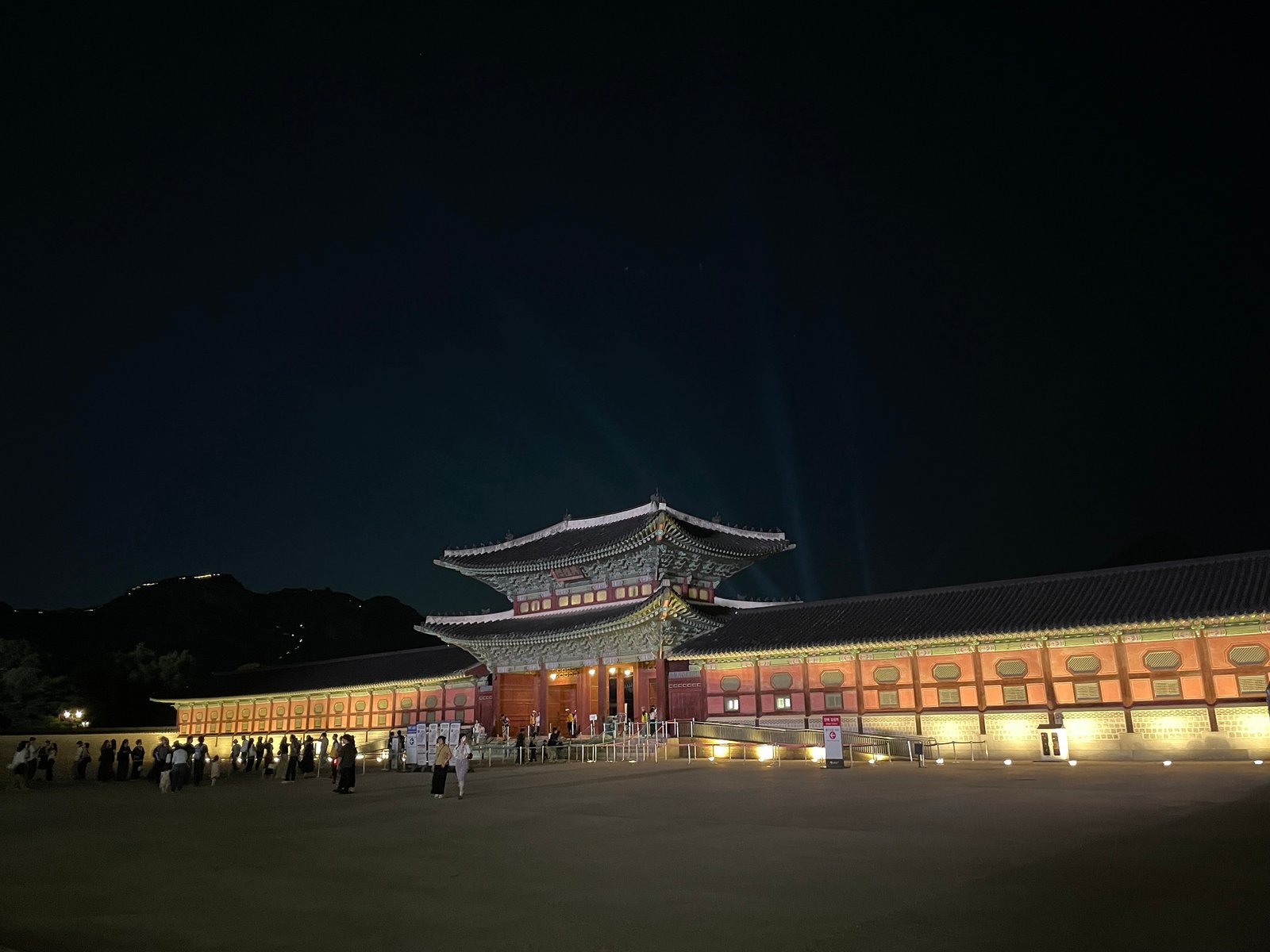
Eventually I found the ArtDrunk cart and met [name redacted] who was so sweet and gave me one of their Frieze week Survival Kits. It included some hangover jelly and instant Americano sticks and I just thought that that was so Korean. Lol. There wasn’t really any artwork in all of my Samcheong Night gallery-hopping that I was moved by. I was there to vibemaxx anyways, but I left early to walk through Gyeongbokgung Palace and went to bed that night hopeful that I’d see something Amazing Awesome Insane Lifechanging or at the very least Memorable at the fair.
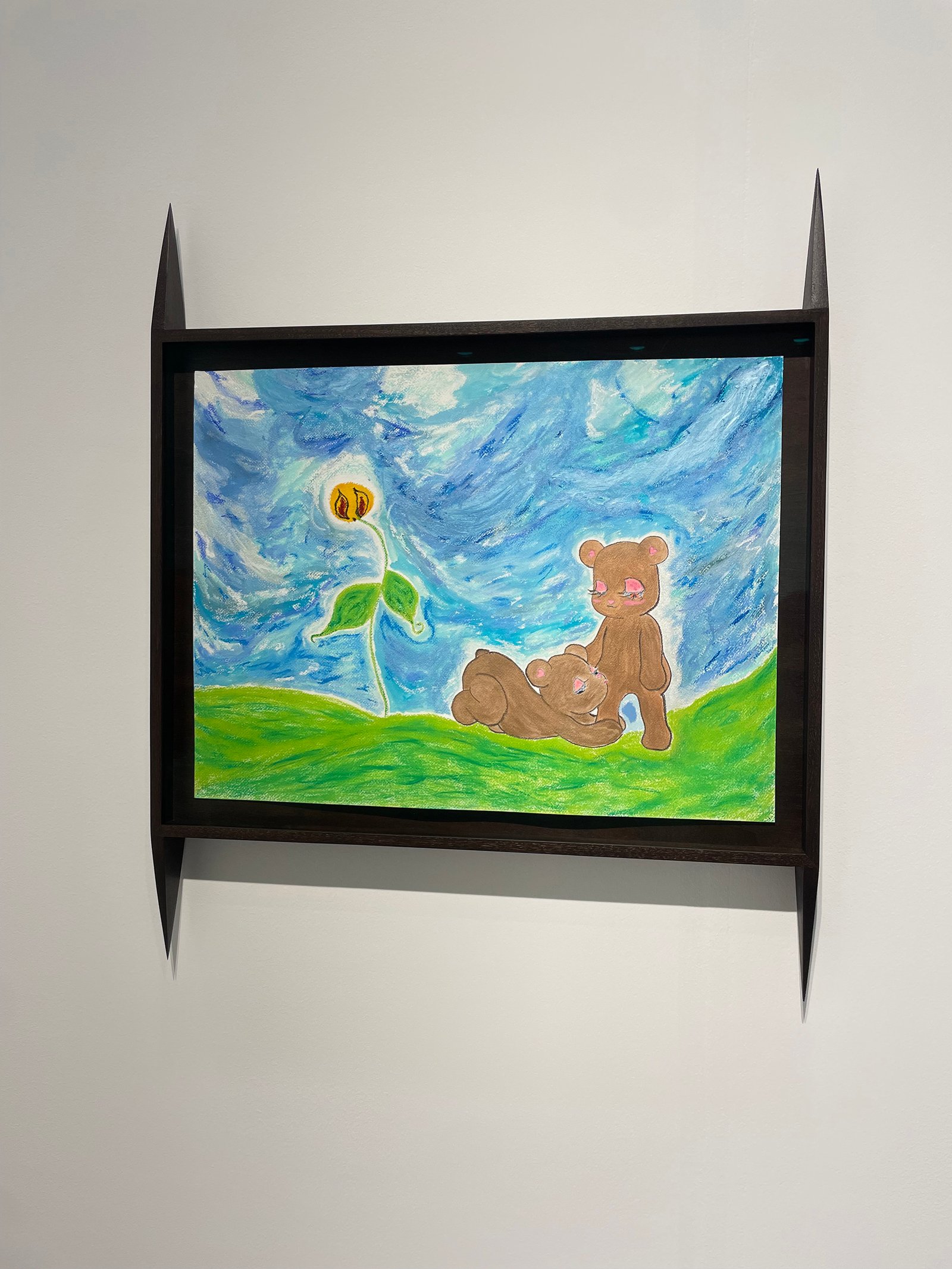
The next day, I made my long arduous trek over to Gangnam (I’m staying with relatives in the west tip of Seoul) to the COEX center hosting both Frieze and Kiaf. I started at Frieze, wandering the maze of booths in that giant white hall like some flâneuse without any gallery to beeline for. I think this is the ideal approach to experiencing a fair or any situation where there are hundreds if not almost a thousand artworks in one place; keeping an open heart, mind, and eye to whatever piques your interest – which, for me, tends to be works that lean heavily on a certain feminine sensibility.
My favorite works, in no particular order:
Ryan Gander with Lisson
*The thermals made me lazy, or The squatters (Smoky meet Monk’s Deflated Sculpture II (2009))*, 2020
Precious Okoyomon with Mendes Wood
*I pray for that which I cannot hold*, 2026
*I swear to you I’m going to get what I want*, 2026
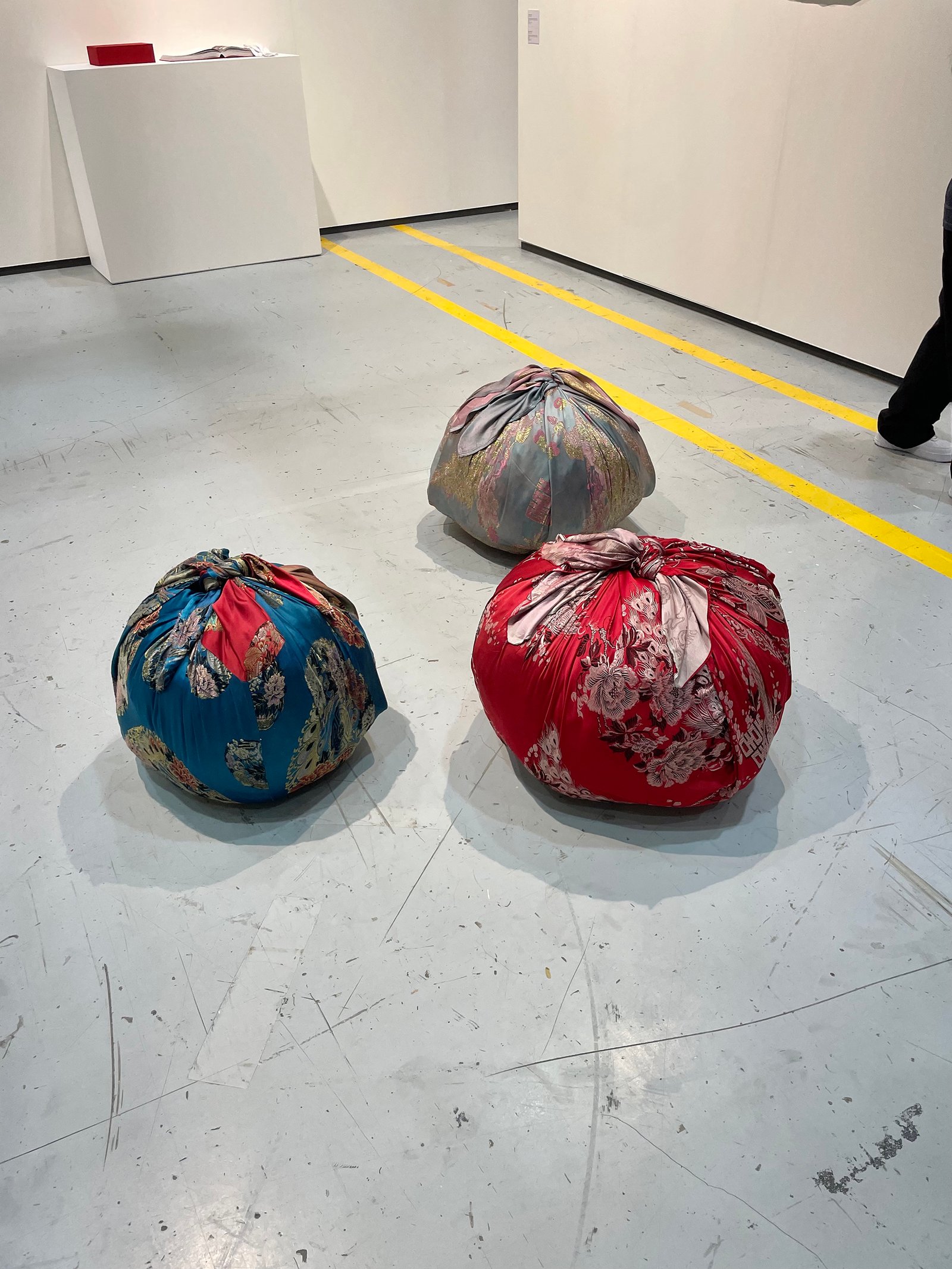
Kimsooja with Axel Vervoordt Gallery
*Bottari*, 2022-2026
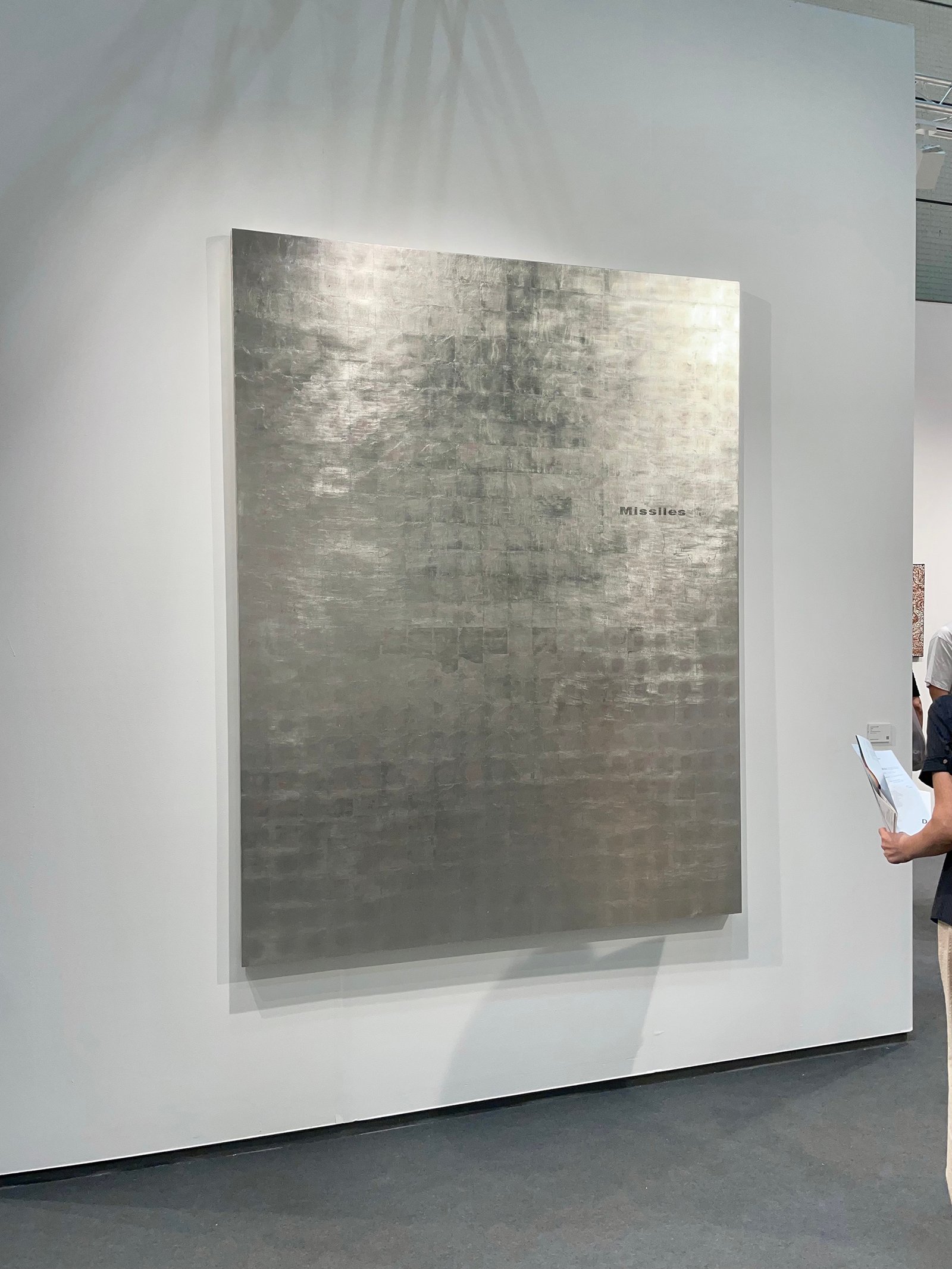
Jenny Holzer with Kukje Gallery
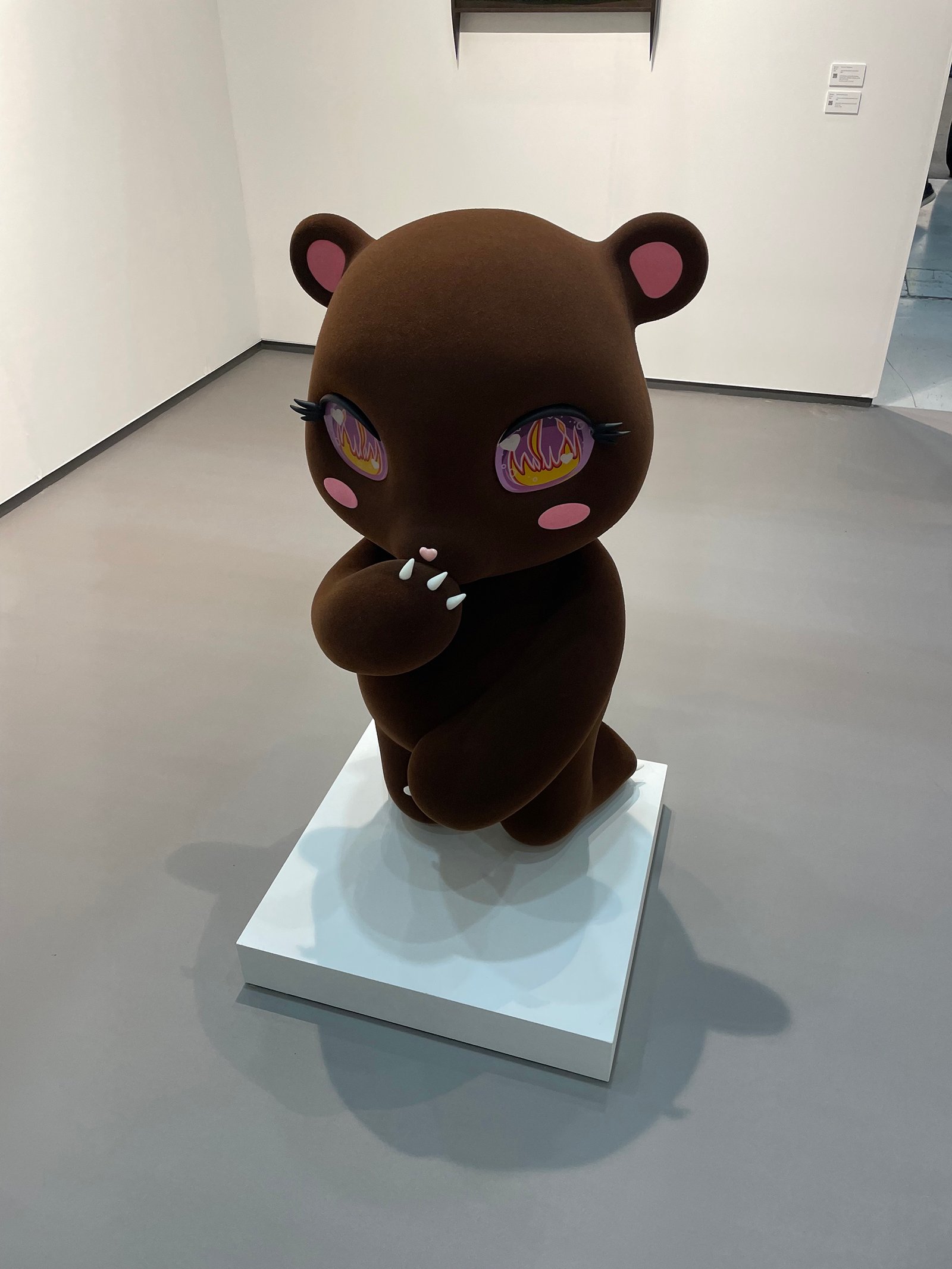
*Missiles*, 2024
Sylvie Fleury with Sprüth Magers
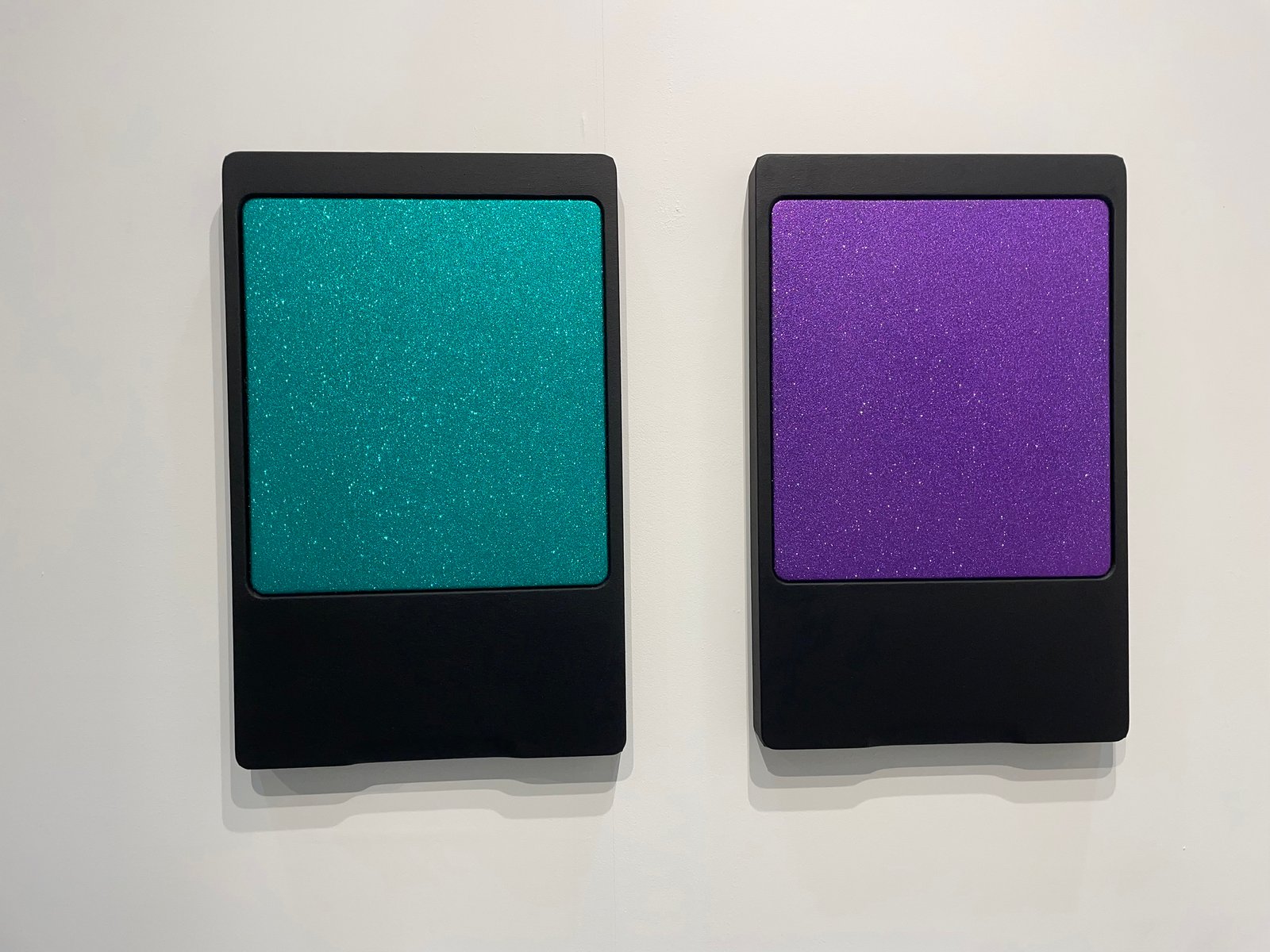
*Wet & Wild (Turquoise)*, 2017
*Wet & Wild (Purple)*, 2017
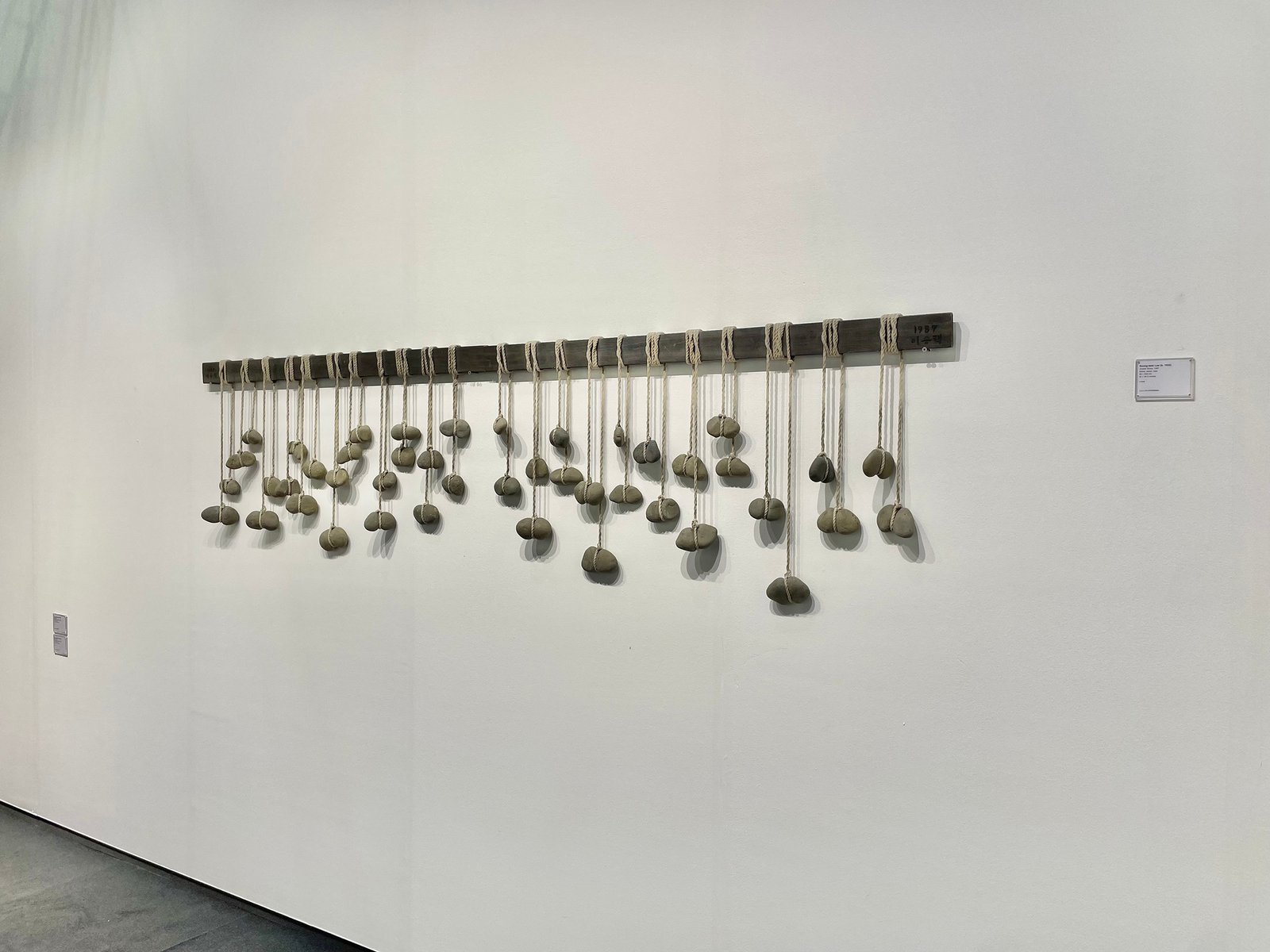
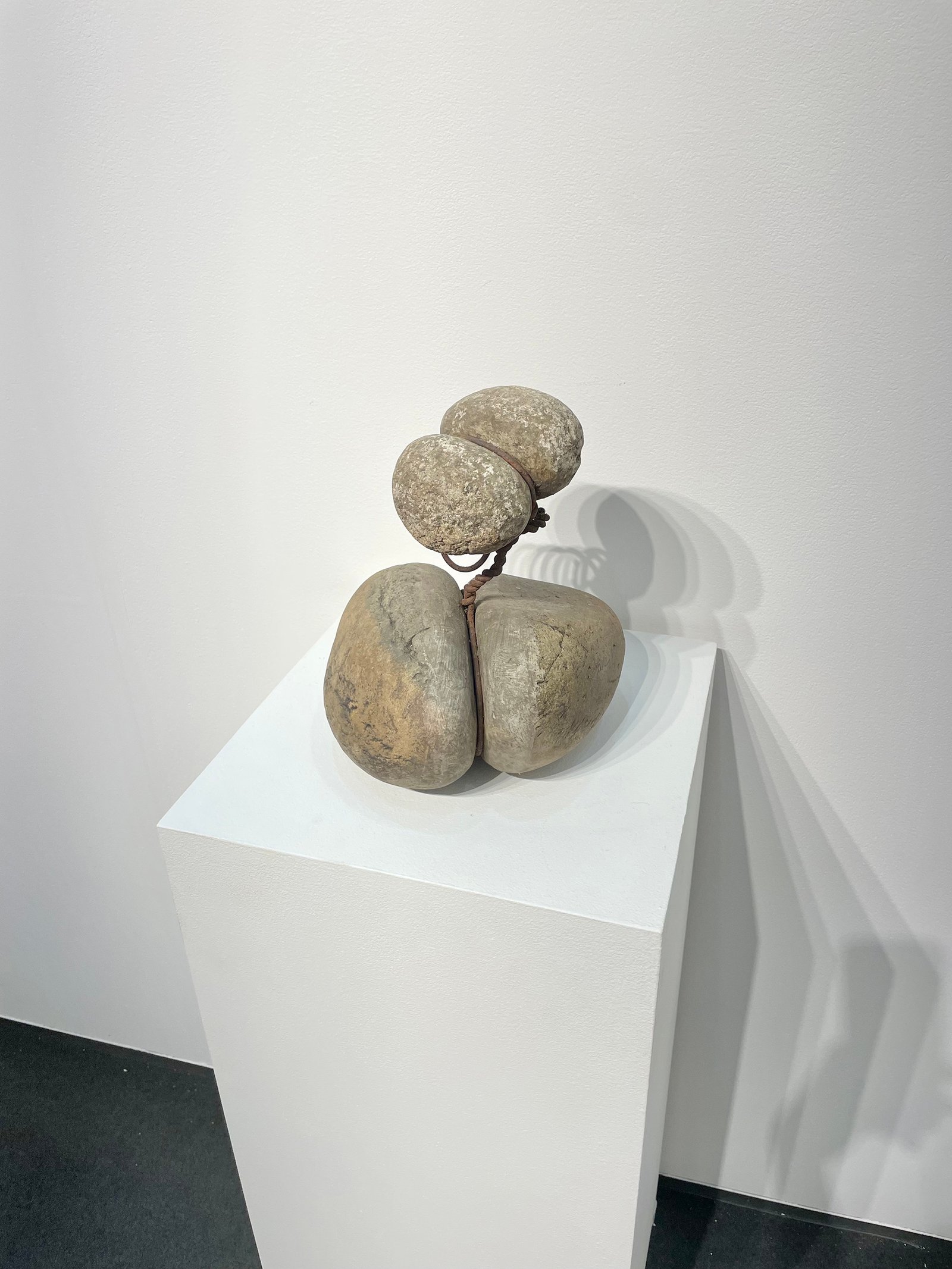
Seung-taek Lee with Gallery Hyundai
*Godret Stone*, 1987
*Tied Stone*, 1985
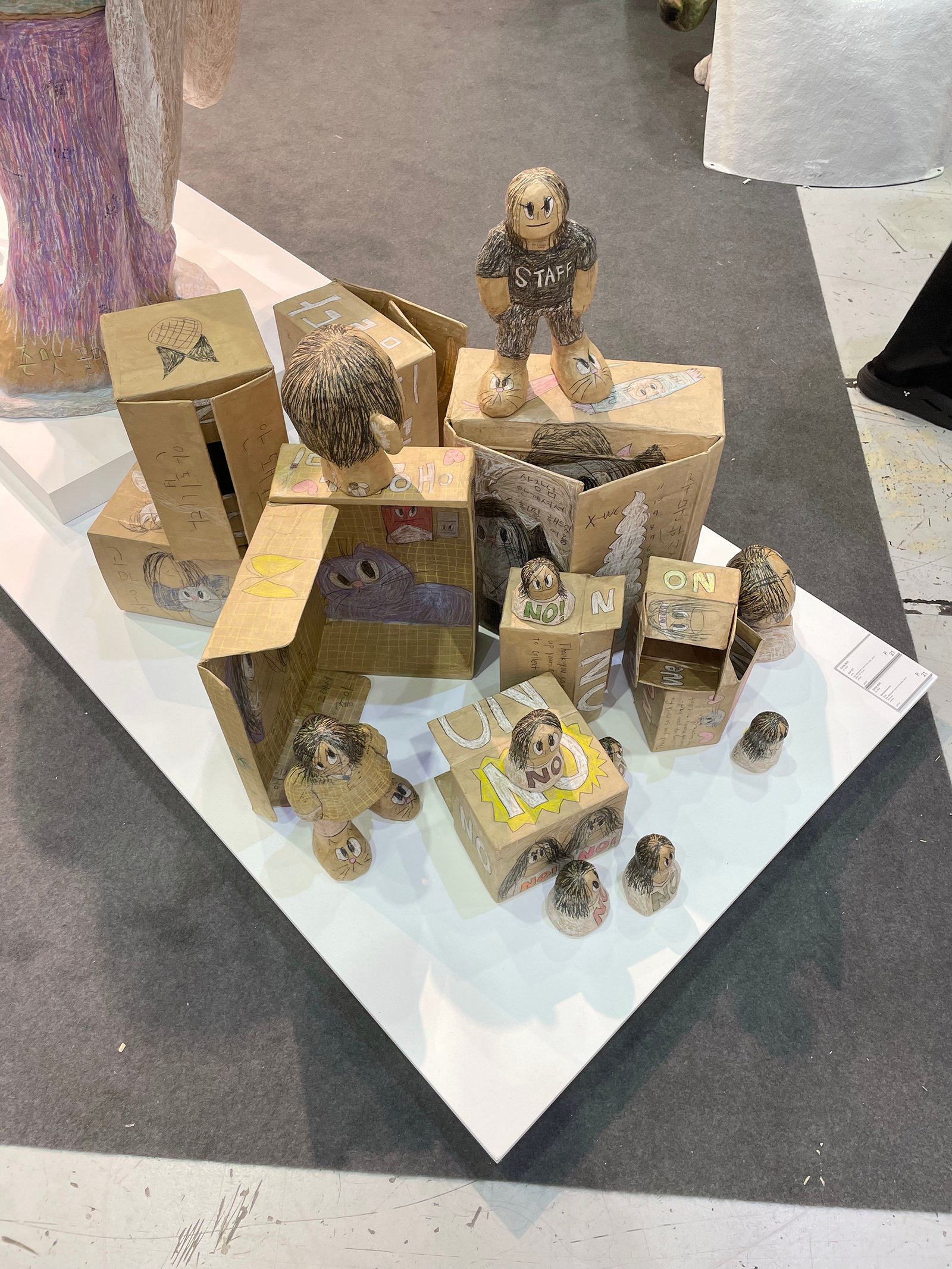
Shin Min with P21
*Milk*, 2026
*Nononononono*, 2026
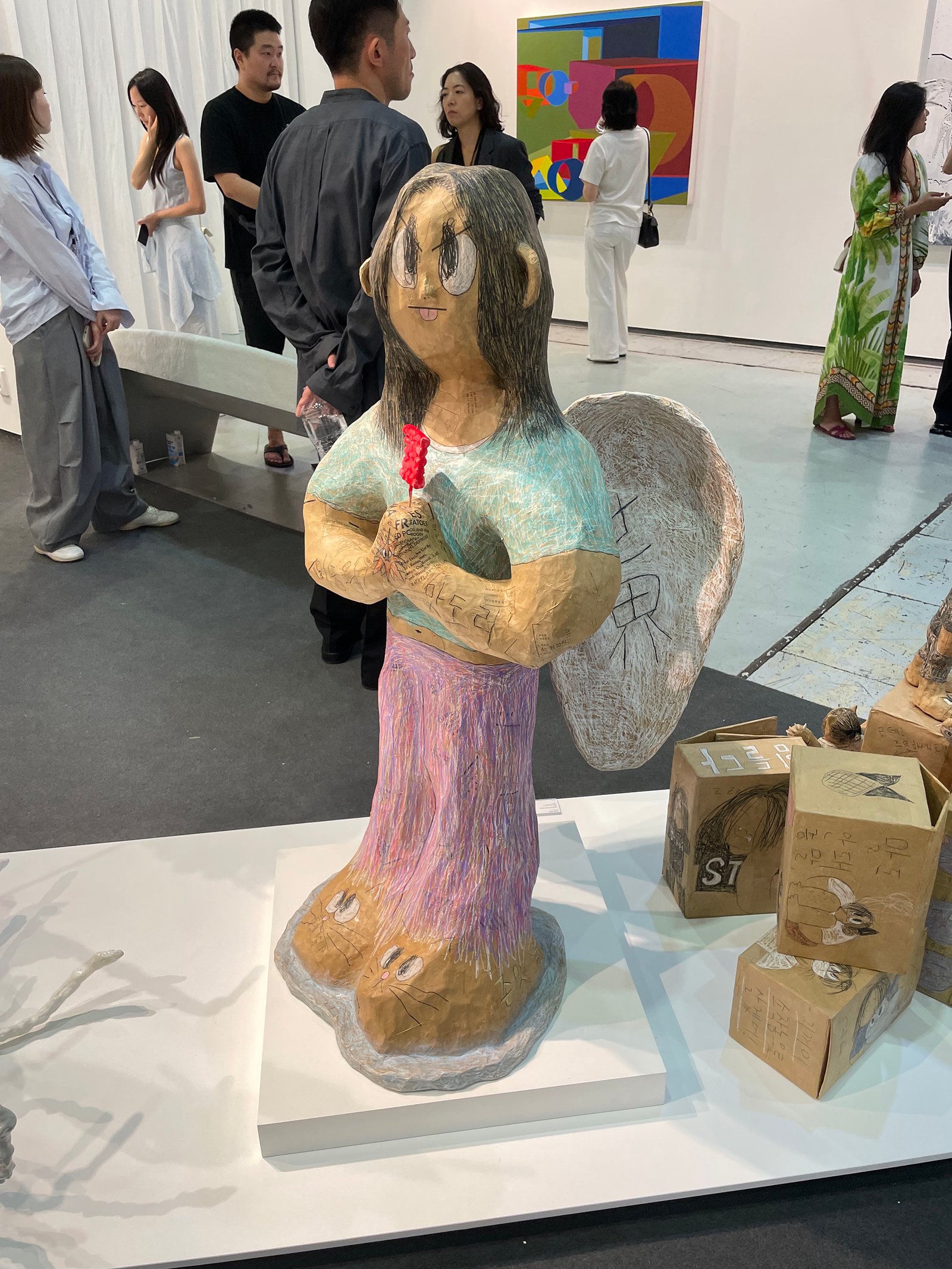
*Tteokkochi Angel-Siwon*, 2026
Zangano with Kaikai Kiki Gallery
*room*, 2026
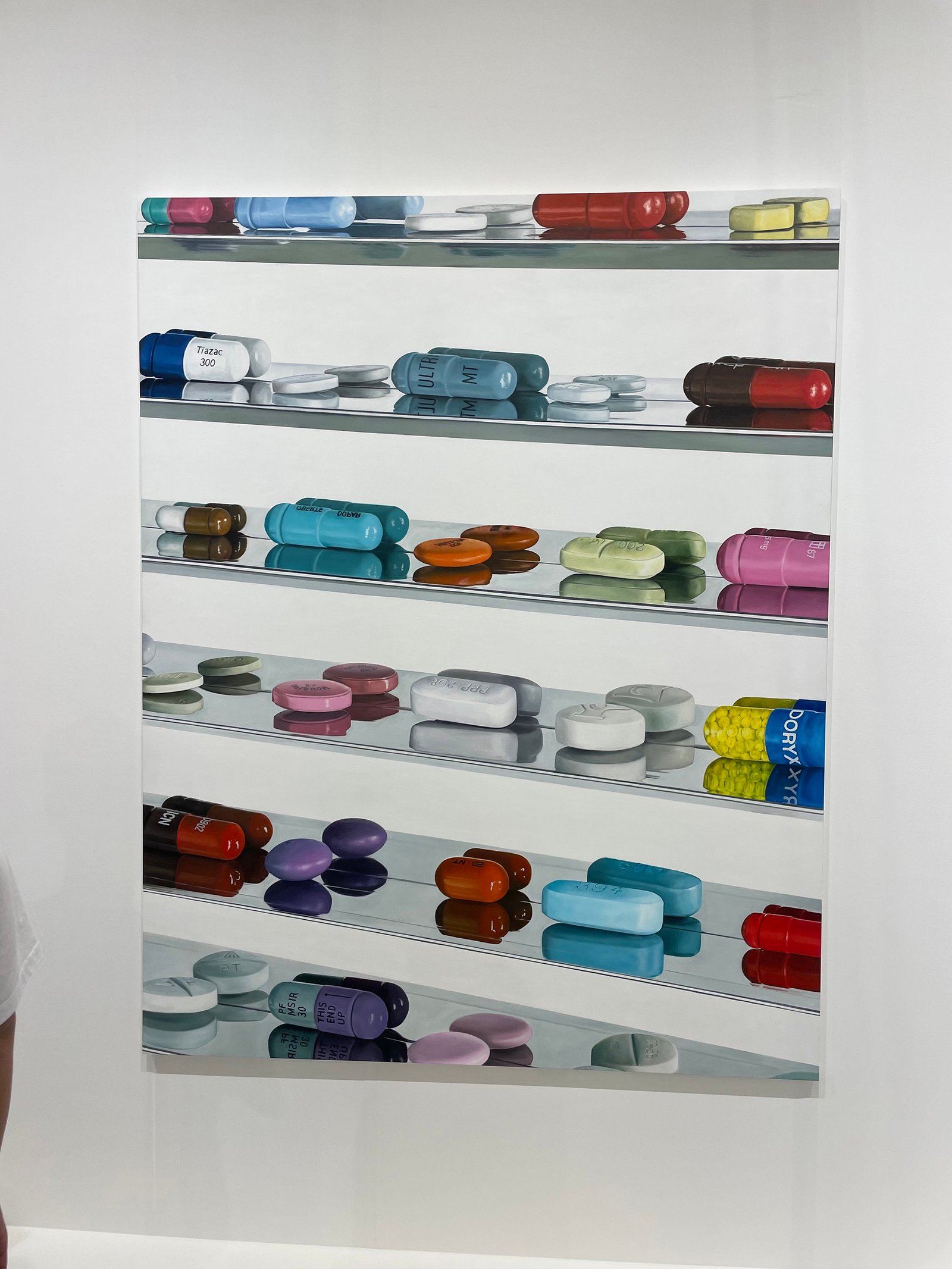
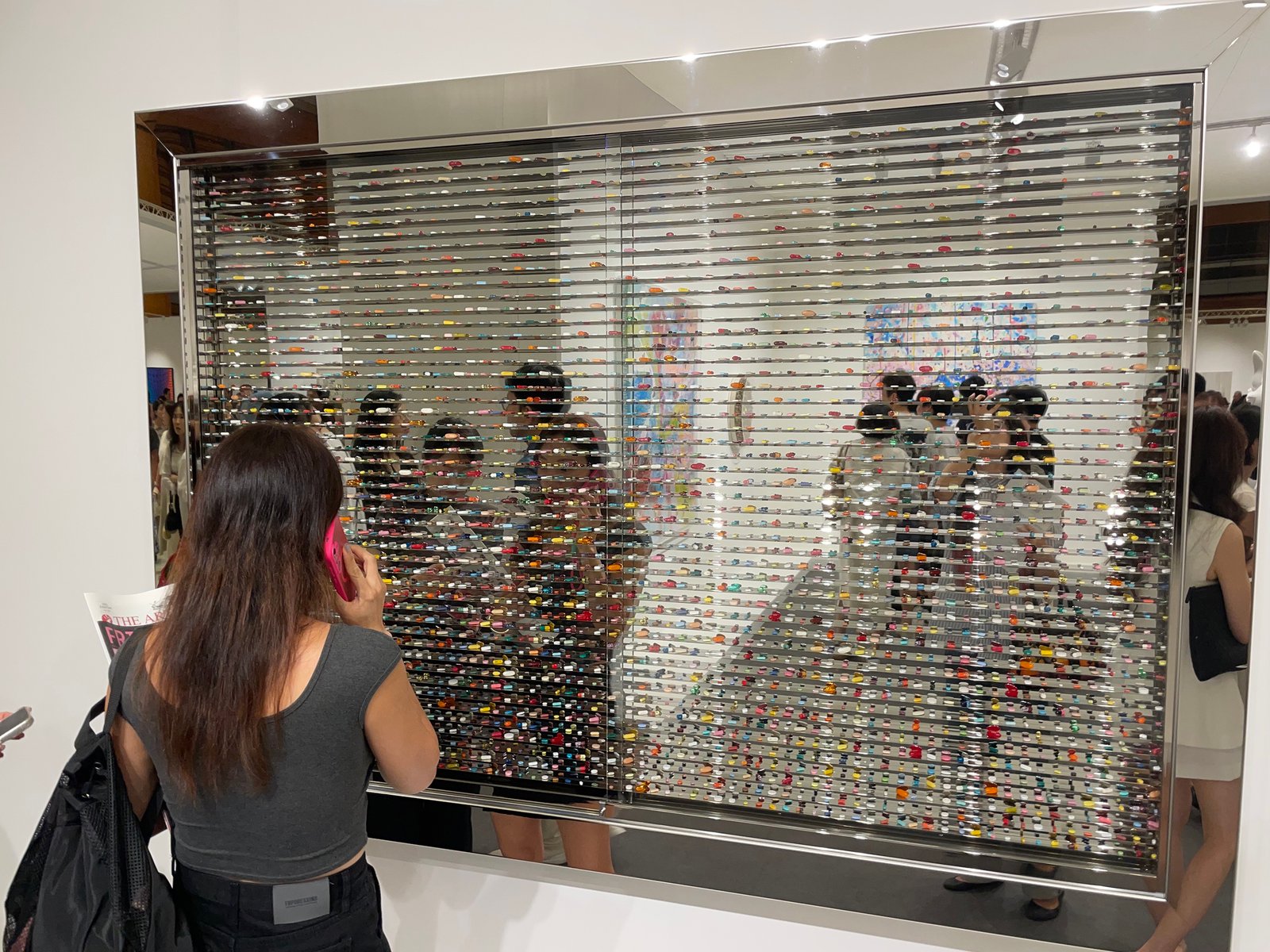
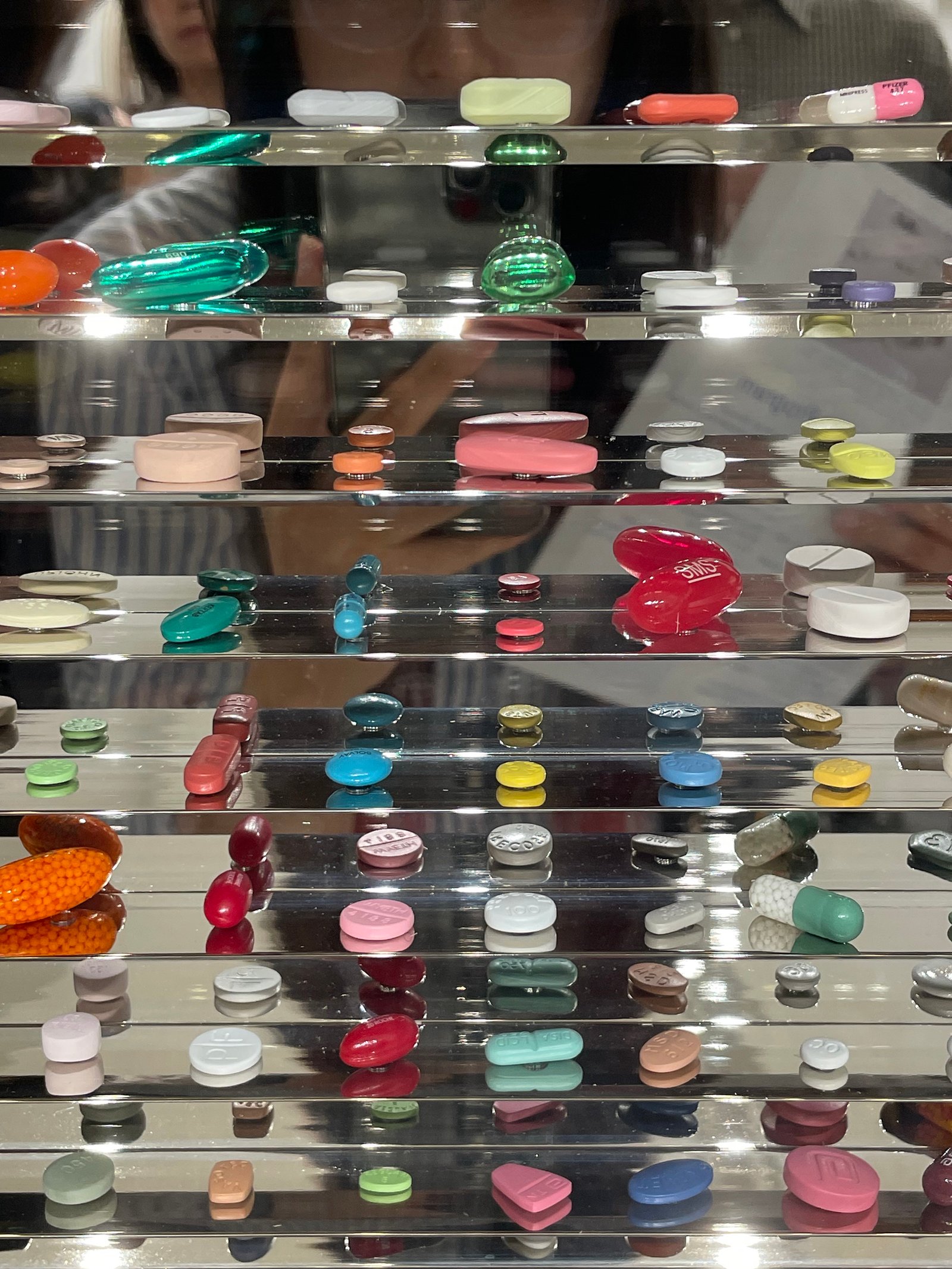
Damien Hirst with Gagosian
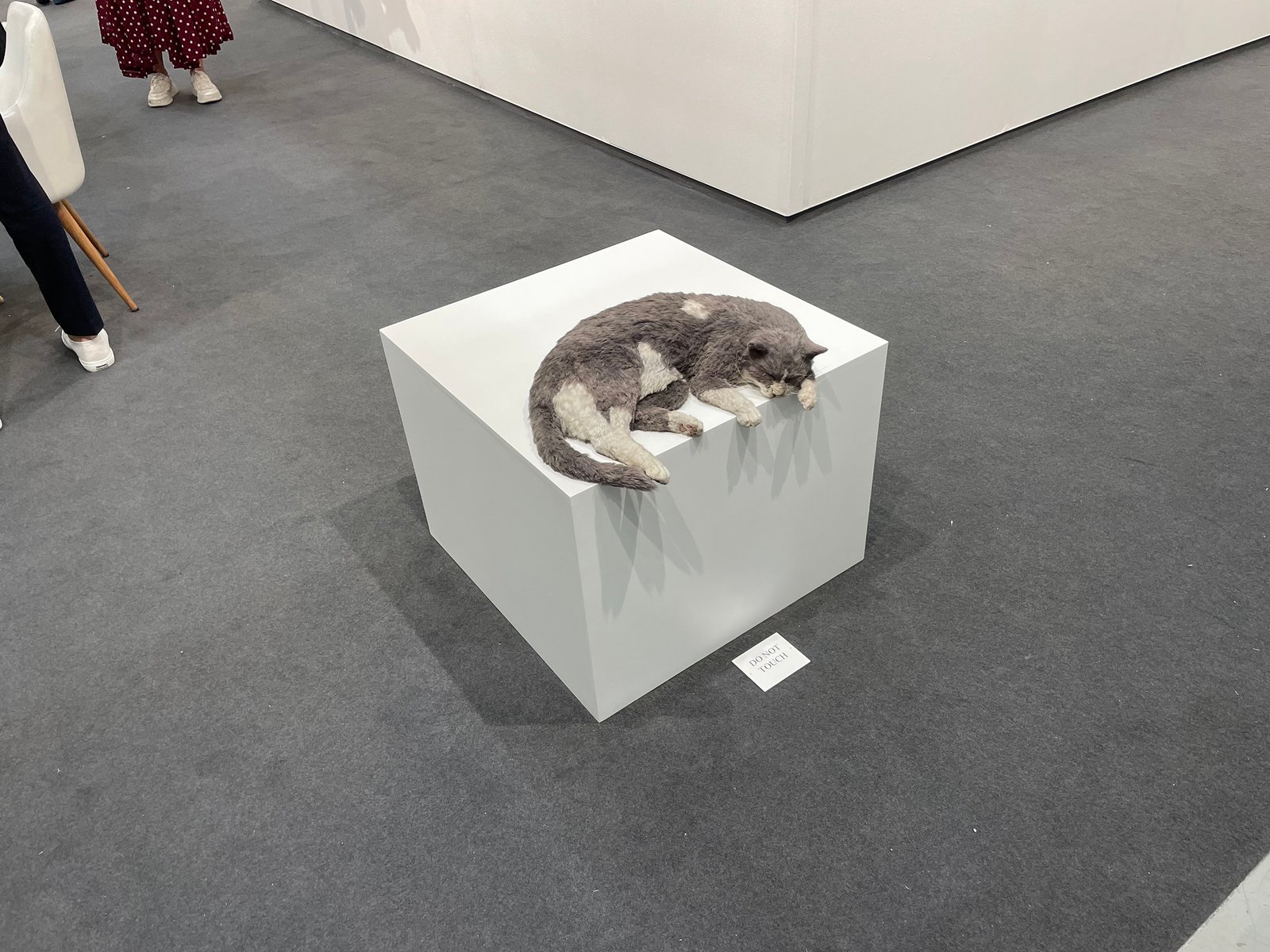
*Pharmaceuticals*, 2005
*Nemesis*, 2007
Featuring the girl who stood in front of it for at least 10 minutes taking a phone call while everyone patiently waited behind her to get a better picture… Honestly #fab of her…
Three with Whitestone Gallery
*5679g*, 2026
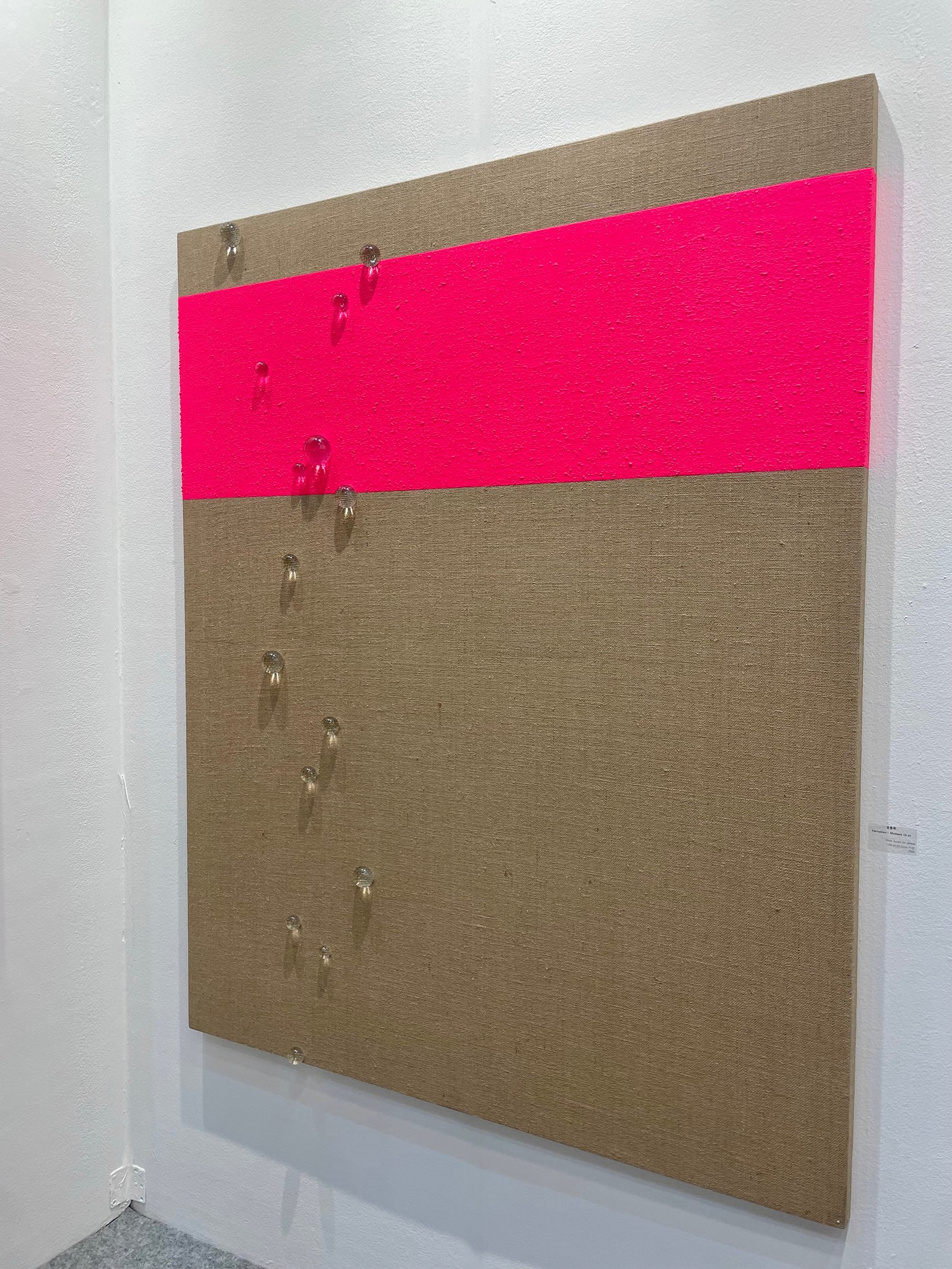
Yoo Choongmok with Allme Artspace
*Formation - Moment 10-31*, 2022
My favorite piece from the entire fair!!!!! J'adore…
At a certain point I got tired of the art and felt I had pretty much seen everything I needed to see at the Frieze side. I’d been there for about an hour, which made me feel like I maybe went too fast. So even though I was tired as shit, I forced myself to keep walking between the booths. To appease my bored, dopamine-addicted attention span that thirsts for Reels, I kept myself stimulated by keeping a Chanel bag and Birkin tally in my Notes app. When the count of Chanel bags reached 26, that started getting boring too, so I changed my criteria to increment my counter only if it was a non classic flap. Once my Chanel bag counter reached 40 and Birkin counter 4, I sat down in the corner to rest and post on my Instagram Story – as one should mid-fair.
When the count of Chanel bags reached 26, that started getting boring too, so I changed my criteria to increment my counter only if it was a non classic flap.
I posted about the popular bags I was seeing (the Goyards, Issey Miyake Bao Baos, Balenciaga Cities) and their respective demographics of choice – the points for which I don’t need to reiterate here. After the bag counting game got boring, I started playing Sweet or Sour, where you look out the back of the bus and smile at the passing drivers to see which smiled back (sweet) and which didn’t (sour). My Frieze-adaptation of the game essentially entailed speedwalking by the booths, making very overt eye contact with the gallerists huddled at their corner tables and smiling at them to see what my hit rate would be. I ended with 6 sweet and 41 sour before taking the escalator to Kiaf.
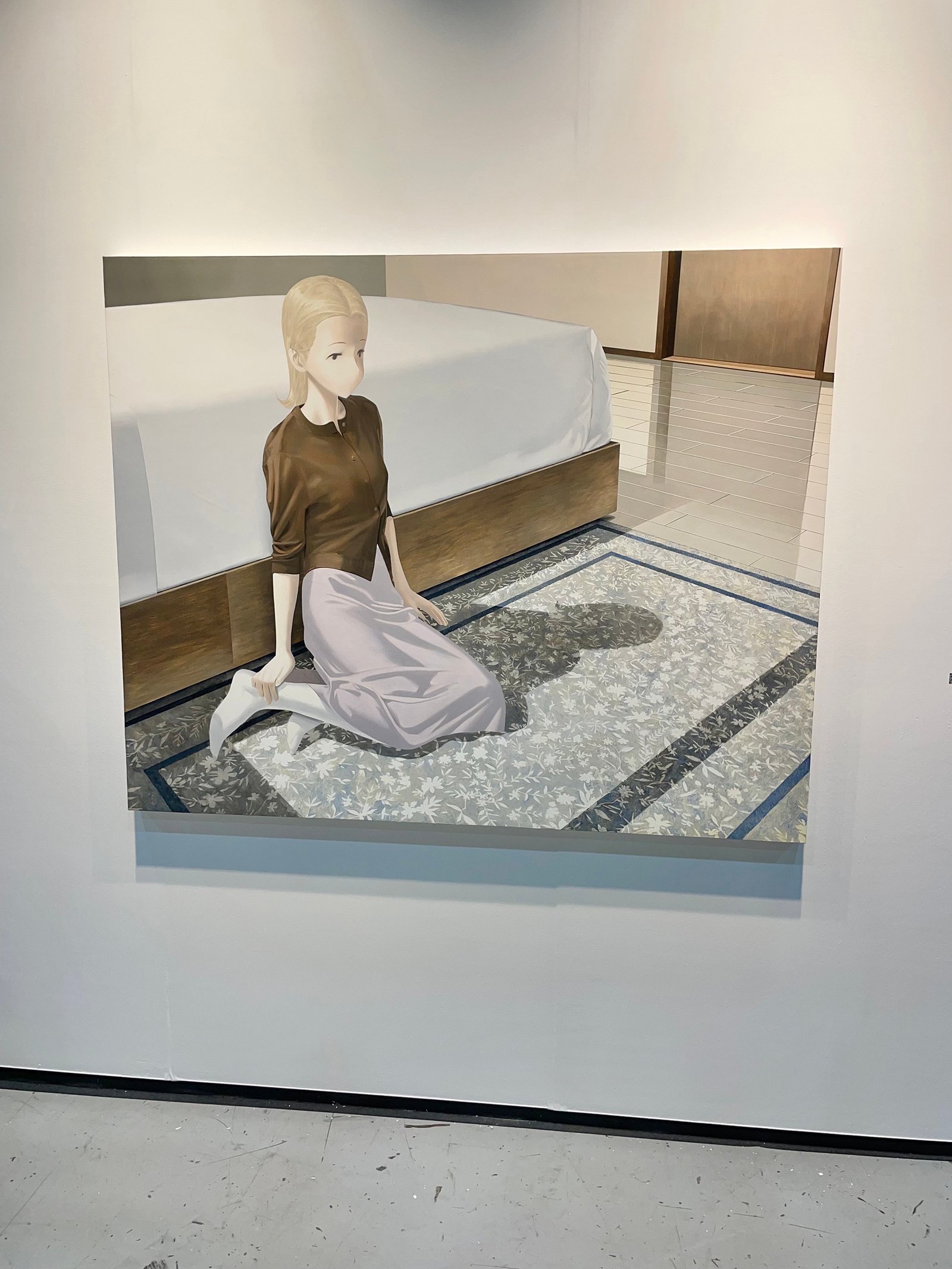
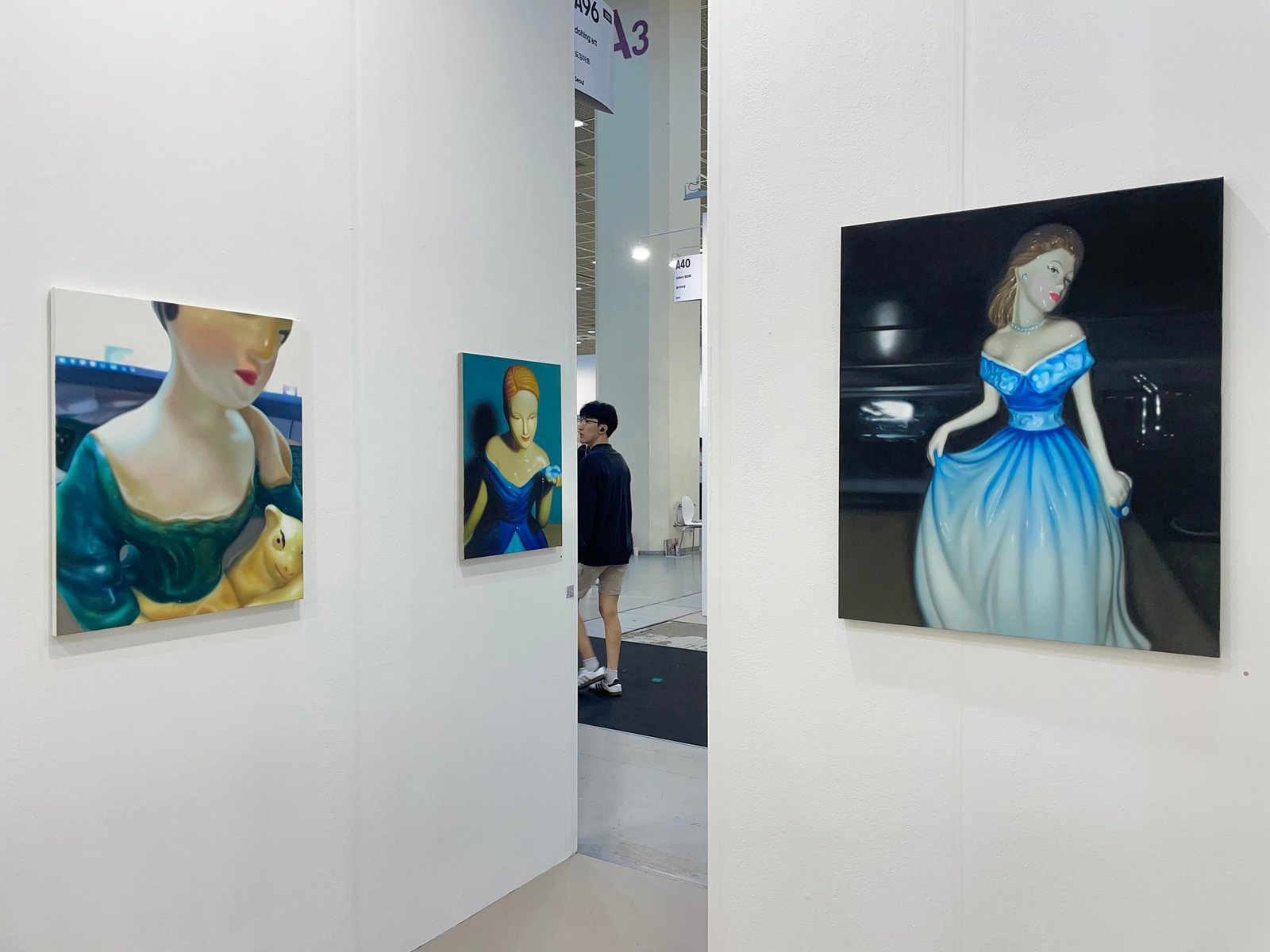
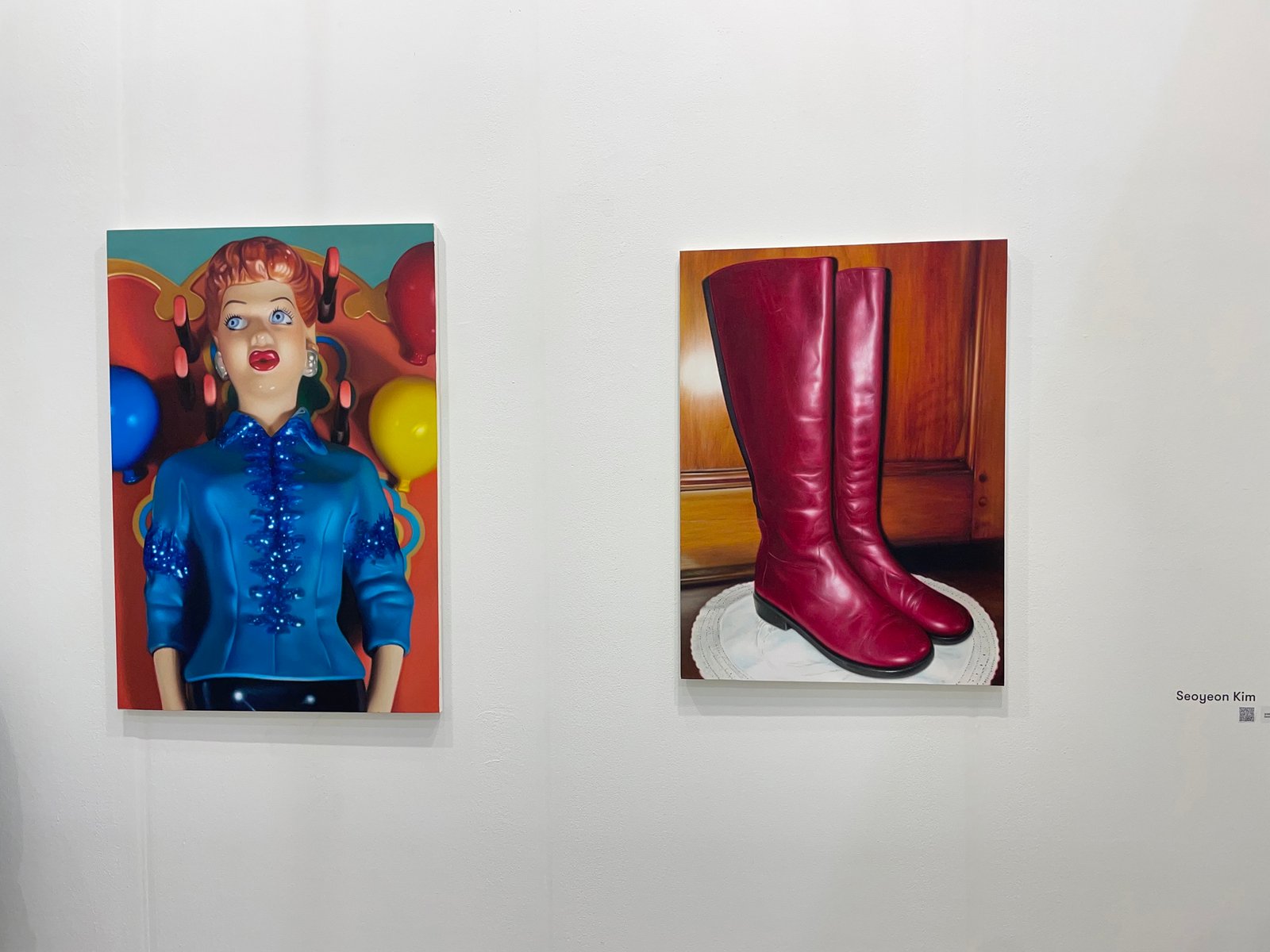
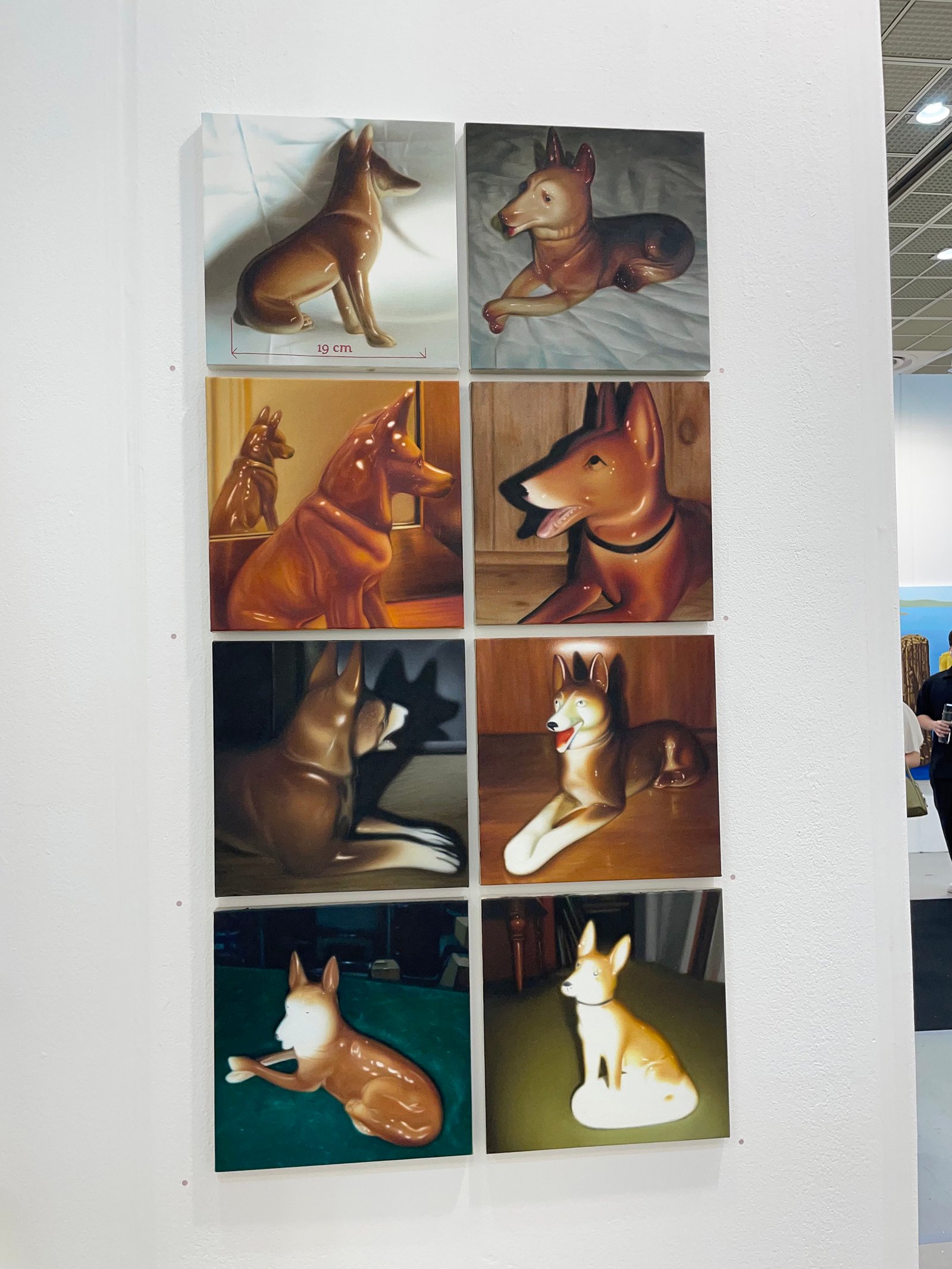
My favorite booth from the entire day was Dohing Gallery on the Kiaf side. They showed these insane, hyperrealistic paintings of porcelain doll objects by Seoyeon Kim. When my aunt went the next day, she said that all of Seoyeon’s work had been sold. Kiaf had more of the pop-art, kitschy, tasteless works like glittery paintings of Chanel and Nike sneakers, rhinestoned Buddha and KAWS-type sculptures, and this one booth I was honestly so enthralled by because they juxtaposed Keith Haring works on a wall adjacent to these hentai cat girl paintings and it was all just so abominable that it brought a genuine smile to my face.
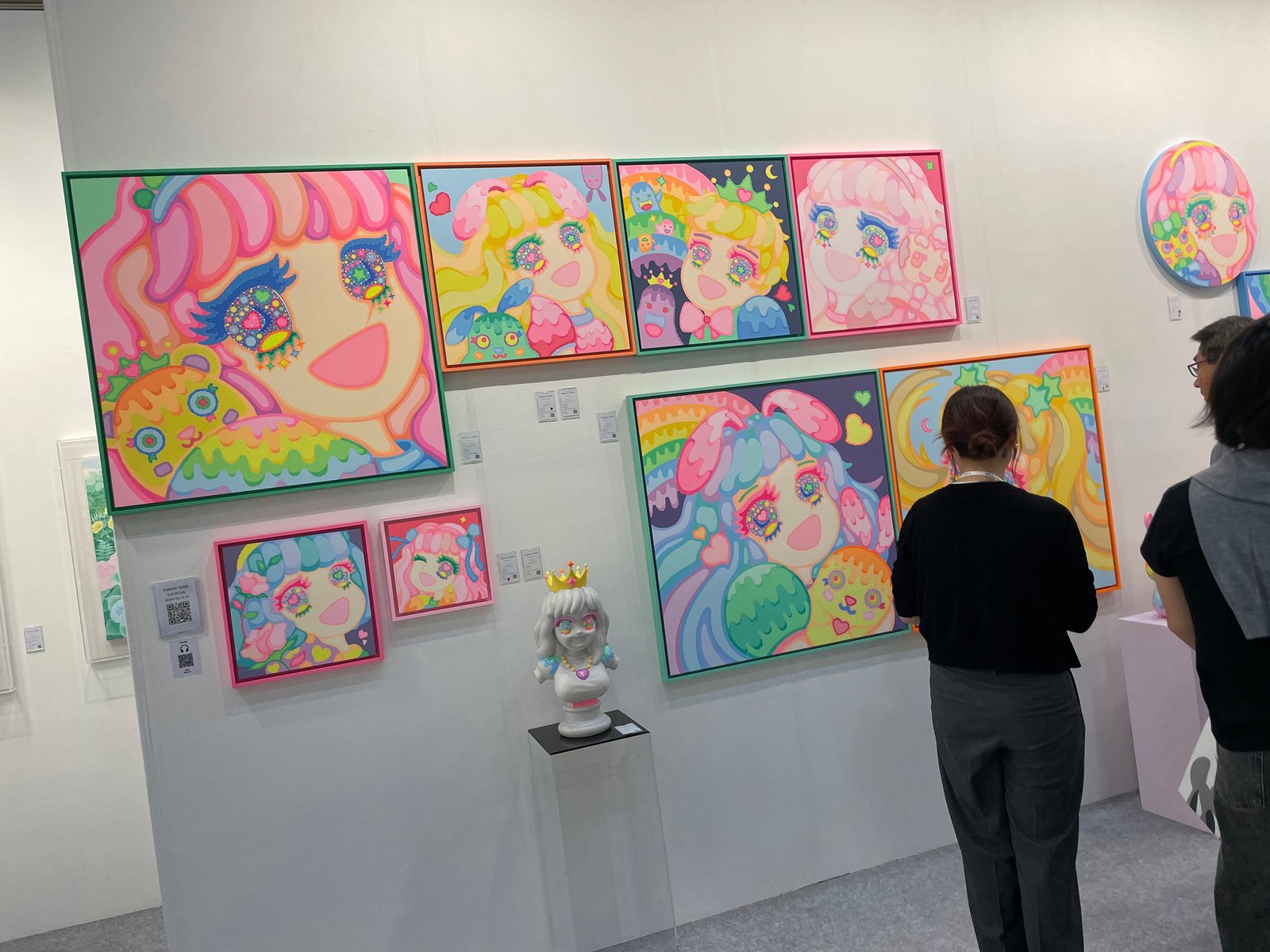
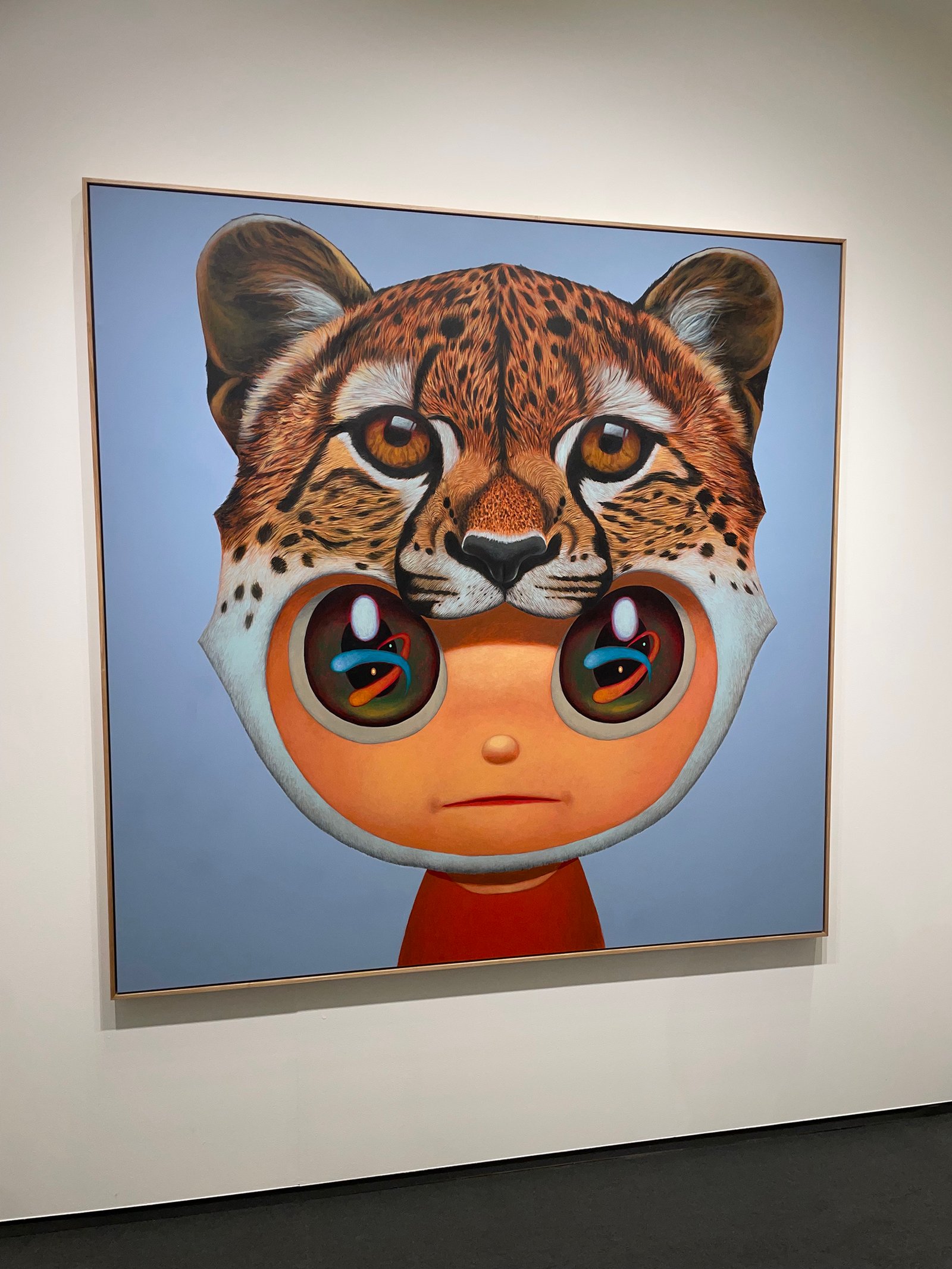
Something I had also noticed across both fairs was that nearly all the Japanese galleries do cute, in the sense that the cute art object appears to be the dominant theme. Cute as a mode – not just for the artists in creating these cute-entrenched, Yoshitomo-Nara-esque works but seemingly for the galleries as well. Almost like the cuteness as branding felt like their approach to selling the work. What felt like leaning heavily into the Orientalist stereotypes that conflate cuteness with East Asia and especially anything Japanese was done to such an overt extent that it almost felt like some radical act of autonomy… a reclamation of kawaii… perhaps even the cute as a mode of self-determination… But this is my generous reading of it dressed up in big words; many of these works were low-vibrational and spiritually-obsolete, or just not my cup of tea but were probably low-hanging fruit enticing to Korean chaebols looking to decorate their newborn’s playroom in their Jeju vacation home, or something.
After perusing all that Kiaf had to offer, I plopped myself in the corner and took a moment to process all that I had seen. I had this epiphany that my approach to the fair – consuming as much as I could within a short period of time without any preordained direction or affinities – rendered my experience of the art into something akin to Clavicular’s speed dating stream. With all the options to see and with the speed at which I was consuming them, an artwork truly had a fraction of a second to pique my interest before I was already onto the next. I genuinely felt like Clav interrupting a girl mid sentence to dismiss her for the one behind her. But I think this Clav speed dating metaphor works really well because, like the power dynamic at play between Clav (who maintains the attitude that these girls are to impress him and not vice versa) and the girls (who come in eager to win him over), I approached the art with the attitude that they were to impress me, and had a mere second to do so. I didn’t have much of this willingness to give in to any piece or allow it to grow on me by really sitting with it – although, I did have my Woah Vicky (the Yoo Choongmok piece).
However, I think it’s important to admit my superficiality as a viewer, because the honest truth is that I only had a very surface-level interaction with the works. The conditions of the fair also make this so, simply because of the sheer mass of art to see, the absence of descriptive context, and the constant movement of foot traffic that unconsciously keeps your legs walking despite your eyes and heart maybe being glued to a piece. An art fair is not where you go to fall in love with an artwork. Or to fall in love. There’s nothing wrong nor depressing about this – most artworks for me fall into the category of Like and rarely into Love anyways – but I think this is what makes art fairs feel like a grand game of surfaces. I had more fun studying the people there than the works, but that is one of the pleasures that art offers; it brings people together. Cliché yeah I know, but true. At the very least, it creates a chance to fraternize with others around some shared aesthetic affinity and what else would you possibly want to do besides that? That is seemingly the predominant mode of living nowadays anyways and Frieze is really just a microcosm of it…
Till next time… Reporting from Seoul… Xoxo.. Yoona…
Artist Take
/ 7 September 2026 / By: Editorial Team
No Bra has a party to not go to, and she works harder at not going than most people work at going. Her own diagnosis of "Munchausen"...the compulsion to inflate celebrity affiliations and countercultural achievements, obscure bands, rare slash non-existent STDs, and not caring if the facts hold.
(No Bra Calling)
Is life how you imagined it as a child?
No, because I didn’t know any of the things I’m now doing existed, let alone that I could be doing them.
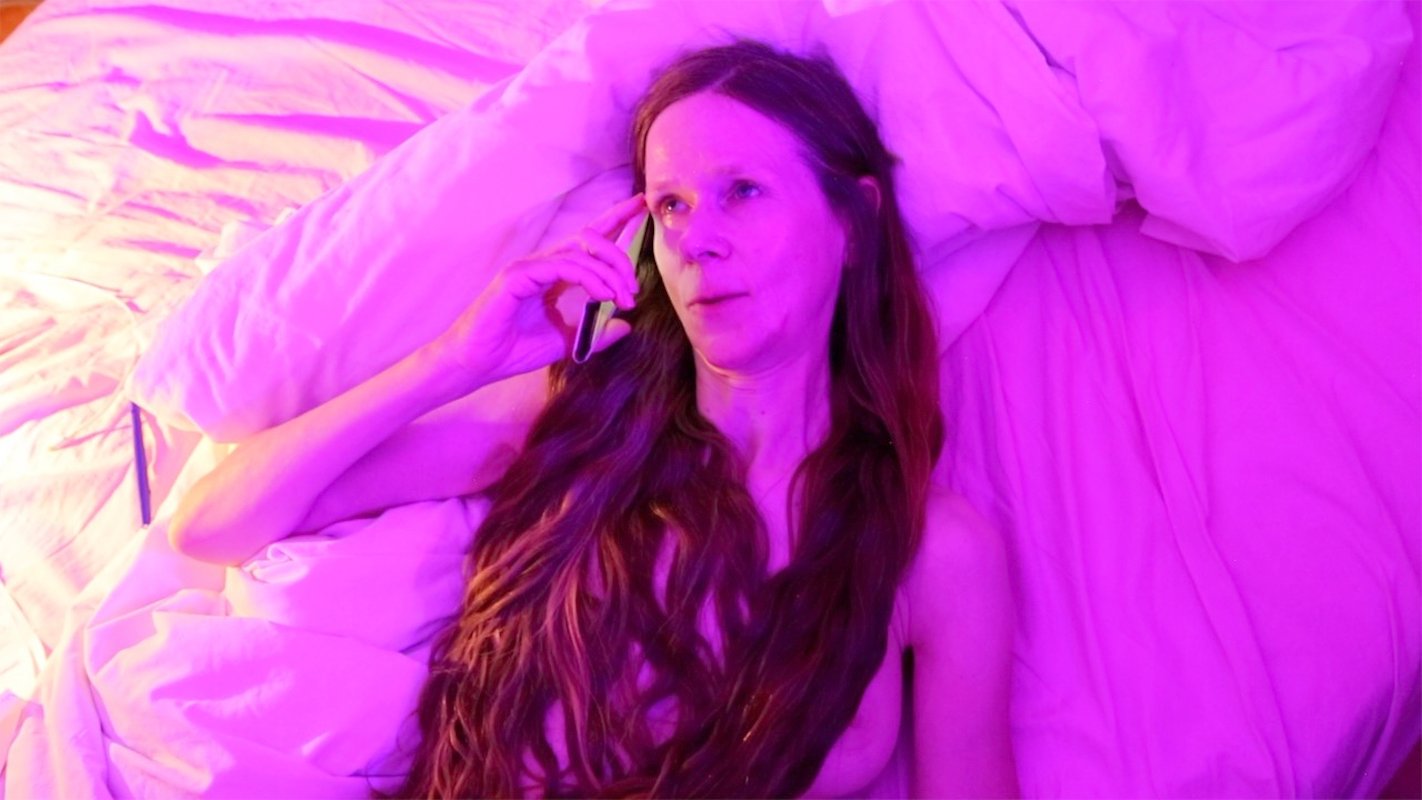
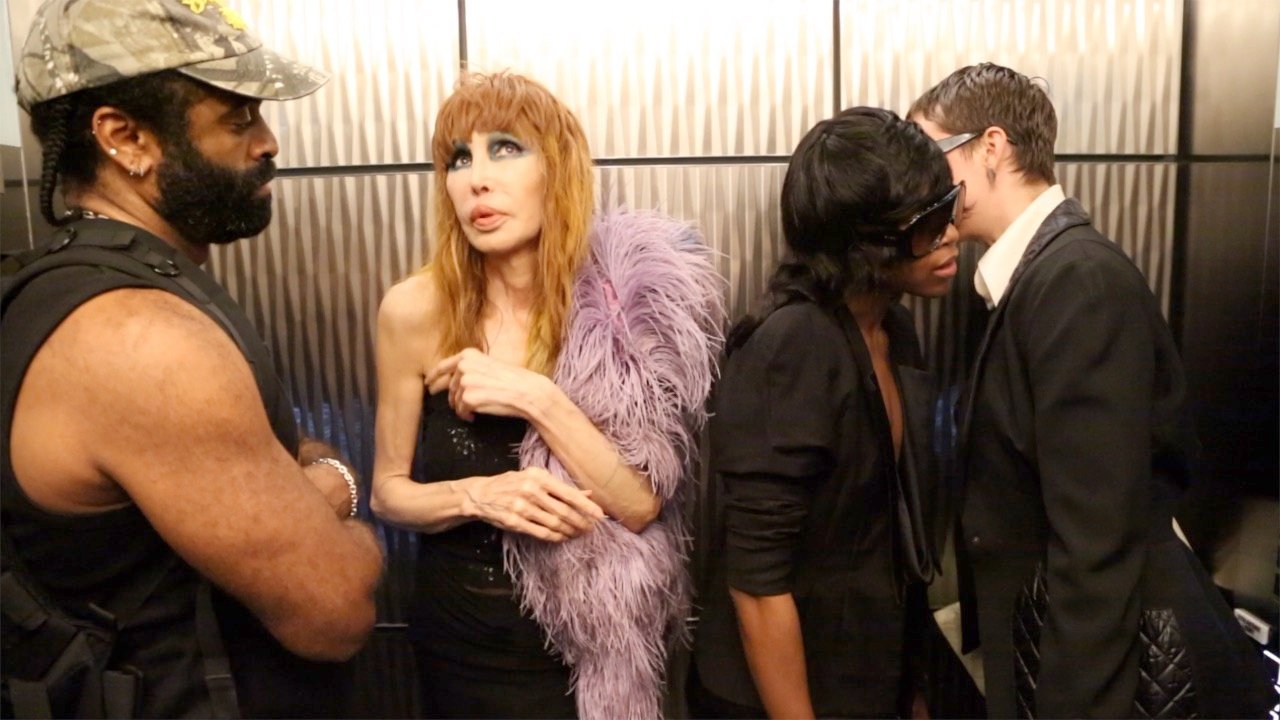
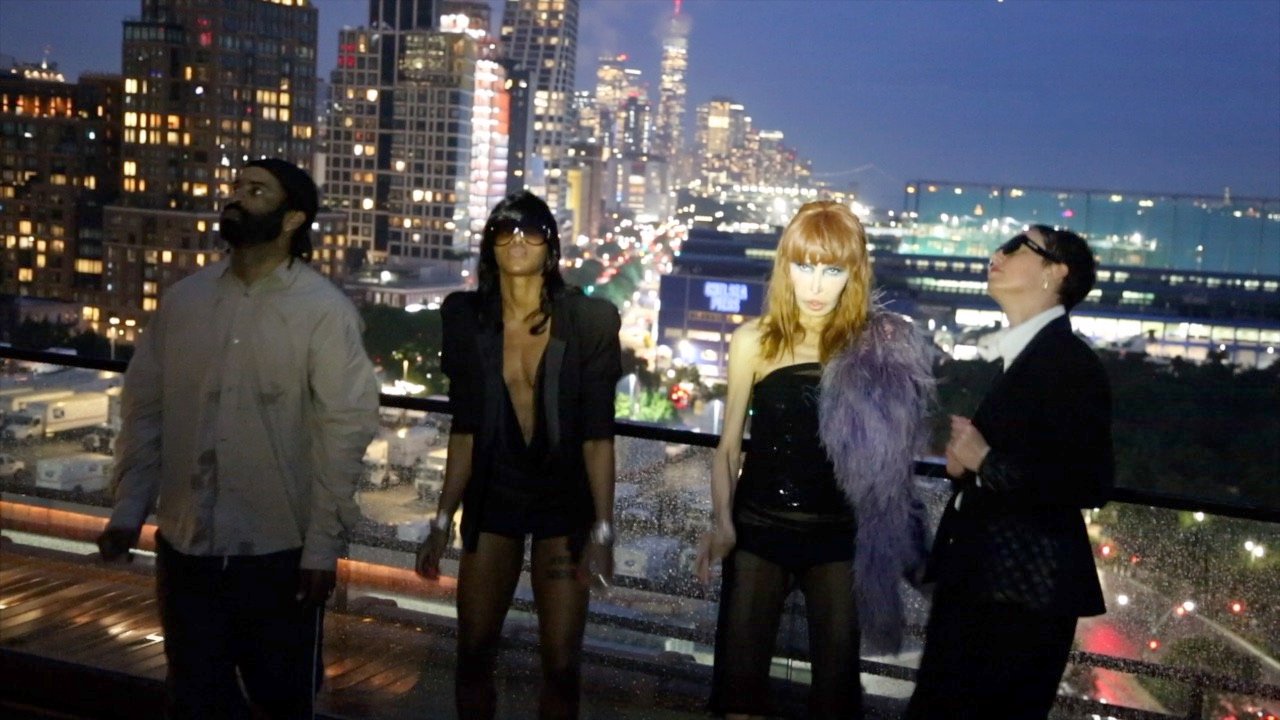
It’s about me being unable to decide whether to go to a certain celebrity party in Chelsea, NYC, imagining walking there and what it’s going to be like (people dancing awkwardly - the party never really seems to take off), and being caught in an elevator with intensely chatting socialites and celebrities who are giving me funny looks because I’m not one of them. Then it goes into a more general section about not having the motivation or cash to participate in the body perfection culture this party seems to represent (this part is not serious). In the end, I never make it there.
(socialites/celebrities on 18th floor)
DOES FAME CHANGE PEOPLE?
PROBABLY!
Why should people see you perform?
I heard it’s supposed to be very “intense” and “maximum energy”.
Define the term “Munchausen” and also tell me where and when the best place to listen to Nina Hagen is.
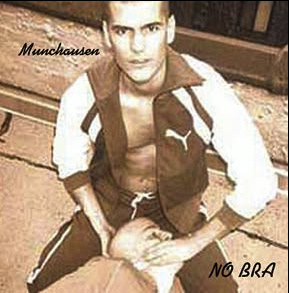
(No Bra "Munchausen" record cover, photo by Slava Mogutin)
“Munchausen” is a compulsion to show off and lie about things like celebrity affiliations and countercultural achievements, such as playing in obscure bands or catching rare/non-existent stds, and not caring if you’re getting the facts wrong. At some point it doesn’t really matter if any of it is true.
The bit about Nina Hagen is actually only partial “Munchausen” - she turned up at my house once when I lived in Camden - one of my flatmates was friends with her and had been babysitting her kid when they all lived in a squat together some years previously.
Who is the enemy?
Greed.
Neoliberalism.
What is in a name? Where does “No Bra” come from?
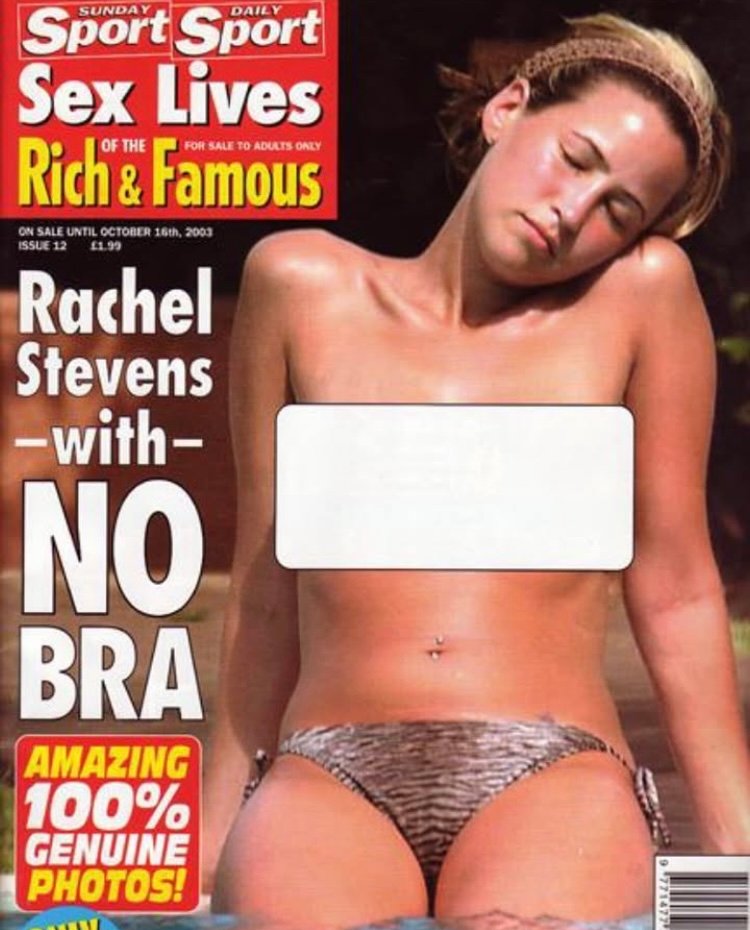
The name came from a cover of the now online-only “Daily Sport” softporn mag, saying “Rachel Stevens with No Bra”. [insert image?] We liked the simplicity of the name and the bad grammar - I didn’t really know about the various connotations of the term “no bra” in anglo culture at the time.
(Daily Sport Cover)
Is Page three, as a mindset, quintessentially british?
I see what you’re getting at - apparently it was only introduced in 1970 by Rupert Murdoch though who is Australian tho?
What would your uniform be for eternity?
(No Bra being undecided)
Mini skirt, trainers, heels in bag, bomber jacket - adapted for climate change.
Does a stage occlude reality or create reality?
It creates reality.
What does Hollywood mean to you?
It’s a place in Los Angeles. It’s also a specific way of telling stories in film that is reflective of a certain 20th century American/western ideology, centred around maintaining traditional power structures, Freud-inspired psychology and binary thinking.
Where is…the original…in music
Originality starts as soon as you’re writing about what’s important to you specifically instead of copying things. Are you asking me what music nowadays is original? I feel like most music i hear is original! (Kembra Pfahler djing at Gay Vinyl/photo by Susanne Oberbeck)
In 2011, you started the weekly Gay Vinyl Club, how do your memories of that time shape up?
(Tigga Calore and DeSe Escobar at Gay Vinyl/photo by S.O; No Bra and Honor Titus at Gay Vinyl/photo by Shayne Oliver; No Bra, Arca and Shayne Oliver at Gay Vinyl/photo by Brian Marrero)
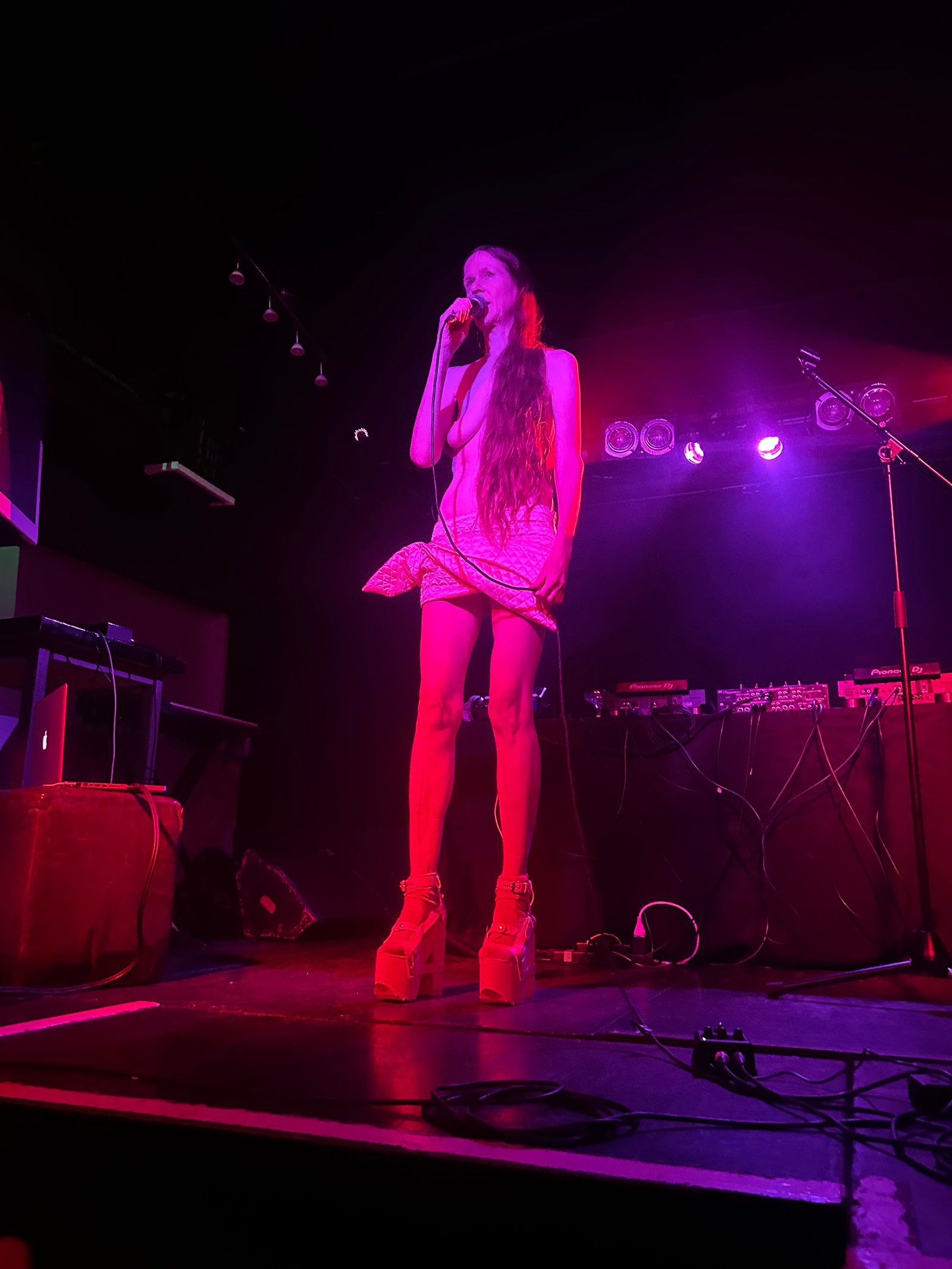
It was amazing because of the range of really talented DJs and performers we were lucky to have - the idea was to encourage experimentation and let everybody do what they wanted with no rules, besides it was a free party on Tuesdays, so there was no pressure..There was this really amazing energy - it felt like everyone was coming together for some kind of shared mission of sonic/cultural anarchy. Arca recently told me she thinks that Gay Vinyl “shifted the culture” via the quote “creative and emotional fusion that happened during the party”, and it’s where she learned to DJ.
The party also attracted a really mixed crowd, who were generally open to anything musically. I remember one time there were only these two kids left in the club, body-popping across the benches and floor to Coil’s “Where Are You?” for ages, then one looked up, going “i wrap my last kiss in a bandage” - what??”
How is it to work with Bruce LabRUCE?
It’s great! Bruce is a lovely, generous and hilarious person who has maintained his punk ethos to and has an encyclopedic knowledge of movies!
What better way to start the school year than with a review of a live show in Hackney Wick? Teo discusses Beatlemania and how to self-model as an indie band.
Sydney Sweeney asked Teo, What is with WPDMT's Jesus Gimmick? Teo responds:
Once upon a time, allusions to Jesus felt like the price of admission to rock. Despite a wave of late-80s avant-garde bands having put an end to such trends, by opening their album with a gospel choir, Worldpeace seem eager to revive such an outdated fad. The interest in Jesus doesn’t ring as genuine as his in Lennon. It's retro-proactive pop.
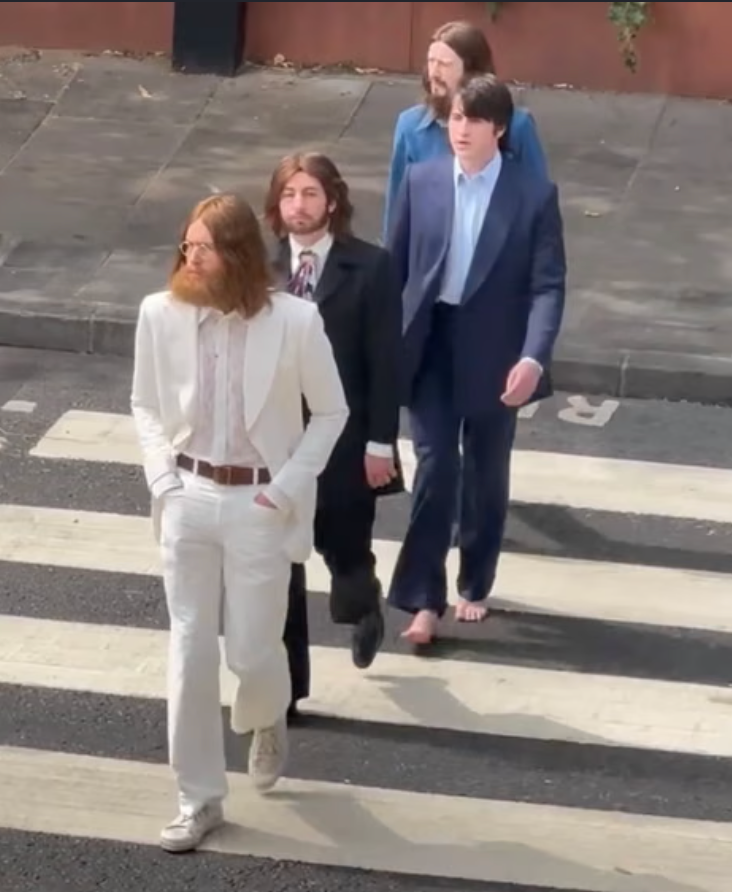
Beatlemania thrived off the currency of the young. Not so recently, hating the Beatles was fun. "I hate the Beatles" or "The Beatles are overrated" was something you said when you wanted to be different.
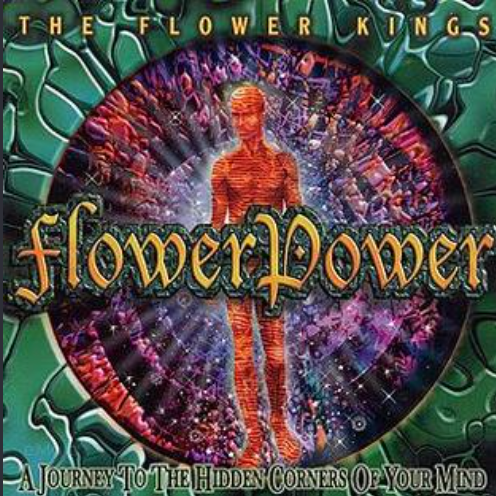
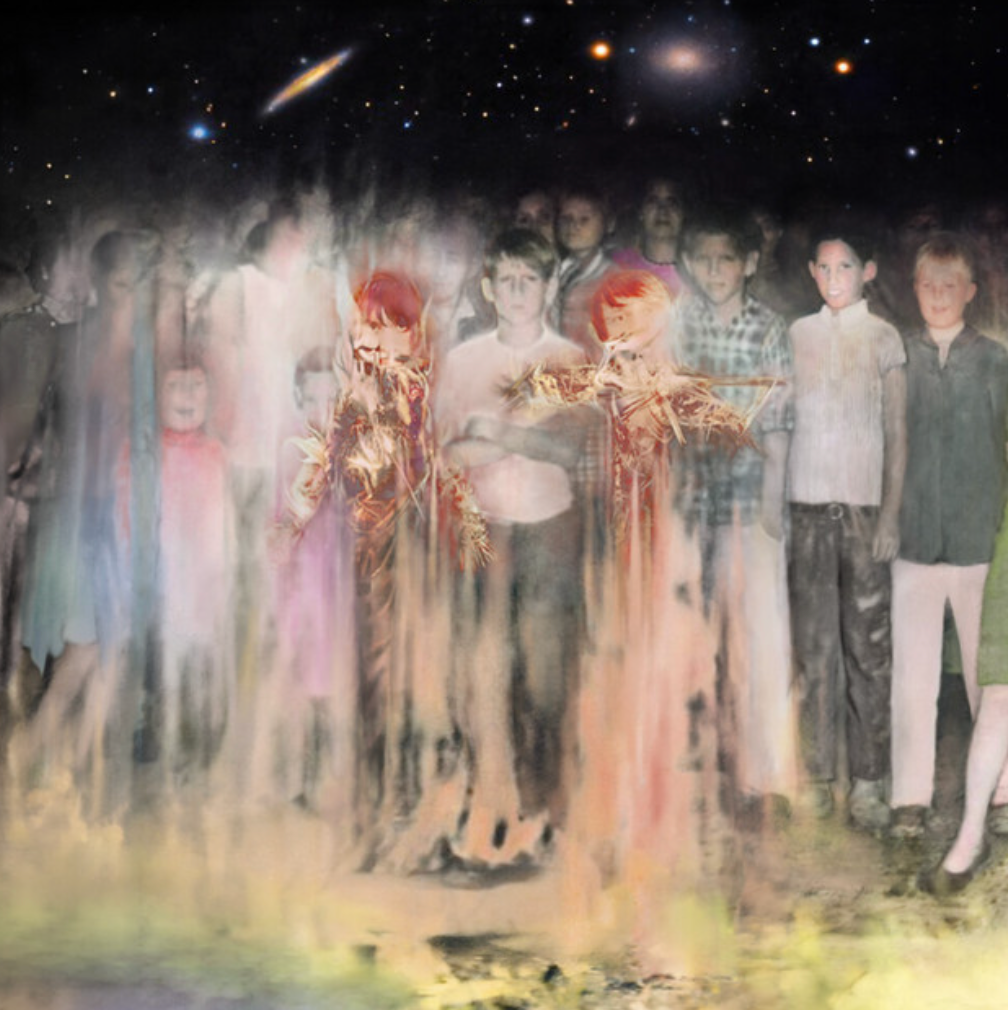
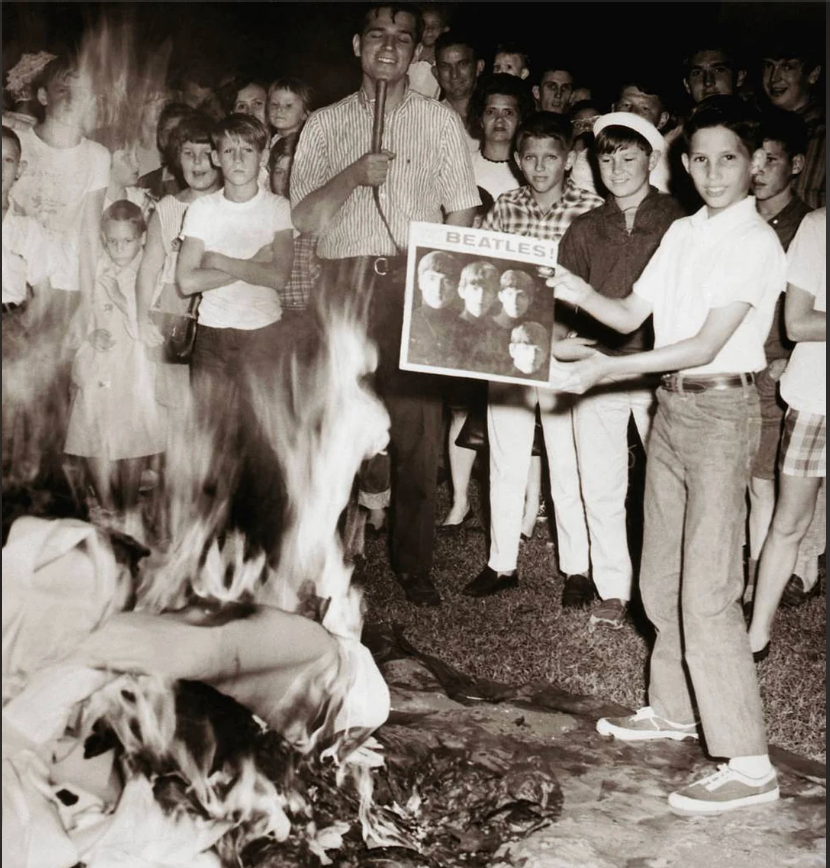
While he reviews WPDMT's new release, FLOWERS POWERS, Teo also discusses the evidence of a PR lead "Beatlemania" revival. WPDMT's album cover takes the original image of kids in America burning the Beatles' albums because, you guessed it, they'd said: "We're bigger than Jesus". In the centre of the flames are two effigies of Rowan and Leo. It reminds Hollywood of a satanic ritual, AKA Jennifer's body, where someone is sacrificed, and the indie band pays the ultimate price, in exchange for... WPDMTmania?
If we are talking about spam instagrams, one side of our heart is devoted to @inthebackofthetruck, the other looks to @thepsychedlicdump.
REVIEW OF FREE SHOW AT HACKNEY WICK, FRIDAY 28th of AUGUST, featuring Bassnotesonhope and J'wow.
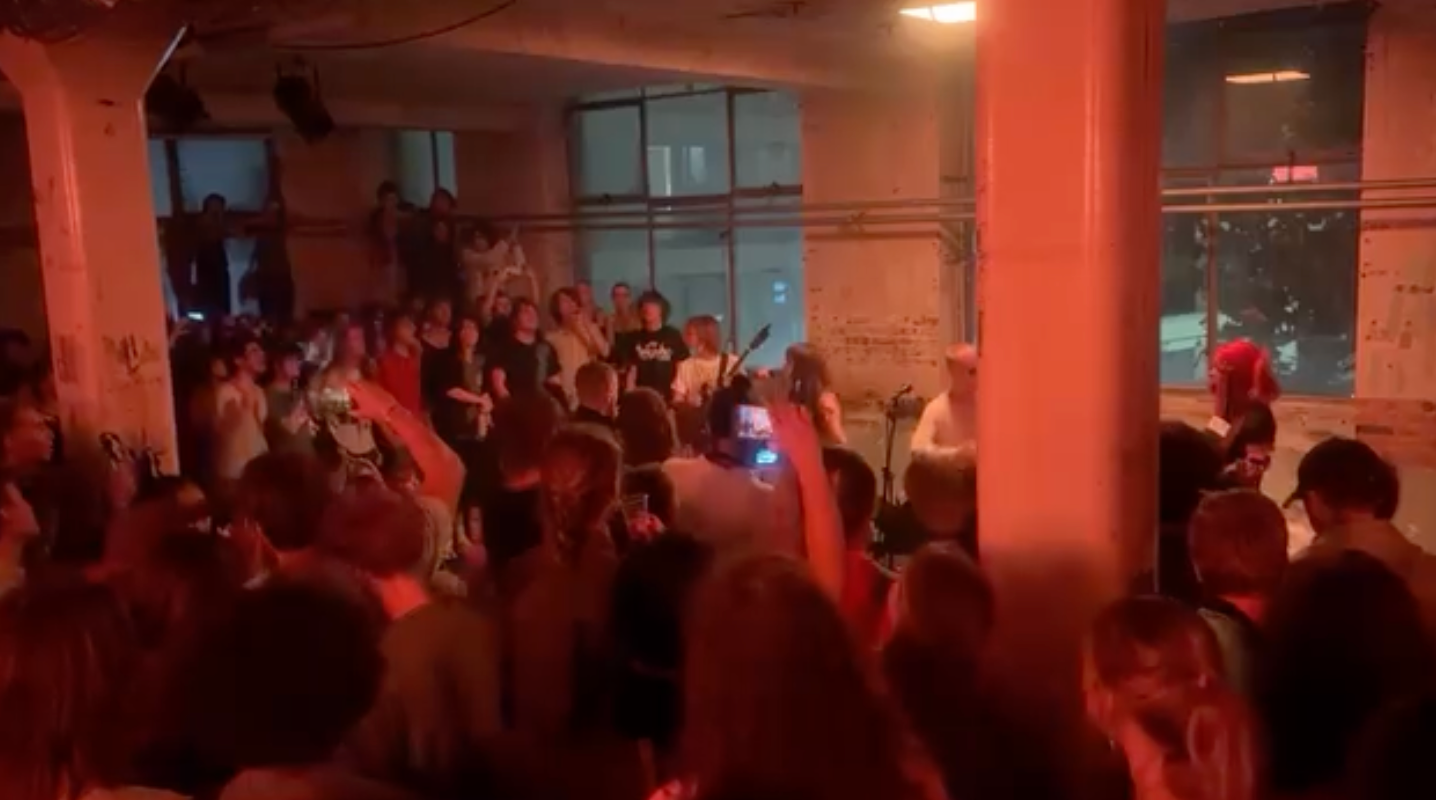
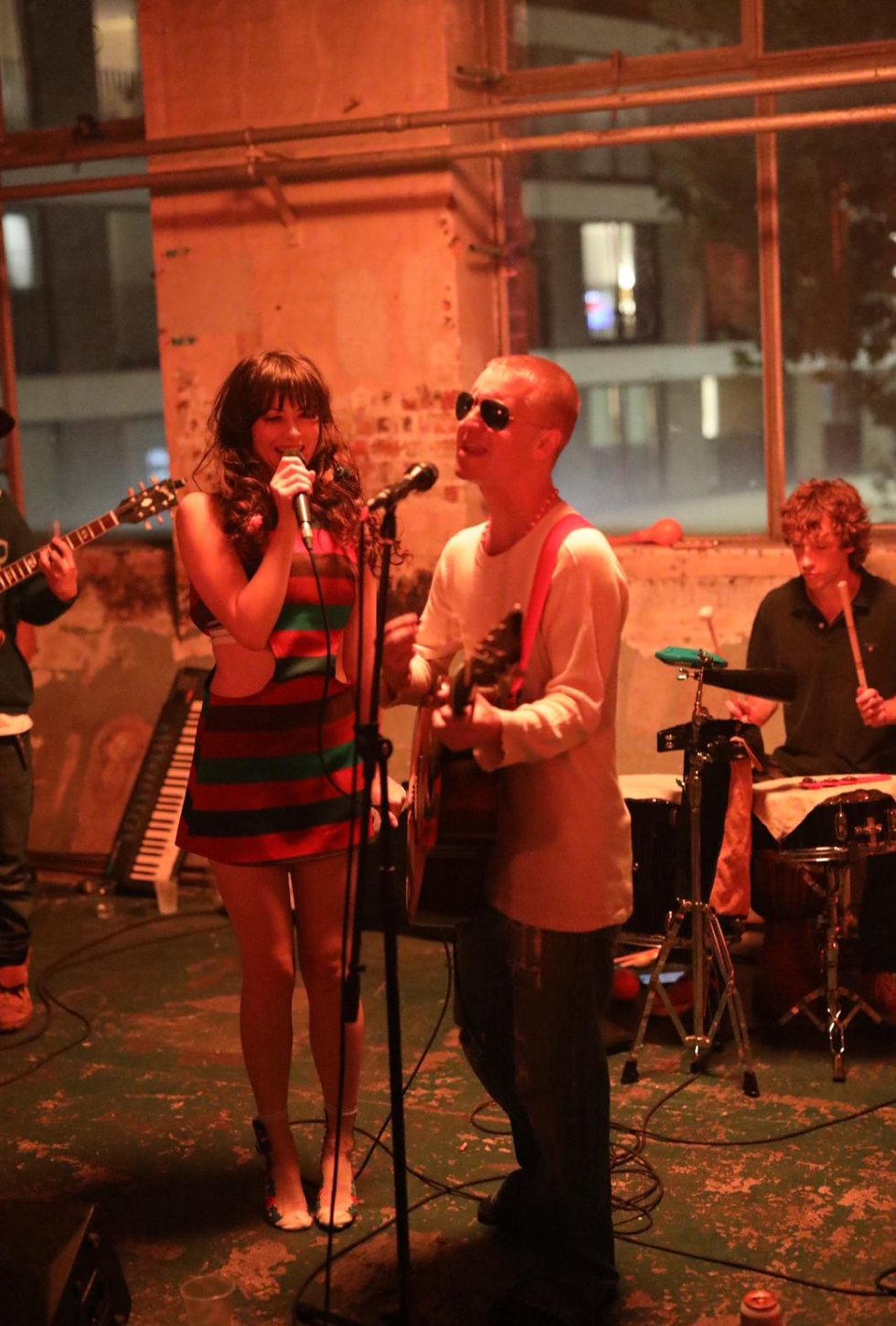
When Worldpeace DMT announced they were doing a free show, I let myself be excitedly lured up and into yet another ex-industrial hall, alongside a queue of Londonese youth alike. So when Sydney Sweeney asked me to review the night, I was caught off guard. I had fun, and I was happy to contribute to the young and local invasion of such a gauche venue; but there’s certainly something to be said about where the show lands on Worldpeace’s cunningly marketed new-Bealtes masterplan.
As she introduced their set, Rowan Please joked about how the crowd was anomalously cool given the location of the free show. Turns out it’s easier than you’d think to pack a bunch of young people into a hot room in the pulseless heart of Hackney Wick.
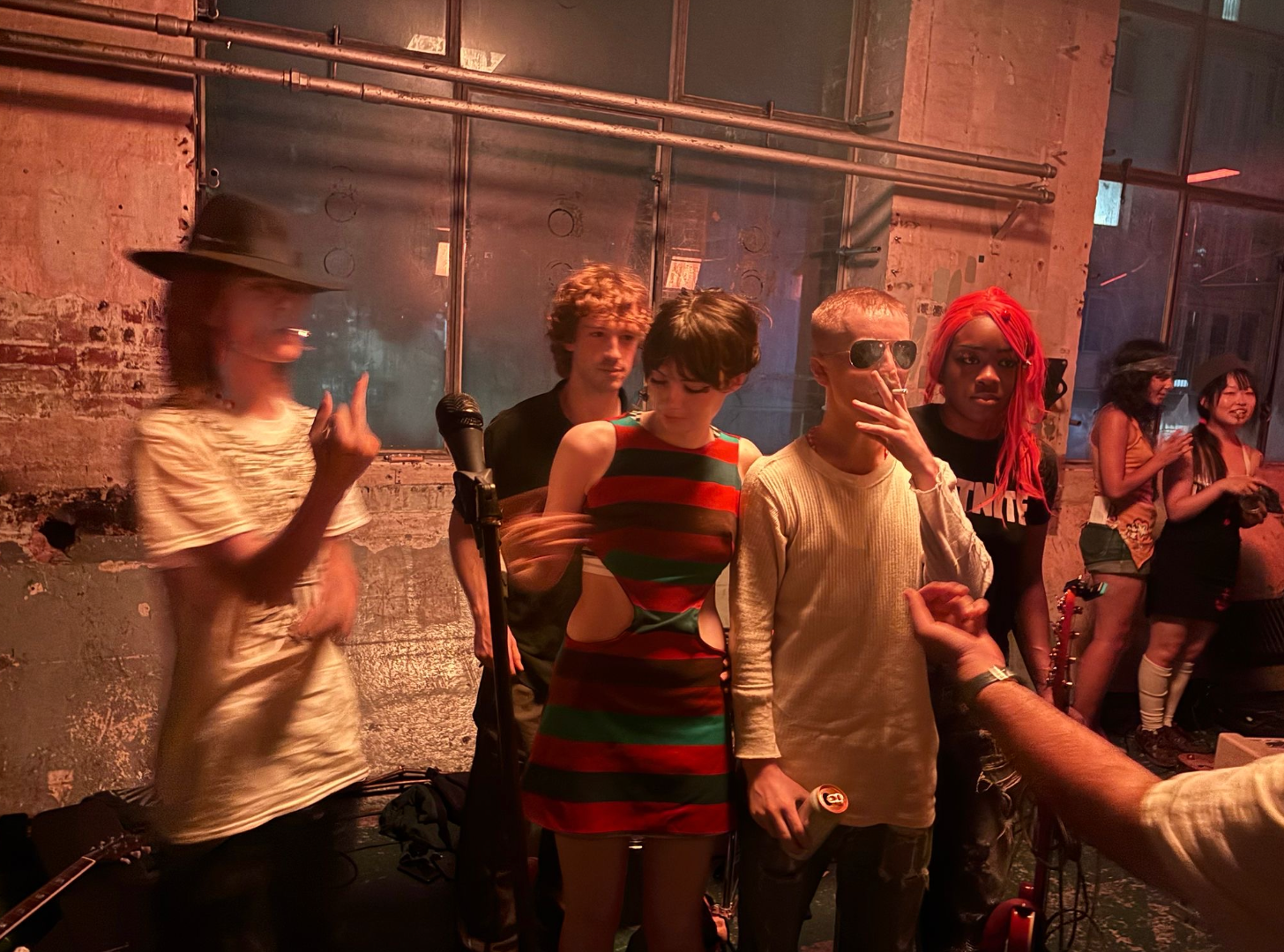
Debuting their latest live formation, the duet is joined on stage by a guitarist wearing a top hat and a bassist wearing a Fortnite tee. Rayban shades: on, Leo utters the first words of the show “school is out, and I never did it like it anyway” with the sobriety of a judicial testament and continues to set out his childhood plan of proving his parents wrong by starting a band and being “the biggest in the world”- while so far being unresolved, tonight feels like he’s making a case for it. At a time when “Worldpeace DMT” starts to awkwardly make their way into industry-curated festival lineups, putting on a show in Hackney Wick feels like they’re claiming local success and enjoying a glimpse of the Beatlemania-type cultural effect that they’re so hungry for.
The quintet’s nervously jagged acoustic arrangements of “Bigger Than Jesus”, “Big Yellow Taxi” and songs from the forthcoming album “Stick around for Tea”, gently suggest that their music has just as much emotional weight without electronic sounds. Half-heartedly imitating worship, we close our eyes, lift our heads and delicately sway through the semi-biblical verses of “Jesus Jesus”; in contrast to the fuller texture on the album, the guitar romps give the song a closer affinity with The Velvet Underground's own “Jesus”.
While the crowd dissociates into chatter for some unreleased ballads, the band’s self-fulfilling prophecy feels particularly imminent during their few Beatles at Shea Stadium moments, as the crowd bursts into frenzies of bar-for-bar singalongs to “Love Yourself” and “Marina”; when Rowan sings live, her chirps and screams are slightly out of tune, and all the more spellbinding. And now, a gem for the superfans: I was stunned by the tender-hearted, alternate version of the otherwise cute-but-whacky deep-cut “Hey Marshmallow”, sealing the late-August London night with a lovely ambience of world peace.
On their inter-album mixtape, Worldpeace DMT powers through a myriad of sounds, with that alternately punning and self-reflective sensibility that made the London duet such an enticing new entity over the last year. Their growing popularity doesn’t seem to have compromised their ethos of fun, or their willingness to be a bit delirious and weird; Flowers Powers is slightly perverse, retro-proactive pop.
It doesn’t take long to hear that the band has sized up on arrangements (budget). At its exposition, the opening hymn “Jesus Jesus” finds Leo in sorrow and seeking repentance, but progresses to sound like primary-school Mass, ornamented by a choir, stabs of strings and what sounds like a tiny rainbow xylophone. The Joni Mitchell cover, “Big Yellow Taxi” picks up on this playful note; the guitar licks sound like they’re being resurrected from Rubber Soul and Rowan’s tongue-in-cheek inflexions: “you don’t know what you’ve got till it’s gone” make for the poppiest WPDMT in memory. Following “Surfin’s” capricious kazoo, the quasi-emo, dead-end crescendos uplifting GUCCISAMO’s quivering bars on "Pimp My Ride” briefly glimpse at poignancy.
The slight but generous tracklist seems pretty confused about how the band want to sound; thus making their sound pretty clear, aiming beyond definition, like every beatle phase strung into one tracklist. They’re like how John Peel described The Fall: “always different, always the same” Compared to The VU & Rowan, the somewhat slippery “laptop twee” tag suggested by friends& seems less useful for understanding this release. While a song like “Tabletop” evokes an inclination towards twee, it feels like mere coincidence that they play on this aesthetic. There’s less vocal stutters, bleeps and bloops. If anything, the clanker-cacophony on stinkers such as “Artrock” and the alternate version of “Surfin’” contributes to the canon of post-beatles satire and psychedelia rather than the legacy of hyperpop and The Pastels. It’s retro-proactive music!!
Now a sanctioned member of the band, Rowan Please’s lyrical charm and wit marks the mixtape’s catchiest and most affecting poetry. Such as on the nursery rhyme “Dinosaur Punk”, which reminds me of Television Personalities’ “I know where Syd Barrett lives”, sharing a voice that weaves pop mythology with kidlike fantasy as Rowan sweetly mutters: “Dracula lives above a record store, where they play John Peel to Dinosaurs”. And I can’t help hearing an undertone of wartime-pop underneath the glimmering texture of “When Summer Comes”, in which Rowan lulls herself, yearning for the summer to bring her baby home, who turns out to be Leo: deadpan and expressionless. Distinct from her femcel swag, Rowan’s 60s darling demeanour brings a winsome glamour to Leo’s compositional freak; the sound is an unlikely combination of the pretty and the shambolic, the quaint and the manic.
It’s difficult not to acknowledge that the word “Jesus” appears three times on the tracklist. You wonder whether WPDMT are inviting listeners to reckon with their hipster micro-aggressions- but it feels like Christ is just another character among the likes of Frankenstein, Dracula and John Lennon within the absurd pop-rock folklore of Flowers Powers. Once upon a time, feigned allusions to Jesus felt like the price of admission to rock. By opening their album with a gospel choir, WPDMT seem eager to revive such an outdated fad; but their interest in Jesus doesn’t seem as genuine as that in John Lennon.
Drawing from the same source material as the album’s cover, the innocently provocative summer-hit, “Bigger than Jesus” opens with the 1966 report of when a radio station in Texas was hit by a lightning strike after inviting kids to burn beatles records following John Lennon’s infamous claim that The Beatles were more popular than Jesus- I read this intro and the album’s cover as an instance of plain beatles-fetishism rather than a comment on music, or Jesus- before the verse slaps you with the heart-warmingly cringe, middle-school defiance of, “We don't have a single care, Don't have our seatbelts on” and the maturity of the song peaks at: “I have my own two hands until they crumble off”. The Lord is once again hailed in the acoustic, off-key and off-beat finale, in which Leo (maybe druggedly) asks for forgiveness; ‘Lonesome” feels like an apologia for the alchemical heresy of the tape, which makes you want to play the whole thing over again, and again.
Considering a recent insta story that expressed WPDMT’s intrigue in breaking into the mainstream, the dump of rosy-cheeked hooks and springy 3-chord charms on Flowers Powers feels like a warm tease and wink at the non-commercial route to world domination that the duet are plotting before Stick Around For Tea drops in October.